Latest posts
-
Math Exam Revision Timetable Strategy: A 14-Day Plan

A revision calendar can look perfect and still fail on exam day. I learned this when I spent equal time on every math topic, even though a few types of problems caused most of my errors. My math exam revision timetable strategy now starts with those errors. It gives weak topics more practice, brings older…
-
Understanding Limits and Continuity Clearly: A Simple Test

A graph can approach a point without ever touching it. That detail confused me when I first studied calculus: I kept treating a function’s value and its limit as the same answer. For understanding limits and continuity clearly, I now ask two separate questions. Where is the function heading, and what happens at the point…
-
Binomial Theorem Expansion Solved Examples Made Easy

If you can expand (x + 2)² but get stuck at (x + 2)⁴, repeated multiplication is probably slowing you down. I use the binomial theorem to build each term in order, then run a short check for mistakes. These binomial theorem expansion solved examples show both steps, with equations you can copy into Google…
-
Easy Ways to Memorize Math Formulas That Actually Stick
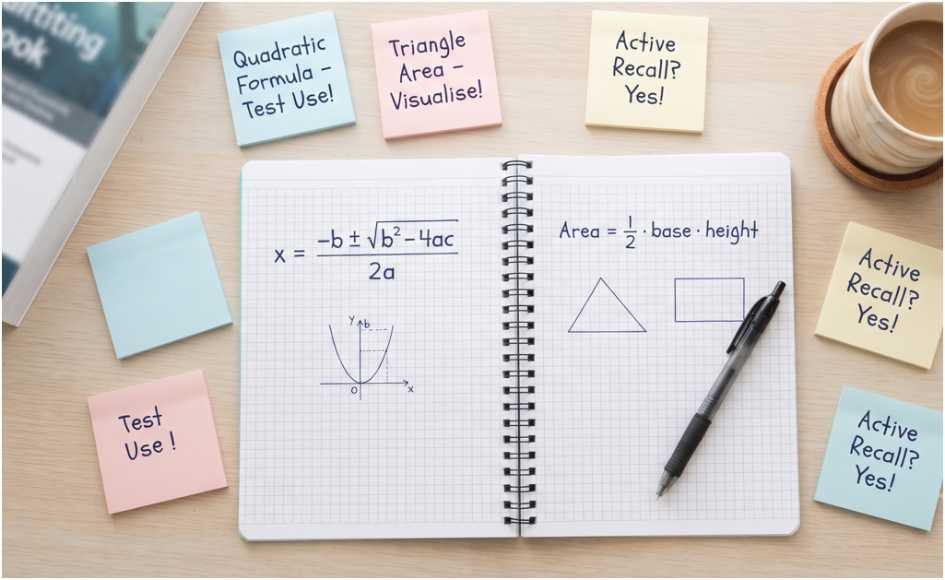
I used to recognize formulas instantly on a study sheet, then forget them when a test asked me to solve a problem. If that sounds familiar, you need easy ways to memorize math formulas that work after the sheet is gone. I now study each formula in four stages: recognize what it describes, recall it…
-
How To Find The Inverse Of A Matrix: A Practical Linear Algebra Guide

Computing the inverse of a matrix can feel like navigating a maze of rigid algebraic rules without a map. Over years of working through advanced linear algebra models and data transformations, I realized that understanding the core mechanics—rather than just memorizing formulas—makes all the difference. When you multiply a square matrix by its inverse, the…
-
Sequence and Series Formulas Revision Guide for Exams

A page of formulas is useful only if you can tell which one fits the question. I start revision by checking how the terms change: do they have a constant difference, a constant ratio, or both? This sequence and series formulas revision guide puts that decision before the calculations. All equations below use plain text,…
-
Solved Examples of Differential Equations: Three Methods That Actually Make Sense
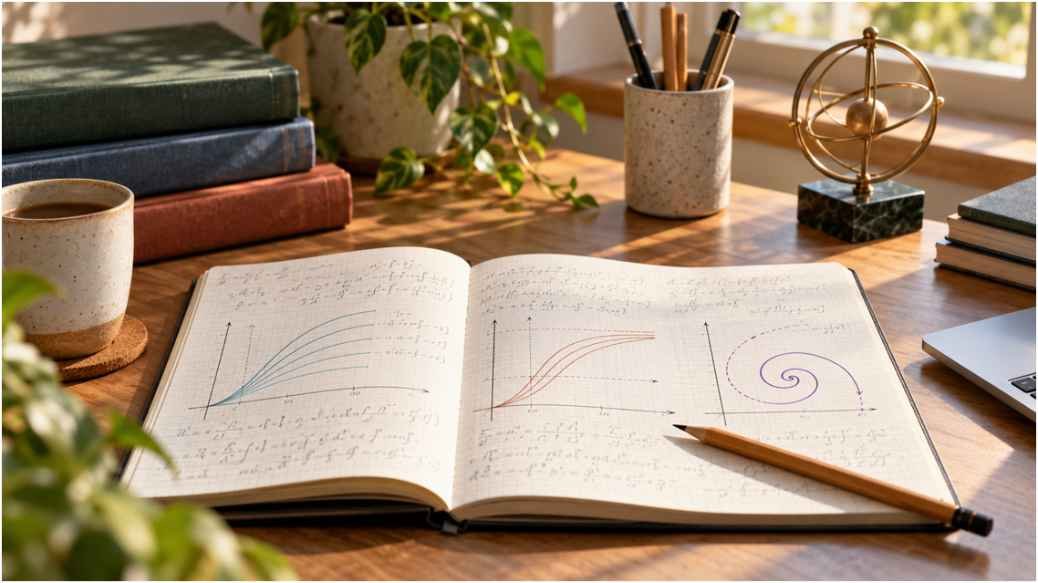
A differential equation gives you a derivative and asks you to find the function behind it. When I first worked through these problems, integration was rarely the hardest part. Choosing the right method was. These solved examples of differential equations show three common first-order methods: separation of variables, an integrating factor, and substitution with y…
-
Probability and Statistics Formulas Explained Simply

A formula is only helpful when you know which question it answers. Are you finding the chance of an event, describing data you collected, or estimating something about a larger group? That choice matters more than memorizing symbols. I find probability and statistics formulas explained most clearly when I use one example across all three…
-
How to Master Functions and Graphs in Math: A Clear Plan

A graph can look like a puzzle when you only know how to plot points. The change that helped me was asking three questions: What inputs work? Where does the graph go? Why does it bend or turn? That is the practical answer to how to master functions and graphs in math. Learn to move…
-
Geometry Theorems Proof Step By Step: Master Math Logic

Staring at a blank geometry page while trying to figure out how to write a valid proof triggers instant frustration for many students. Learning geometry theorems proof step by step transforms an intimidating puzzle into a predictable, logical sequence. Logic, axioms, and established rules replace guesswork. Tackling foundational proofs builds the exact analytical muscle needed…