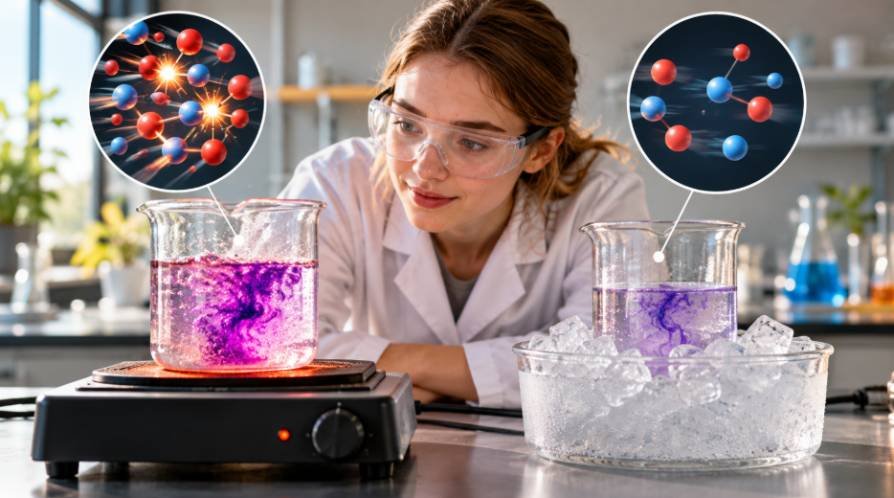
I first noticed how strongly temperature affects chemistry when comparing reactions that seemed identical except for heat. A mixture could sit quietly when cool, then react much faster after warming. That made me curious because the particles had not changed into different substances. Something about their motion and energy had changed.
I also found that “hotter means faster” leaves out the most interesting part. Temperature does increase particle motion, but the bigger effect is on how many particles can cross the energy barrier needed for a reaction. Once that distinction becomes clear, reaction rates, activation energy, and collision theory fit together naturally.
What Reaction Rate Actually Means
Reaction rate describes how quickly reactants are consumed or products form. Temperature is a major factor because it changes particle behavior and, consequently, the rate constant for many reactions.
When temperature rises, particles have greater average kinetic energy. They move faster, encounter one another more often, and have a different distribution of energies across the sample.
Collision Theory Explains the Basic Change

Collision theory provides a useful starting point. Reacting particles must collide for many reactions to occur, but simply hitting another particle is not enough. A productive collision requires suitable orientation and enough energy to reach the transition state.
Heating increases particle speed, which can modestly increase collision frequency. More importantly, it changes the energy distribution. A larger fraction of particles now has enough energy to overcome the activation-energy barrier.
That second effect is why temperature can have a much stronger influence than a small increase in average particle speed suggests.
Activation Energy Is the Key
Activation energy is the minimum energy required for a reaction pathway to proceed. Particles below the required energy cannot cross it, even if they collide.
At higher temperature, more particles occupy the high-energy portion of the distribution. More collisions can reach the transition state and continue toward products.
This also explains why reactions with different activation energies do not respond equally to the same temperature change. A reaction with a larger barrier can be especially sensitive to heating because more particles enter the energetic range needed to react.
What the Energy Distribution Reveals
When temperature increases, the distribution spreads toward higher energies. The important region is the area beyond the activation-energy threshold.
That is why saying “particles move faster” is true but incomplete. The crucial change is the fraction of particles energetic enough to make successful collisions.
How the Arrhenius Equation Connects Temperature and Rate

The Arrhenius equation gives a mathematical way to describe this relationship:
k = Ae^(-Ea/RT)
Here, k is the rate constant, A represents the frequency and orientation factor, Ea is the activation energy, R is the gas constant, and T is absolute temperature in kelvin.
The exponential term is especially important. As T increases, the exponential factor increases, so k generally increases.
This explains why temperature changes can produce surprisingly large rate changes.
Why Different Reactions Respond Differently
Not every reaction speeds up by the same amount when heated. Activation energy is one major reason. Reactions with larger activation energies are generally more temperature-sensitive over a given range.
Reaction mechanisms matter too. A complex reaction may involve several elementary steps, each with its own energy barrier.
This distinction is useful when studying kinetics alongside equilibrium. Temperature can affect how quickly equilibrium is reached and can also change the equilibrium position, but those are different concepts. Students working through Le Chatelier principle chemistry problems explained should keep equilibrium shifts separate from the kinetic question of how quickly a process occurs.
Does a 10°C Increase Always Double the Rate?
A common classroom shortcut says a reaction rate doubles for every 10°C increase. It can be a useful approximation, but it is not universal.
The actual change depends on the reaction, its activation energy, the temperature range, and other kinetic details in a given temperature range. The Arrhenius relationship provides a more reliable framework because it accounts for the specific temperature dependence of the rate constant.
For that reason, increasing a reaction from 20°C to 30°C does not automatically make it exactly twice as fast.
Everyday Examples of Temperature and Reaction Rate
The same chemistry appears in familiar situations. Food generally spoils faster when stored warmer because many chemical and biological processes proceed more rapidly.
Cooking provides the opposite experience. Heating accelerates reactions responsible for changes in texture, color, aroma, and flavor.
Temperature also matters when concentrations are prepared for experiments. A student using molarity and dilution calculations with examples may calculate the intended concentration correctly, but the measured reaction rate can still differ if mixtures are tested at different temperatures.
Frequently Asked Questions
1. Does higher temperature always make a reaction faster?
For many reactions, increasing temperature increases the rate constant and speeds the reaction. However, temperature effects depend on the reaction pathway, so the relationship is not identical for every chemical system.
2. Why is activation energy important?
Activation energy represents the energy barrier reacting particles must overcome before products can form. Raising temperature increases the fraction of particles with enough energy to cross that barrier, making productive collisions more likely.
3. Is collision frequency the main reason reactions speed up?
It contributes because faster particles can collide more frequently. However, the more significant effect is usually the larger fraction of collisions carrying enough energy to overcome activation energy and produce a reaction.
4. Why is temperature measured in kelvin in the Arrhenius equation?
Kelvin is an absolute temperature scale, so it can be used directly in the Arrhenius relationship. Celsius values cannot simply be substituted because the equation describes temperature on an absolute scale.
Why Understanding the Energy Barrier Changes the Picture
Temperature affects reaction rate because chemistry depends on what particles can do during collisions, not simply on how warm a container feels. Heating increases molecular motion, but its stronger kinetic effect is increasing the fraction of particles able to overcome the activation-energy barrier. It also explains why reactions with different mechanisms and activation energies respond differently to the same temperature change.
Once the energy barrier is part of the picture, “hotter means faster” stops being a memorized rule and becomes useful chemical reasoning.
Leave a Reply