Category: Chemistry
-

Why Does Reaction Rate Change With Temperature in Chemical Reactions?
I first noticed how strongly temperature affects chemistry when comparing reactions that seemed identical except for heat. A mixture could sit quietly when cool, then react much faster after warming. That made me curious because the particles had not changed into different substances. Something about their motion and energy had changed. I also found that…
-

Green Chemistry Concepts and Their Role in Sustainable Chemistry
I started noticing green chemistry when familiar ideas such as waste, solvents, and energy began to look less like separate laboratory concerns and more like design choices. A reaction can produce the desired compound and still create waste, require hazardous materials, or consume more energy than needed. That changed how I thought about what makes…
-

How to Solve Multi-Step Chemistry Problems Using a Clear Strategy
I used to think multi-step chemistry questions were difficult because they contained too much math. After working through more of them, I noticed the real problem was usually losing track of what one step was supposed to accomplish before starting the next. I also found that the hardest-looking questions became calmer once I stopped treating…
-
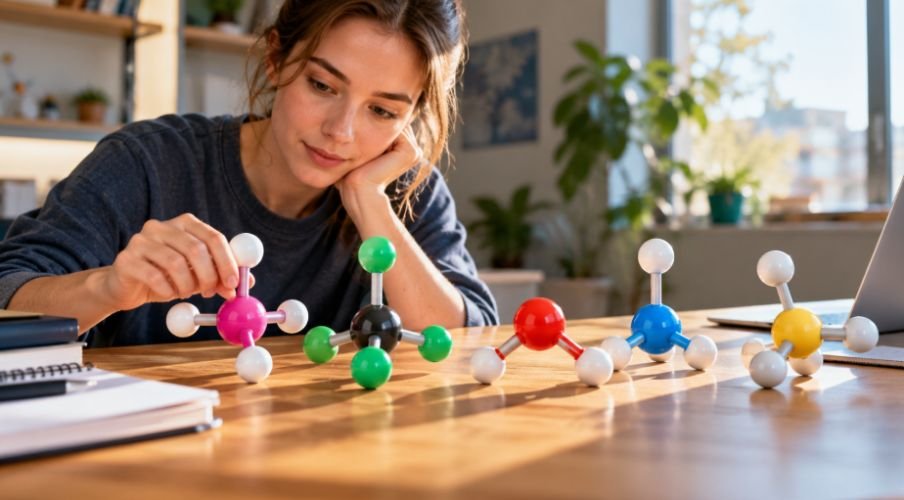
Why Do Molecules Have Different Shapes in Chemistry? What VSEPR Theory Reveals
I used to picture molecules as tidy formulas on a page, with atoms connected by lines and little else to think about. Once I started looking at molecular geometry, those formulas felt incomplete. The same atoms can arrange themselves in noticeably different ways, and those shapes are not random. They come from how electrons occupy…
-

Chemistry Stoichiometry Problems With Worked Solutions for Better Practice
I used to think stoichiometry was mostly about remembering formulas. After working through a few chemistry problems, I noticed the harder part was usually figuring out which quantity mattered first and how the units connected. I also found that a problem could look intimidating until I wrote the balanced equation and treated the calculation as…
-

How to Calculate Enthalpy Changes in Chemistry Using Key Formulas
I first found enthalpy confusing because several formulas seemed to describe the same thing. Once I connected each equation to the kind of information given in a problem, the calculations became much easier. I started asking one question: what data do I have? I also noticed that most mistakes came from signs, coefficients, units, or…
-

Sustainable Chemistry Principles Explained: Core Concepts, Benefits, and Applications
I started noticing how often chemistry is described as successful simply because a reaction produces the desired compound. That definition feels incomplete once you consider solvent, unused reactants, energy, and waste. A reaction can work in a flask and still create avoidable problems elsewhere. I realized that sustainable chemistry asks a more useful question: can…
-

How Does a Catalyst Affect Reaction Mechanisms and Reaction Rates?
I used to think of a catalyst as something that simply made a reaction happen faster. That explanation works at first, but when I looked more closely at reaction mechanisms, I realized the better question is what the catalyst actually changes along the way. The answer sits in the sequence of molecular steps between reactants…
-

Understanding Molarity and Dilution Calculations With Examples
I first understood molarity as more than a formula when I had to work backward from a measured mass to the concentration of a solution. The arithmetic was simple, but units mattered. A missed conversion to liters could completely change the answer. I also found dilution problems easier once I stopped treating M₁V₁ = M₂V₂…
-

The Rise of AI-Assisted Chemistry Problem Solving in Education
I started noticing how often AI appeared in chemistry study sessions when a difficult equation no longer meant waiting for office hours or searching through several textbook pages. A student could ask for a breakdown of a calculation, request another explanation, or compare two approaches within minutes. That convenience changed the rhythm of studying, but…