
I used to think stoichiometry was mostly about remembering formulas. After working through a few chemistry problems, I noticed the harder part was usually figuring out which quantity mattered first and how the units connected.
I also found that a problem could look intimidating until I wrote the balanced equation and treated the calculation as a chain of small conversions. Once that habit clicked, grams, moles, ratios, and products stopped feeling like separate topics and started fitting together.
The biggest improvement came when I stopped treating each exercise as a new puzzle. The same relationships kept returning, even when the numbers and substances changed. That makes repeated practice more useful than memorization alone.
What Stoichiometry Is Really Asking You to Find
Stoichiometry describes the quantitative relationship between substances in a chemical reaction. The coefficients in a balanced equation tell you the relative numbers of moles involved, making the equation the foundation for nearly every calculation.
A mass may need to become moles first, while a particle question may require Avogadro’s number. The balanced equation then supplies the chemical bridge between substances.
This is also where understanding formulas and bonding becomes useful. Students exploring how to understand molecular structures in chemistry can see why chemical formulas matter before moving into the numerical side of a reaction.
A Reliable Method for Stoichiometry Problems
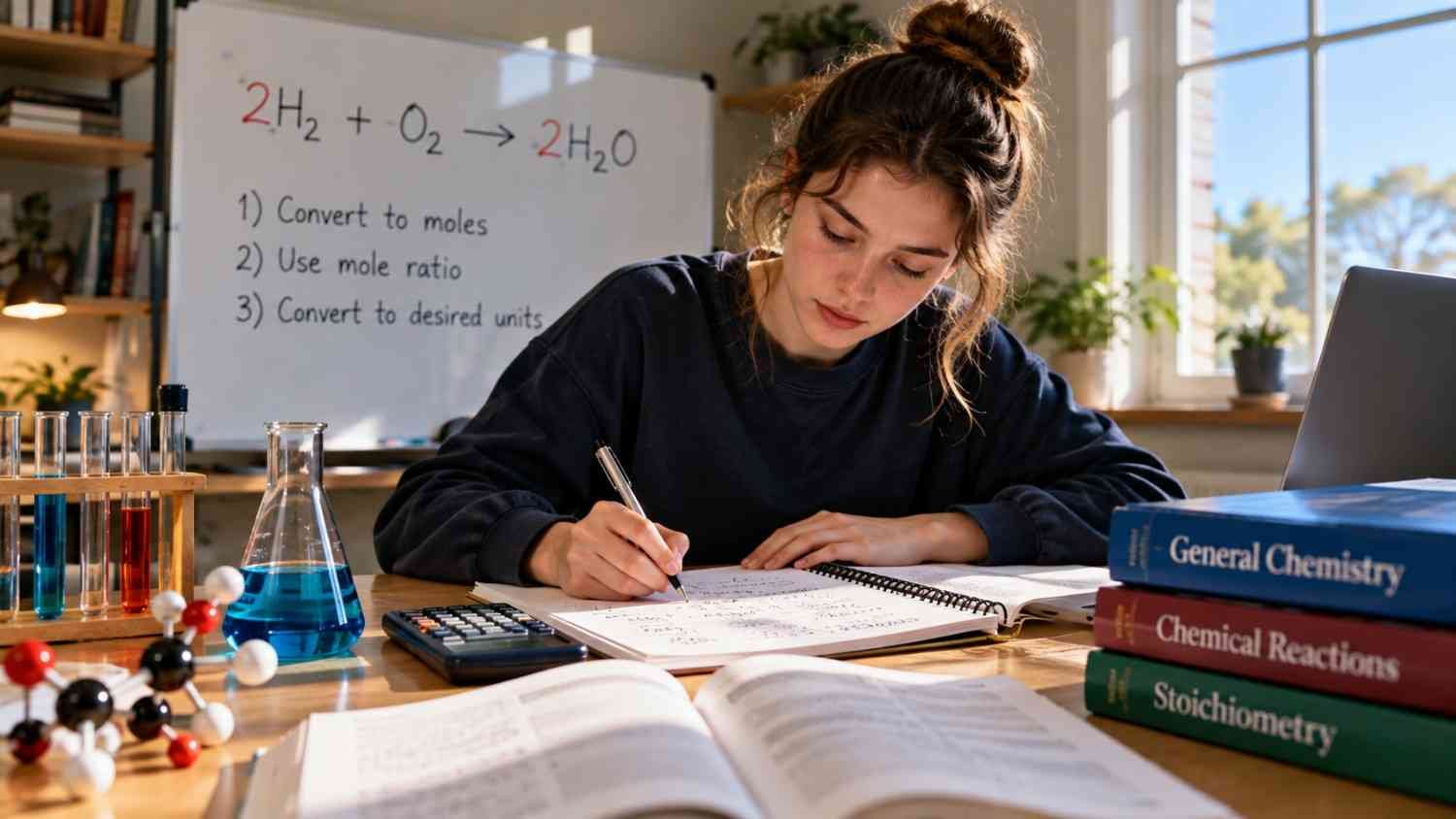
Most introductory stoichiometry problems can be handled with the same basic sequence.
- Balance the chemical equation.
- Convert the known quantity to moles.
- Apply the mole ratio from the balanced equation.
- Convert the answer into the requested unit.
The key is to keep units visible. For a mass-to-mass calculation, the path is usually grams of the given substance to moles of the given substance, then moles of the product, and finally grams of the product. This dimensional-analysis approach makes it easier to spot a reversed ratio or an incorrect conversion.
Molar mass connects grams and moles, while the coefficients connect moles of different substances. Those are two different relationships, and keeping them separate prevents many common errors.
Worked Problem: Mass to Mass
Consider this problem:
What mass of water is produced when 4.00 grams of hydrogen gas react completely with excess oxygen?
Step 1: Balance the equation
The reaction is:
2H2 + O2 → 2H2O
The coefficients show that two moles of hydrogen produce two moles of water. The mole ratio is therefore 1:1 for these two substances.
Step 2: Convert hydrogen to moles
Hydrogen has a molar mass of about 2.016 grams per mole.
4.00 g H2 × 1 mol H2 / 2.016 g H2 = 1.984 mol H2
Step 3: Apply the mole ratio
Using the balanced equation:
1.984 mol H2 × 2 mol H2O / 2 mol H2 = 1.984 mol H2O
The chemical equation has now converted the amount of one substance into the amount of another.
Step 4: Convert water to grams
Water has a molar mass of about 18.015 grams per mole.
1.984 mol H2O × 18.015 g H2O / 1 mol H2O = 35.7 g H2O
So, the reaction produces approximately 35.7 grams of water under the conditions given.
A More Challenging Case: Limiting Reactants
Not every problem gives one reactant in excess. When two reactants are supplied in specific amounts, one may run out first. That substance is the limiting reactant, and it determines the maximum amount of product that can form.
A practical way to find it is to calculate how much product each reactant could produce independently. The reactant producing less product is limiting. The other is present in excess.
This distinction matters because using whichever reactant appears first in the question can produce a chemically impossible answer. Limiting-reactant problems test whether the balanced equation is actually being used rather than merely copied.
Common Mistakes That Cost Easy Points

Several errors appear repeatedly in stoichiometry practice. The most basic is starting with an unbalanced equation, which changes every mole ratio that follows. Another is treating coefficients as if they represent grams. They represent relative amounts in moles.
Students also sometimes skip the mole conversion when moving between different substances. A direct grams-to-grams ratio may seem convenient, but the balanced equation operates through moles.
Rounding too early can create another problem. Keep extra digits during intermediate calculations and round the final answer according to the appropriate significant figures.
Where Stoichiometry Appears Beyond Homework
Stoichiometric calculations are not limited to classroom exercises. Chemists use quantitative relationships when determining how much reactant is needed, estimating product formation, analyzing solutions, and interpreting experimental results.
The same reasoning can support broader areas of chemistry. For readers exploring computational chemistry concepts for beginners, stoichiometry also provides useful groundwork because chemical models still depend on correctly representing substances, quantities, and reactions.
Percent yield adds another practical layer. Theoretical yield represents the amount a reaction could produce under ideal conditions, while actual yield is what an experiment produces. Comparing the two helps describe how closely a real reaction approaches its theoretical result.
FAQs: Chemistry Stoichiometry Problems With Worked Solutions for Better Practice
1. What should I do first in a stoichiometry problem?
Balance the chemical equation first. Then identify the given quantity, convert it to moles, apply the correct mole ratio, and convert to the requested unit.
2. Why are mole ratios important?
Mole ratios come from the coefficients of a balanced equation. They show how many moles of one substance react with or produce a given number of moles of another.
3. How do I know which reactant is limiting?
Calculate the potential product amount from each reactant. The reactant that produces the smaller amount of product is the limiting reactant.
4. Why should I keep units in every step?
Units reveal whether each conversion is moving in the correct direction. They can also expose incorrect molar masses, reversed ratios, and missing conversion steps.
Why Practice Makes Stoichiometry More Predictable
Stoichiometry becomes much less mysterious when every problem is treated as a sequence rather than a single calculation. Balance the reaction, establish the mole relationship, track the units, and let the chemistry determine the path. With repeated practice, the setup becomes familiar enough that attention can shift from worrying about the formula to understanding what the reaction is actually saying.
The goal is not to memorize a pile of tricks. It is to recognize the relationships hiding inside a chemical equation and use them consistently. Once that skill develops, even unfamiliar stoichiometry problems become easier to unpack.
Leave a Reply