
I used to think balancing a chemical equation was mostly a matter of guessing coefficients until the numbers looked right. With several compounds, I found myself changing one number and accidentally throwing another element out of balance. The problem was where to start.
I also noticed that complex equations become less intimidating when I stop treating every atom as a separate puzzle. Looking at formulas as groups and leaving free elements until later creates a controlled process. Once that habit clicked, balancing became a sequence of small decisions instead of a guessing game.
Why Complex Chemical Equations Feel Difficult
A chemical equation represents reactants changing into products, and the number of atoms of each element must remain the same. That requirement comes from the law of conservation of mass. A balanced equation therefore has matching atom counts on both sides.
The difficulty rises with several compounds, repeated elements, polyatomic ions, or formulas with parentheses. Al2(SO4)3, for example, contains two aluminum atoms, three sulfur atoms, and twelve oxygen atoms.
One rule is worth protecting from the beginning: change coefficients, never subscripts. A coefficient changes how many units are present. A subscript changes the substance itself.
Start With the Most Complicated Substance
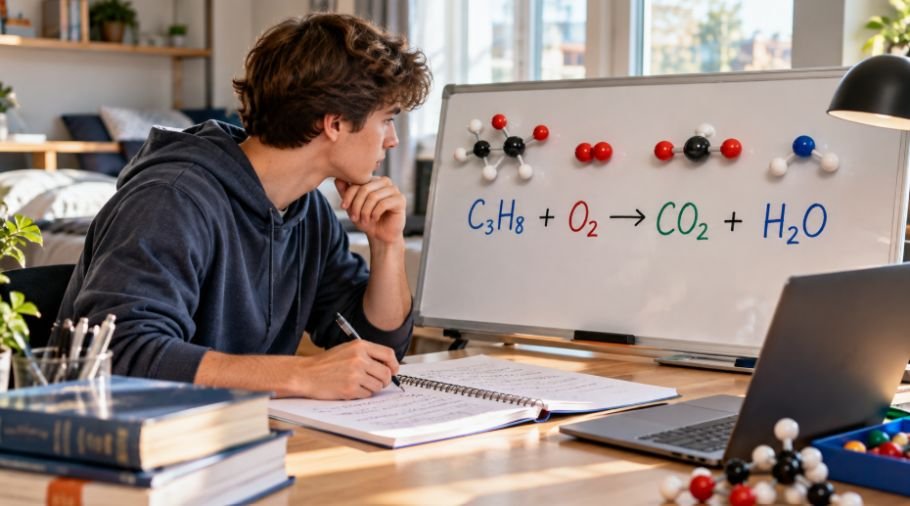
When an equation looks crowded, begin with the compound that gives you the most useful information, often the largest formula or one containing a unique element.
Suppose you are balancing a reaction containing Fe2O3, CO, and Fe. Iron and carbon provide clearer targets than oxygen because oxygen may appear in several places. Balance iron first, then carbon, and leave oxygen for later.
There is no rigid order. Look for elements that can be adjusted without disturbing other counts. That makes trial and error much more systematic.
Keep Polyatomic Ions Together
Polyatomic ions can simplify equations when the same ion appears unchanged on both sides. Sulfate, nitrate, carbonate, and hydroxide are common examples.
If SO4 appears as a complete group on both sides, count SO4 as one unit rather than separately counting sulfur and oxygen. Balancing the group directly can save several coefficient changes.
This works only when the polyatomic ion remains intact. If a reaction breaks the group apart, count its individual elements instead. Always compare the formulas before deciding to treat an ion as a unit.
This way of reading formulas also makes chemistry stoichiometry problems with worked solutions easier to follow because coefficients become the mole relationships used in calculations.
Balance Unique Elements First
After identifying useful groups, look for elements that occur in only one compound on each side. These are usually the easiest places to begin.
Imagine an equation where one reactant contains three phosphorus atoms and one product contains two phosphorus atoms. The smallest common multiple is six, so coefficients can be chosen to give six phosphorus atoms on both sides. Once phosphorus is settled, move to the next element.
Least common multiples help when counts do not match naturally. If one side has two atoms and the other has three, six provides a clean target. This is more reliable than repeatedly adding random coefficients.
After each adjustment, recount the affected elements.
Leave Elemental Forms Until Last
Free elements are often best handled near the end. This includes elemental oxygen, O2, nitrogen, N2, hydrogen, H2, and other diatomic molecules when they appear as elemental products or reactants.
If oxygen appears in several compounds, changing its coefficient too early can alter several counts. Once other elements are balanced, the remaining oxygen or hydrogen count is easier to resolve.
For example, if your final oxygen count requires six atoms and the elemental form is O2, a coefficient of three supplies them. You are solving a remaining mismatch rather than rebuilding the equation.
Use a Reliable Final Check
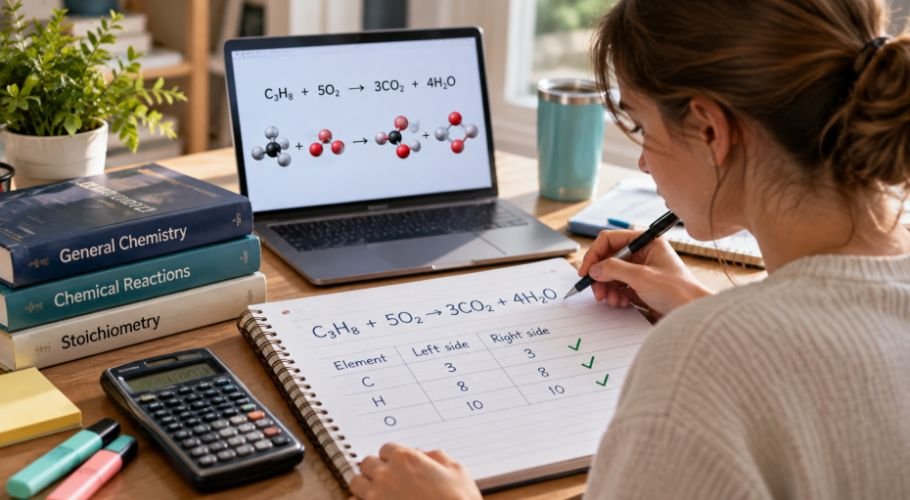
A balanced equation should never be accepted simply because the coefficients look tidy. Count every element on the reactant side and compare it with the product side.
A final check should include:
- Count each element separately.
- Confirm polyatomic groups where appropriate.
- Make sure every coefficient is a whole number.
- Reduce the coefficients to the lowest whole-number ratio.
If coefficients share a common factor, divide them by that factor to get the simplest ratio.
For especially complicated reactions, an algebraic method can help. Assign variables to coefficients, write an equation for each element, and solve the system. It takes longer at first, but it can help when inspection becomes messy.
Common Mistakes That Cause Trouble
The biggest mistake is changing a subscript. Turning H2O into H2O2 creates a different substance rather than balancing the original.
Another problem is forgetting parentheses. In Ca(OH)2, there are two oxygen atoms and two hydrogen atoms. A coefficient multiplies the entire formula, so 3Ca(OH)2 contains three calcium, six oxygen, and six hydrogen atoms.
Learning how to understand molecular structures in chemistry can also make grouped formulas easier to read.
Students sometimes balance oxygen or hydrogen first because those elements appear familiar. That can create unnecessary backtracking. Start with the clearest elements or intact groups, then handle flexible elements.
Do not stop after one successful adjustment. Balancing is complete only when every element matches.
Frequently Asked Questions
1. What should I balance first in a complex equation?
Start with the most complex substance or an element that appears in only one compound on each side. This reduces later adjustments and gives you a clearer starting point. Avoid choosing an element that appears in several formulas unless necessary.
2. Can polyatomic ions be balanced as a group?
Yes, when the same polyatomic ion remains intact on both sides. Treating it as one unit can make coefficient calculations simpler. Always check that the group has not been split or changed during the reaction.
3. Should oxygen and hydrogen always be balanced last?
Not always, but leaving them until later is often helpful because they commonly appear in multiple compounds and can create extra adjustments. The best order depends on the formulas in the specific reaction.
4. How do I know an equation is fully balanced?
Count every element on both sides, verify the formulas were not changed, and reduce the coefficients to the lowest whole-number ratio. If every count matches and no common factor remains, the equation is ready for stoichiometric use.
Why a Simple Method Makes a Real Difference
Balancing complex chemical equations becomes easier with a clear order. Read formulas carefully, identify the most useful element or intact group, adjust coefficients deliberately, and postpone flexible elements. The method does not remove the chemistry, but it reduces confusion.
You begin noticing useful ratios and easy targets before touching a coefficient. Balancing then stops feeling like trial and error.
Leave a Reply