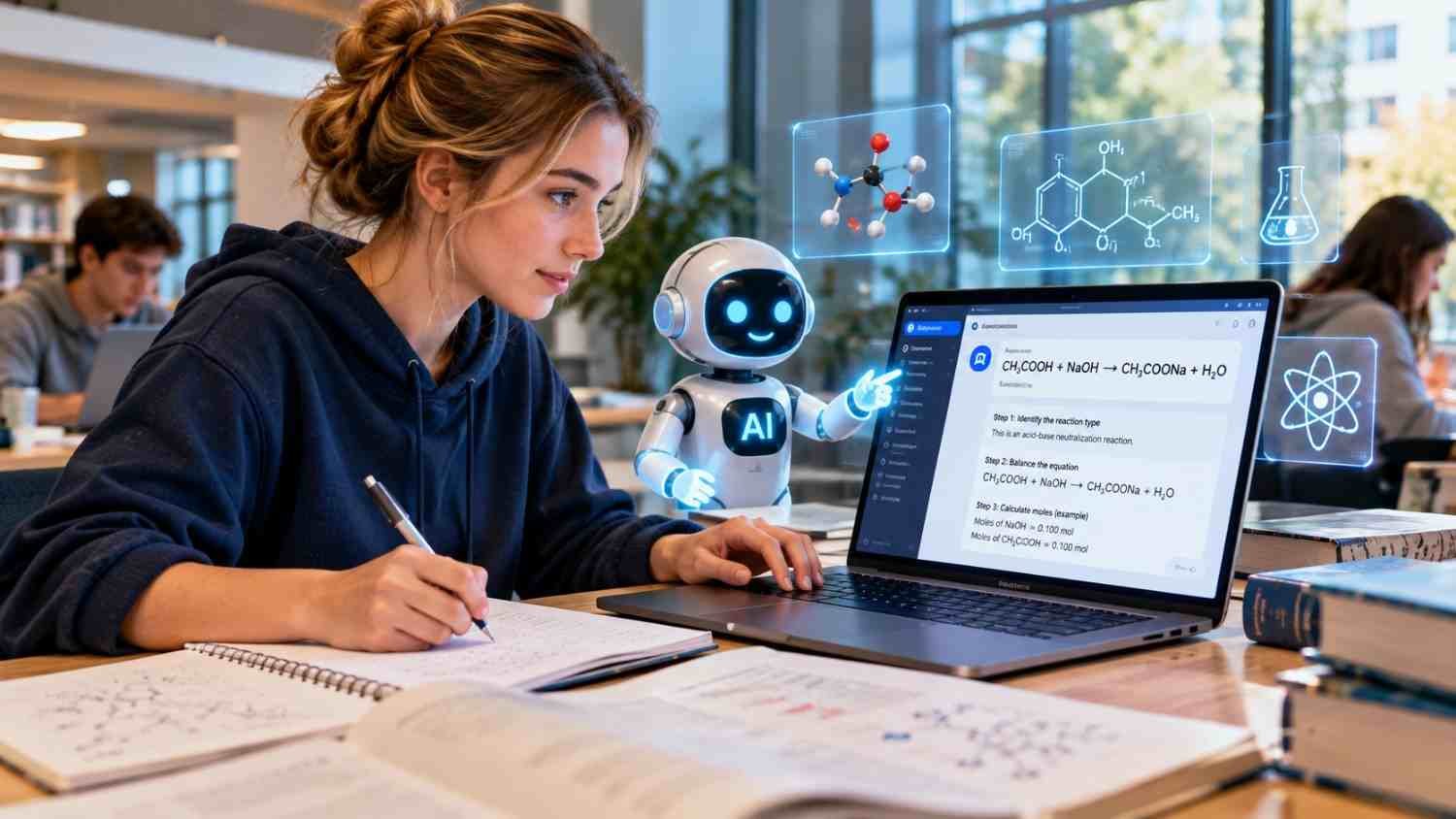
I started noticing how often AI appeared in chemistry study sessions when a difficult equation no longer meant waiting for office hours or searching through several textbook pages. A student could ask for a breakdown of a calculation, request another explanation, or compare two approaches within minutes. That convenience changed the rhythm of studying, but it also raised a question I kept coming back to: does getting help faster actually lead to better chemistry understanding?
I realized the answer depends heavily on how the technology is used. AI can make an intimidating problem feel manageable by explaining unfamiliar terminology, organizing calculations, or pointing out a mistake. At the same time, a polished response can hide an incorrect assumption. For chemistry students, that distinction matters because understanding why an answer works is often more valuable than reaching the answer quickly.
How AI Is Changing Chemistry Learning
AI-assisted problem solving in chemistry education is moving beyond simple question answering. Generative AI systems can respond to written questions, interpret some visual information, explain concepts in different ways, and create practice problems. That makes them useful as an additional layer of support alongside instructors, textbooks, calculators, laboratory work, and established study resources.
The appeal is especially clear when chemistry combines several kinds of reasoning. A stoichiometry problem may require unit conversion, mole relationships, a balanced equation, and careful interpretation of the question. A useful AI response can separate those steps and explain what each one accomplishes instead of presenting a bare numerical result. This can make difficult material easier to revisit independently later.
Where AI Can Help With Chemistry Problems

One practical use is guided tutoring. Students can ask an AI system to explain a calculation step by step, identify the formula needed, or provide a hint without immediately revealing the final answer. It can also generate similar questions for additional practice, which is useful when a student understands an example but struggles to reproduce the method independently.
Visual learning is another developing area. Chemistry relies heavily on representations that are difficult to describe with words alone, including molecular structures, reaction schemes, and three-dimensional arrangements. AI-enabled visual tools can help students explore those representations and connect symbolic equations with what is happening at the molecular level.
The same principle applies to organic chemistry. Instead of asking only for the product of a reaction, a student can request an explanation of electron movement, reaction conditions, or the role of a reagent. That changes AI from an answer source into a potential reasoning aid.
The Quality of the Prompt Matters
A vague request such as “solve this chemistry problem” gives an AI system little direction about the student’s level or learning goal. A more useful prompt can state the course level, show the student’s attempted work, identify the confusing step, and ask for guidance before the final answer.
For example, a student working on an equilibrium calculation might ask the system to check the setup, explain why a particular expression is used, and identify any unit or assumption errors. This approach encourages diagnosis rather than copying.
Why Chemistry Answers Still Need Checking
Chemistry presents a difficult test for AI because a response can sound convincing while containing a subtle scientific or mathematical error. Research has found that AI performance can vary across chemistry tasks, with some calculations handled more reliably than complex titration, equilibrium, aqueous-salt, or redox problems.
Errors can involve more than arithmetic. An AI-generated solution might use an inappropriate equation, balance a reaction incorrectly, misunderstand a limiting reagent, confuse assumptions, or provide an incomplete reaction mechanism. In laboratory contexts, unverified instructions can also create safety concerns.
Students should therefore check units, balanced equations, significant figures, assumptions, reaction conditions, and the final numerical result. Comparing an explanation with class notes, a textbook, or instructor feedback adds another layer of protection.
Avoiding AI Dependence in Chemistry
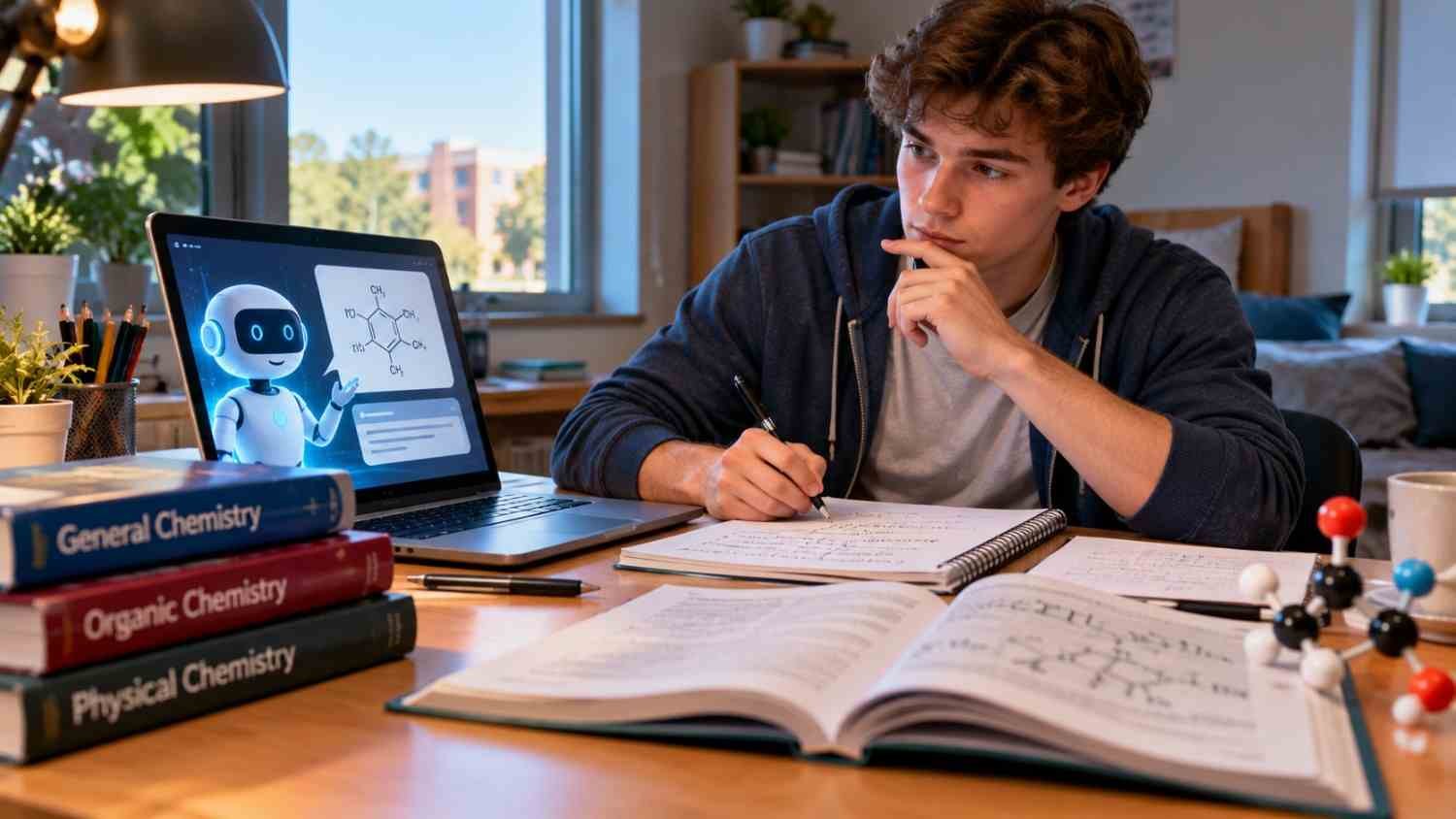
The biggest educational risk is not that students use AI. It is that they stop doing the thinking that makes chemistry knowledge stick. If every unfamiliar problem is handed to a chatbot before the student has attempted it, the difficult but valuable part of learning can disappear.
A better routine is simple:
- Attempt the problem independently before asking for help.
- Ask AI to identify errors or provide hints before requesting a complete solution.
- Rework the problem without looking at the response.
- Verify important results against reliable course materials.
This approach preserves productive struggle while reducing wasted time. It also makes mistakes useful because students can investigate exactly where their reasoning went off track.
What AI Means for Chemistry Education
For instructors, AI creates opportunities and responsibilities.
That does not remove the teacher from the process. Human oversight remains essential for judging scientific accuracy, appropriate difficulty, learning objectives, and laboratory safety. It also means chemistry education may place greater emphasis on showing reasoning, explaining choices, interpreting data, and defending an answer rather than submitting an isolated final number.
FAQs: The Rise of AI-Assisted Chemistry Problem Solving in Education
1. Can AI solve chemistry problems accurately?
AI can solve many routine chemistry problems, but accuracy varies by task. Calculations involving several assumptions or complex reasoning should always be checked against reliable course resources.
2. How can students use AI without cheating?
Students can use AI for explanations, hints, practice questions, and error checking. Completing the original work independently and following course rules keeps the technology in a supporting role.
3. Can AI help with organic chemistry?
Yes. It can explain reaction concepts, reagents, mechanisms, and terminology. However, students should verify mechanisms and products because plausible-looking explanations can still contain errors.
4. Is AI useful for chemistry exam preparation?
It can generate practice problems, explain difficult concepts, and help identify weak areas. Strong preparation still requires solving problems independently and reviewing verified material.
The Skill That Matters Beyond the Screen
AI-assisted chemistry problem solving will likely become a normal part of how students study, but its real educational value depends on what happens after the response appears. A student who questions an explanation, checks a calculation, redraws a mechanism, and solves a similar problem has gained something that a copied answer cannot provide. The technology can shorten the path to clarification, but understanding still develops through active reasoning.
The most useful role for AI is not replacing the struggle of learning chemistry. It is making that struggle more focused, more interactive, and easier to recover from when a concept does not click the first time.
Leave a Reply