
A graph can approach a point without ever touching it. That detail confused me when I first studied calculus: I kept treating a function’s value and its limit as the same answer. For understanding limits and continuity clearly, I now ask two separate questions. Where is the function heading, and what happens at the point itself?
That distinction explains most introductory problems. A missing point can still have a limit. A filled point does not guarantee continuity. The examples below use equations you can copy directly into Google Docs.
What Does a Limit Tell You?
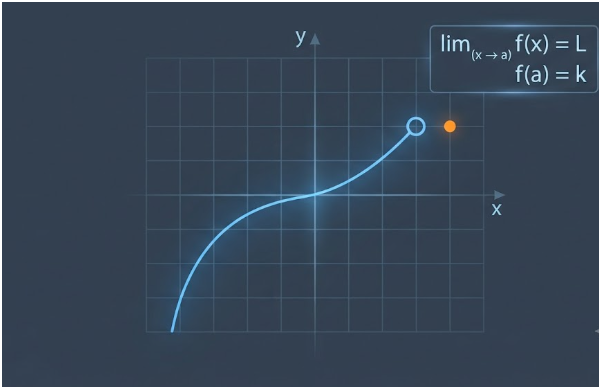
A limit describes the value a function approaches as its input gets close to a number. We write:
lim(x → a) f(x) = L
Read this as “the limit of f(x), as x approaches a, equals L.” The equation describes nearby behavior. It does not require f(a) to equal L, or even require f(a) to exist. OpenStax’s introduction to limits develops this distinction through graphs and numerical examples.
If f(x) = x + 2, the limit as x approaches 2 is 4. Values just below 2 produce outputs just below 4. Values just above 2 produce outputs just above 4.
lim(x → 2) (x + 2) = 4
Here, direct substitution works. The more interesting cases appear when substitution produces an undefined expression.
A Hole That Still Has a Limit
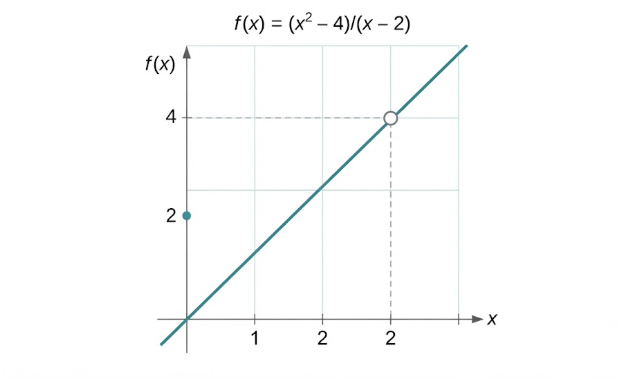
Consider this function:
f(x) = (x² − 4) / (x − 2), for x ≠ 2
Substituting x = 2 gives 0/0. That expression is undefined; it is not the answer to the limit. Factor the numerator instead:
x² − 4 = (x − 2)(x + 2)
For every allowed x other than 2, the common factor cancels:
f(x) = [(x − 2)(x + 2)] / (x − 2) = x + 2
Now the nearby behavior is clear:
lim(x → 2) [(x² − 4) / (x − 2)] = 4
The original function has no value at x = 2, but its graph approaches 4 from either side. Picture the line y = x + 2 with an open circle at (2, 4). I find that picture more useful than memorizing a rule about 0/0.
Why Do One-Sided Limits Matter?
A two-sided limit needs agreement from both directions. The left-hand limit uses inputs smaller than a; the right-hand limit uses inputs larger than a.
lim(x → a⁻) f(x) = L
lim(x → a⁺) f(x) = L
The superscript ⁻ means “from the left,” and ⁺ means “from the right.” A finite two-sided limit exists when those one-sided limits exist and equal the same number. OpenStax states this relationship in its numerical and graphical treatment of limits.
A Jump You Can Check Without a Graph
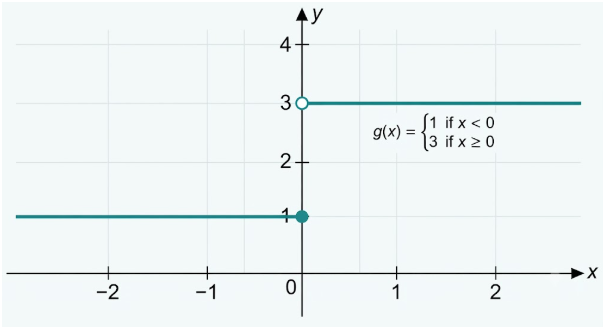
Suppose a piecewise function follows this rule:
g(x) = 1, if x < 0
g(x) = 3, if x ≥ 0
As x approaches 0 from the left, every nearby output is 1. From the right, every nearby output is 3.
lim(x → 0⁻) g(x) = 1
lim(x → 0⁺) g(x) = 3
Because 1 ≠ 3, lim(x → 0) g(x) does not exist. Notice that g(0) = 3. Having a defined value at the point cannot make the two approaches agree.
How Can You Test Continuity at a Point?
A function is continuous at x = a when its limit agrees with its value there. I check three conditions in order:
- f(a) is defined.
- lim(x → a) f(x) exists as a finite number.
- lim(x → a) f(x) = f(a).
If any condition fails, the function is discontinuous at that point. This is the precise version of the familiar “draw the graph without lifting your pencil” idea. That visual shortcut helps, but the three conditions settle cases where a filled dot and an open circle appear at the same x-value. See OpenStax’s explanation of continuity for the formal test.
Return to the earlier example. Its limit at 2 is 4, but f(2) is undefined. It fails the first and third conditions. If we define f(2) = 4, the resulting function becomes continuous at 2. Defining f(2) = 7 would fill in a point, but it would still fail the third condition.
This is where my three-answer check pays off: compare the left approach, right approach, and actual value. All three must agree for continuity at an interior point.
What Kind of Discontinuity Are You Seeing?
Naming the break helps you decide what can be fixed. Mathematics LibreTexts explains the common removable, jump, and infinite discontinuities.
Removable Discontinuity: The Approaches Agree
A removable discontinuity occurs when the finite limit exists, but the function is undefined or has a different value at that point. The factored example above has a removable hole at x = 2. Assigning the function its limiting value repairs continuity there.
Jump Discontinuity: The Approaches Disagree
A jump occurs when the left-hand and right-hand limits are finite but unequal. Our piecewise function jumps from 1 to 3 at x = 0. Changing only g(0) cannot repair the jump; the nearby behavior on at least one side must change.
Infinite Discontinuity: Values Grow Without Bound
For h(x) = 1/x, values near 0 grow very large in magnitude. From the left they decrease without bound; from the right they increase without bound.
lim(x → 0⁻) (1/x) = −∞
lim(x → 0⁺) (1/x) = +∞
Neither side approaches a finite number. The line x = 0 is a vertical asymptote. Writing ±∞ describes the behavior; it does not mean the function reaches infinity as an ordinary value.
Try the Three-Answer Check Yourself
Suppose p(x) = x² for x ≠ 3, but p(3) = 5. What happens at x = 3?
From the left, x² approaches 9. From the right, it also approaches 9. Yet the function’s actual value is 5.
lim(x → 3⁻) p(x) = 9
lim(x → 3⁺) p(x) = 9
p(3) = 5
The limit exists and equals 9, but p is not continuous at 3. The discontinuity is removable: change p(3) to 9, and all three answers agree.
When you practice, write those three answers before naming the discontinuity. If the notation slows you down, review easy ways to memorize math formulas and replace this placeholder with your published internal URL.
Frequently Asked Questions
1. Can a limit exist when a function is undefined?
Yes. The function can approach the same finite value from both sides even if its value at the point is missing.
2. Does a function value determine its limit?
No. A limit depends on nearby outputs, while the function value describes the output at the exact input.
3. How do I know whether a piecewise function is continuous?
At the joining point, compare its left-hand limit, right-hand limit, and defined function value. All three must match.
4. Is 0/0 the value of a limit?
No. It signals that direct substitution has not resolved the limit. Try factoring or another valid method.
Stop Asking the Dot to Do the Graph’s Job
I solve these problems faster when I keep the point and its surroundings separate. I find the left-hand limit, find the right-hand limit, and only then check the function’s value. On your next practice problem, write those three answers on separate lines. The type of discontinuity often becomes obvious before you draw the graph.
Leave a Reply