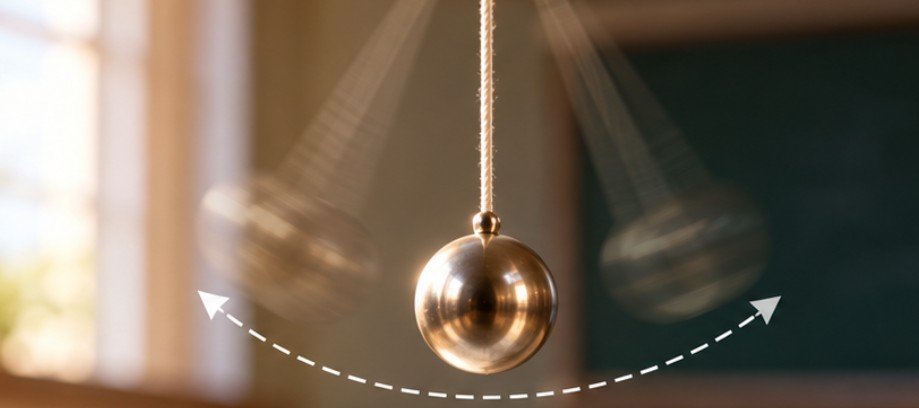
A pendulum can weigh 50 grams or 50 kilograms and, under the simple-pendulum model, its period stays the same. That surprises many physics students because mass matters in so many other motion problems. For pendulums, the key variables are length and gravitational acceleration.
That makes pendulum period problems with solutions easier than they first appear. Once you identify whether the problem gives you period, frequency, length, or gravity, you can usually rearrange one equation and solve. The real challenge is knowing when that equation applies and avoiding unit mistakes.
The Formula That Controls a Simple Pendulum
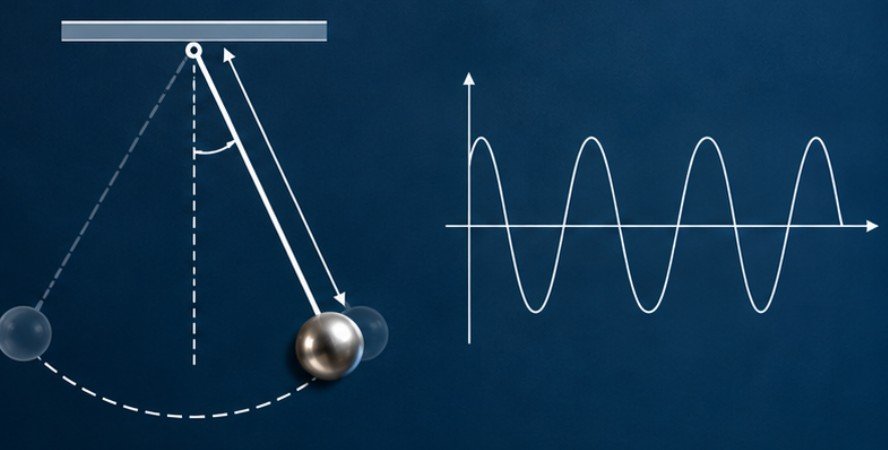
For a simple pendulum undergoing a small-angle swing,
T = 2π√(L/g)
where T is period in seconds, L is pendulum length in meters, and g is gravitational acceleration in meters per second squared. OpenStax explains that the ideal model uses a point-like bob suspended from a nearly massless string and behaves as simple harmonic motion for small displacements.
The equation shows two useful relationships. A longer pendulum swings more slowly because T grows with √L.
Stronger gravity makes it swing faster because T decreases as g rises. The bob’s mass does not appear in the equation.
When analyzing the forces behind pendulum motion, you can draw a free body diagram to visualize gravity, tension, and the direction of the restoring force.
For many U.S. classroom problems, g is rounded to 9.8 m/s². The National Institute of Standards and Technology lists standard acceleration of free fall as 9.80665 m/s², so 9.8 or 9.81 may be expected depending on the precision required.
| Find | Formula | Unit |
| Period | T = 2π√(L/g) | s |
| Frequency | f = 1/T = (1/2π)√(g/L) | Hz |
| Length | L = gT²/(4π²) | m |
| Gravity | g = 4π²L/T² | m/s² |
A Five-Step Method That Prevents Most Errors
- Write the known values and convert length to meters.
- Identify the requested variable: T, f, L, or g.
- Rearrange the formula before inserting numbers.
- Keep units visible during substitution.
- Check the trend: longer length should increase period, while stronger gravity should decrease it.
This approach is useful in U.S. high school, AP Physics, and introductory college courses because the wording of pendulum questions often changes more than the underlying mathematics.
Pendulum Period Problems With Solutions
Problem 1: Find Period From Length
A simple pendulum is 0.70 m long. What is its period near Earth’s surface using g = 9.8 m/s²?
Start with:
T = 2π√(0.70/9.8)
T = 2π√0.07143
T ≈ 2π(0.2673) ≈ 1.68 s
The answer is about 1.68 seconds for one complete back-and-forth cycle.
A one-meter pendulum has a period close to two seconds, so a 0.70 m pendulum should complete its cycle somewhat faster. The result therefore passes a quick reasonableness check.
Problem 2: Find Length From a Given Period
A laboratory setup needs a pendulum with a 3.0-second period. How long should the pendulum be on Earth?
Rearrange the equation:
L = gT²/(4π²)
Substitute the known values:
L = 9.8(3.0)²/(4π²)
L = 88.2/39.478 ≈ 2.23 m
The required length is approximately 2.23 meters.
Notice the square on T. If the desired period doubles, the required length becomes four times as large. That relationship can solve many comparison questions without a full calculation.
Problem 3: Compare Earth and the Moon
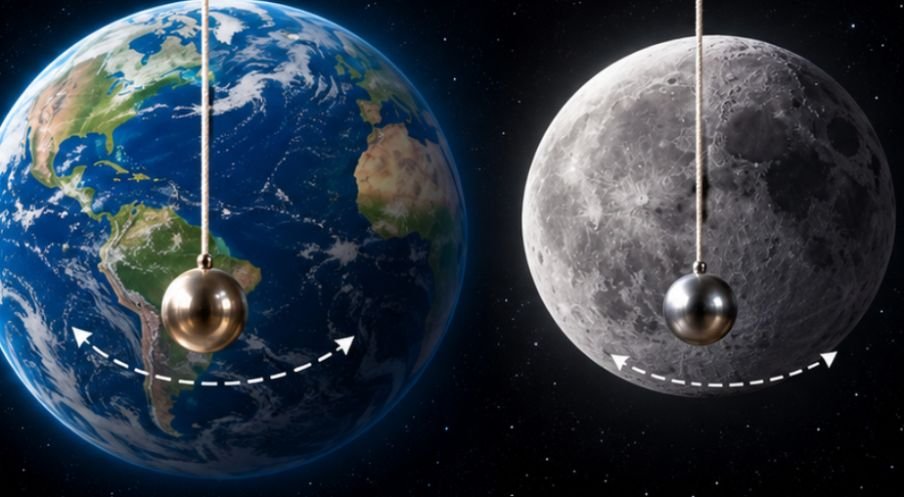
Take the same 0.70 m pendulum to the Moon. NASA reports lunar surface gravity at roughly 1.62 m/s², only about one-sixth of Earth’s surface gravity. NASA: Moon Fact Sheet
Using NASA’s more precise value of about 1.624 m/s²:
T = 2π√(0.70/1.624)
T ≈ 4.13 s
The period would be approximately 4.13 seconds.
Nothing about the pendulum’s length or mass changed. The longer period results from weaker gravity, which provides a smaller restoring acceleration. This demonstrates why pendulum timing depends on location as well as length.
Problem 4: Find Frequency From Period
Suppose a pendulum has a period of 2.50 seconds. Frequency is the reciprocal of period:
f = 1/T
f = 1/2.50 = 0.40 Hz
The answer is 0.40 Hz.
Frequency tells you how many complete oscillations occur each second. Students sometimes confuse frequency and period, but remembering that they are reciprocals prevents most mistakes.
Why the Small-Angle Rule Matters

The familiar pendulum equation is an approximation, not a universal rule for every possible swing.
For problems that go beyond the period formula, conservation of mechanical energy problems can help analyze how kinetic and potential energy change as the pendulum moves through its swing.
OpenStax notes that for angles below roughly 15 degrees, sin θ and θ differ by less than 1% when θ is expressed in radians. That approximation allows the pendulum to be modeled using simple harmonic motion.
At larger release angles, the actual period becomes slightly longer than the basic equation predicts. MIT OpenCourseWare derives higher-order corrections showing that the period acquires an amplitude-dependent term as the initial angle increases.
This resolves an apparent contradiction. Physics textbooks frequently describe the pendulum’s period as independent of amplitude, but that statement is approximately true only while the swing angle remains sufficiently small.
Common Mistakes That Cost Easy Points
The most common error is leaving length in centimeters. A 70 cm pendulum must become 0.70 m before using the standard SI formula. Another mistake is treating half of a swing as one period; a full period means completing an entire cycle.
Do not insert the bob’s mass into the simple-pendulum equation. Also remember that a rigid rod, swinging sign, or other extended object is a physical pendulum rather than an ideal simple pendulum. Its mass distribution and moment of inertia can affect the period.
For a visual experiment, the University of Colorado Boulder’s PhET Pendulum Lab allows students to explore pendulum motion interactively. Changing conditions before solving the equations can make the relationships between length, gravity, and oscillation easier to recognize.
A Fast Reality Check
If your answer says shortening the pendulum makes its period longer, recheck your calculations. If adding mass changes the ideal simple-pendulum period, something has gone wrong. And if weaker gravity produces a shorter period, the result contradicts the equation.
Those three checks can catch many calculator, unit-conversion, and algebra errors without solving the entire problem again.
Frequently Asked Questions
1. Does pendulum mass affect the period?
Not for an ideal simple pendulum. Period depends on length and gravitational acceleration, assuming a small swing angle and negligible effects such as air resistance.
2. Why does a longer pendulum have a longer period?
Because T is proportional to √L. Increasing the pendulum’s length lowers its natural oscillation rate and increases the time required for one complete cycle.
3. What value of g should I use in U.S. physics problems?
Use the value provided in the question. If none is given, 9.8 m/s² or 9.81 m/s² is normally appropriate for classroom calculations near Earth’s surface.
4. Is the pendulum formula accurate for large angles?
Not exactly. As amplitude increases, the true period becomes longer than the small-angle equation predicts, so more advanced problems may require an amplitude correction.
The Takeaway
The most useful part of pendulum physics is recognizing the pattern behind the equation. Length determines how slowly the pendulum swings, gravity determines the strength of the restoring effect, and mass disappears from the ideal simple-pendulum result.
Once you can rearrange T = 2π√(L/g), check the units, and recognize the small-angle assumption, pendulum period problems with solutions become predictable rather than intimidating. Before accepting an answer, make one final physical check: longer means slower, while stronger gravity means faster. If the result follows those relationships, you are usually on solid ground.
Leave a Reply