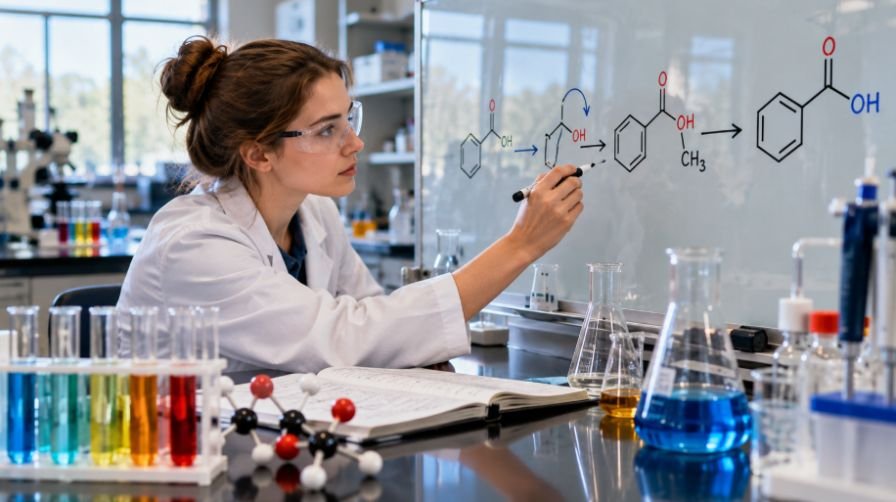
I used to look at an organic chemistry reaction sequence and see a row of formulas connected by arrows. Each arrow seemed to demand a separate fact, and remembering which reagent belonged above which step felt harder than the chemistry itself. Once I started comparing the starting molecule with the product after every step, the pathway became much easier to read.
I also noticed that confusing pathways become manageable when you stop asking, “What reaction is this?” and first ask, “What changed?” A new bond, a missing group, a changed oxidation state, or a new double bond can tell you what kind of transformation occurred and what should happen next.
What an Organic Chemistry Reaction Pathway Shows
An organic chemistry reaction pathway explains how a starting material becomes a target product through one or more chemical transformations. Instead of treating each reaction as an isolated event, you follow structural changes from one stage to the next.
The starting compound is the substrate. Reagents provide what is needed for transformation, while conditions can influence the route. In a multi-step sequence, one product becomes the substrate for the next reaction.
Four Reaction Patterns Worth Recognizing
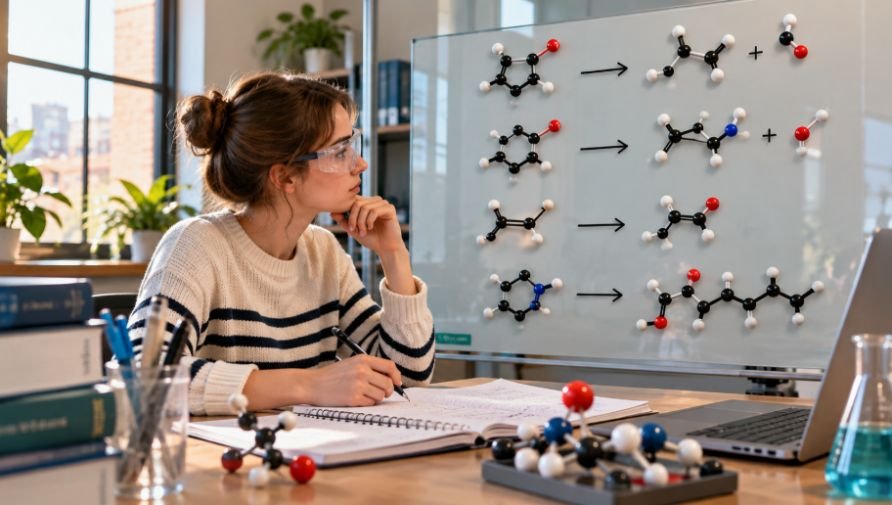
Most introductory pathways fit a few broad patterns.
Substitution
A substitution reaction replaces one atom or group with another. SN1 and SN2 are common examples.
Addition
Addition reactions add atoms or groups across a carbon-carbon double or triple bond.
Elimination
Elimination removes groups and often creates a double bond that can react in a later step.
Oxidation and reduction
Oxidation-reduction reactions change the bonding environment or oxidation state of carbon. For example, an alcohol can become an aldehyde, ketone, or, under suitable conditions, a carboxylic acid.
How to Read a Pathway From Reactant to Product
Start with the structure rather than the reagent name. Compare the reactant and product and mark every meaningful difference. Has a double bond disappeared? Did a leaving group vanish? Did an oxygen-containing group appear? Has the carbon skeleton changed?
Next, identify the functional group involved. An alkene suggests different transformations than an alcohol, ketone, amine, or carboxylic acid. Once you know the functional group, the reagent becomes easier to interpret.
Then ask what role the reagent plays. Is it supplying a nucleophile, creating an electrophile, removing a proton, oxidizing the substrate, reducing it, or helping a leaving group depart?
Finally, check whether the proposed product makes chemical sense. For quantitative chemistry practice, chemistry stoichiometry problems with worked solutions can reinforce careful tracking of reactants and products.
Why Reaction Mechanisms Matter
A mechanism describes how a reaction happens at the molecular level. Curved arrows show electron-pair movement, making it possible to track which bonds break and which bonds form.
Identifying an electron-rich nucleophile, an electron-poor electrophile, and a suitable leaving group can help you reason through unfamiliar reactions.
Intermediates may appear along the way. Carbocations, carbanions, and radicals are reactive species whose stability can affect the pathway.
Reaction conditions matter because solvent, temperature, concentration, catalysts, and reagent strength can influence competing pathways.
Building Multi-Step Synthesis Pathways
A longer synthesis is a chain of controlled transformations.
One practical approach is to work backward from the target and ask what simpler precursor could produce the required functional group.
For example, you might create an alkene through elimination and then use an addition reaction to introduce the desired group. The key is why the first transformation enables the second.
Common Mistakes When Following Reaction Pathways

One frequent mistake is choosing a reagent before examining the substrate. A familiar reagent does not automatically produce the reaction you remember. The molecular structure and conditions determine what transformation is realistic.
It also helps to distinguish reaction class from mechanism. “Elimination” describes a broad transformation, while E1 and E2 describe particular mechanistic routes. Likewise, substitution and SN1 or SN2 are related concepts, but they are not interchangeable terms.
A Better Way to Practice Organic Pathways
Instead of memorizing large reaction charts, practice transformations in small groups. Learn what each functional group can become and which reagents cause those changes.
Then practice mixed pathways. Hide the product and predict it from the starting material and reagents. Reverse the exercise by identifying possible starting materials for a target.
For related equation work, how to balance complex chemical equations can reinforce careful tracking of atoms and products.
Why Reaction Pathways Become Easier With Practice
Organic chemistry feels less disconnected when each transformation has a structural reason. A pathway is a story about bonds being broken, formed, shifted, or rearranged.
The goal is to ask what changed, why it could occur, and what the new structure makes possible.
With practice, even unfamiliar pathways have somewhere to start. You can test each transformation and build the route one logical step at a time.
Frequently Asked Questions
1. What is an organic chemistry reaction pathway?
It is a sequence showing how a starting organic compound is transformed into a target product through one or more reactions, often with intermediates between steps. Each stage shows a specific structural change and the conditions that make that change possible.
2. How do I identify the reaction type?
Compare the starting material and product first. Look for bond changes, disappearing groups, newly formed multiple bonds, or changes in oxidation state. Then consider the functional group and reagent involved.
3. Why are reaction mechanisms useful?
Mechanisms show how electrons and bonds move during a reaction. Understanding them helps you predict products and reason through unfamiliar examples. They also explain why particular reagents work under particular conditions.
4. What is the best way to practice pathways?
Start with simple functional-group conversions, then progress to multi-step sequences. For each step, identify the structural change, reagent role, mechanism, and expected product. Review mistakes before moving to harder pathways.
Why the Chemistry Becomes More Connected
Reaction pathways become less intimidating when every step is treated as a structural decision. You begin to recognize relationships between functional groups, conditions, mechanisms, and products. That habit makes difficult sequences easier to approach with confidence.
With enough practice, the pathway stops looking like a puzzle built from memorized answers. It becomes a sequence you can explain, test, and adjust. That is where organic chemistry starts to feel coherent: the molecules themselves give you clues about what can happen next.
Leave a Reply