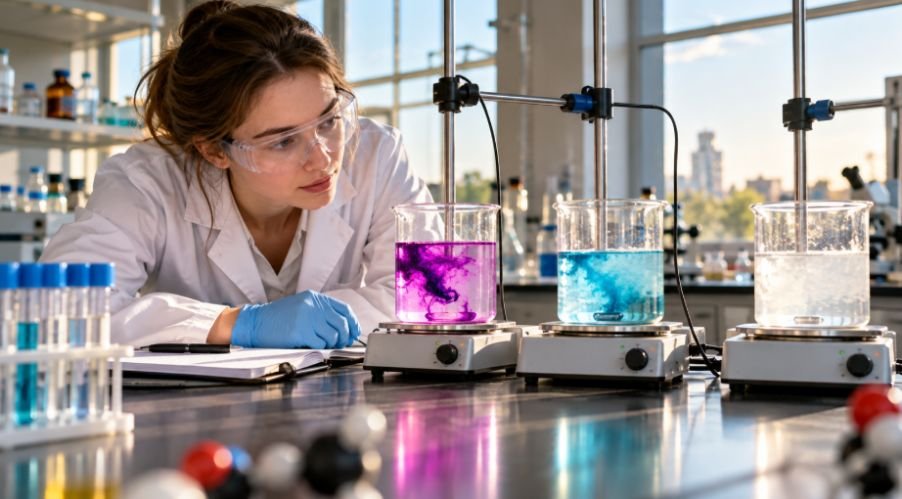
I used to think equilibrium meant a chemical reaction had somehow run out of energy and stopped. When I first looked at reversible reactions, the word made the process sound static, as if nothing was happening anymore. The real picture is more active: particles keep reacting in both directions, even though composition can look unchanged to an observer.
I also noticed that two reactions can settle into equilibrium on very different timelines. One may approach its balanced state quickly, while another can take much longer. That difference makes more sense once reaction rate and equilibrium are separated. Equilibrium describes the state reached, while kinetics helps explain how quickly it gets there.
What Chemical Equilibrium Actually Means
A reversible reaction can proceed in both directions. Reactants form products through the forward reaction, while products can collide and reform reactants through the reverse reaction. Early on, more reactant particles are available, so the forward reaction tends to be faster.
As reactants are consumed, their concentration falls. That reduces the frequency of successful collisions between reactant particles, so the forward rate gradually decreases. At the same time, products accumulate. More product particles means more opportunities for the reverse reaction, so its rate increases.
Eventually, the forward and reverse reactions occur at the same rate. That is dynamic equilibrium. The reactions continue, but opposing rates are equal, so there is no net change in concentration.
Why Equilibrium Can Take Different Amounts of Time
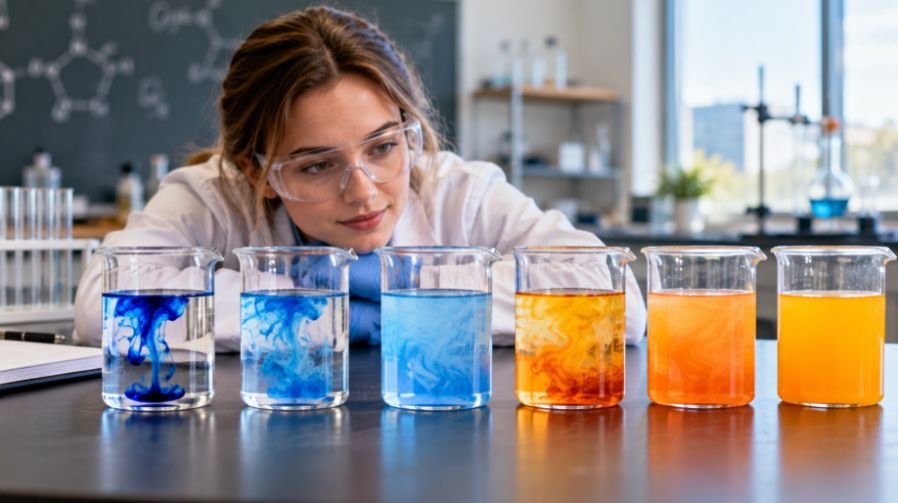
The speed at which a reaction approaches equilibrium depends largely on kinetics. A reaction with a pathway that has a relatively high activation energy generally proceeds more slowly under the same conditions than one with a lower barrier.
Activation energy is the minimum energy needed for reacting particles to reach the transition state. If relatively few collisions can cross that barrier, the reaction progresses slowly. This applies to both directions.
Temperature also matters. Heating generally increases particle kinetic energy, so more collisions can overcome activation barriers. Rates can increase, and equilibrium may be reached sooner, although temperature can also change equilibrium position.
Concentration can influence the approach too. More reactant particles can increase effective collisions, making the forward reaction faster initially. For gases, pressure changes can affect concentrations. These effects influence the response rate, but they are separate from the question of where equilibrium ultimately lies.
Catalysts Change the Route, Not the Destination
A catalyst provides an alternative reaction pathway with a lower activation energy. Because the barrier is lower, the reaction can proceed more quickly.
For a reversible reaction, a catalyst speeds up both directions. It does not simply push the reaction toward products. Instead, it helps the system reach equilibrium faster. The equilibrium constant and final composition remain unchanged.
A faster reaction does not necessarily mean a different equilibrium position. Kinetics describes the journey; equilibrium describes the state reached under particular conditions.
The same idea helps with complicated mechanisms. Individual steps, intermediates, and energy barriers can explain why a pathway proceeds at one rate rather than another. That connection is useful when working through organic chemistry reaction pathways, where several steps may influence the observed rate.
Equilibrium Does Not Mean Equal Amounts
A common misconception is that equilibrium means equal concentrations of reactants and products. It does not.
A product-favored reaction can have far more products than reactants at equilibrium, even while both directions continue. A reactant-favored reaction can reach equilibrium too.
The equilibrium constant describes that balance. Its value reflects the relative amounts of products and reactants at equilibrium according to the balanced equation.
Equilibrium is therefore not a 50/50 split. Equal rates are required, not equal concentrations. The opposing rates eventually match.
What Happens When Conditions Change?
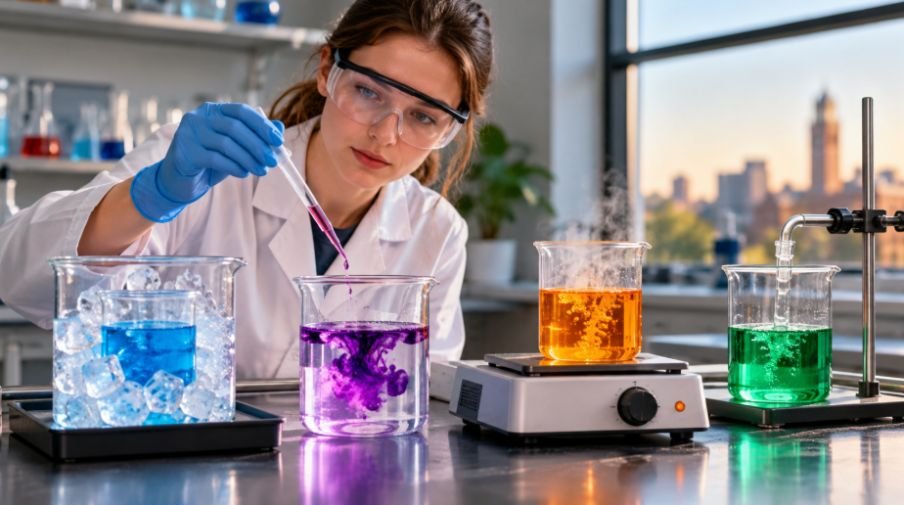
Equilibrium is not permanently locked in place. Changing conditions can disturb the balance between forward and reverse processes.
Adding a reactant, removing a product, changing pressure in a gas system, or changing temperature can cause a response. Le Châtelier’s principle helps predict the direction, while temperature deserves special attention because it changes the equilibrium constant itself.
Adding reactant initially increases the forward reaction rate because more reactant particles are available. The system then adjusts until the forward and reverse rates become equal again.
Acid-base equilibria provide another example. Weak acids and bases participate in forward and reverse processes rather than converting completely in one direction. The rate-based picture helps when working through acid-base chemistry calculations with worked examples.
The Difference Between Fast Reactions and Fast Equilibrium
A reaction can be fast without strongly favoring products. Likewise, a product-favored reaction can approach equilibrium slowly.
That distinction matters in laboratories and industrial chemistry. A reaction may favor a particular equilibrium composition, yet its kinetics can make the process impractically slow. Chemists can adjust temperature, concentration, pressure, surface area, or catalysts to change the approach rate.
The key is separating speed from equilibrium. A catalyst changes speed. Temperature can affect both speed and equilibrium. Concentration and pressure can alter reaction rates and, under appropriate conditions, shift composition until a new equilibrium is established.
Frequently Asked Questions
1. Why do reversible reactions reach equilibrium?
Forward and reverse reactions continue simultaneously. Equilibrium occurs when their rates become equal, so concentrations remain constant overall even though molecular reactions continue.
2. Does equilibrium mean the reaction has stopped?
No. Dynamic equilibrium means both directions are still occurring. They simply occur at equal rates, producing no net macroscopic change.
3. Why does a catalyst make equilibrium happen faster?
A catalyst lowers the activation energy for the reaction pathways. It accelerates both directions without changing the equilibrium constant or final equilibrium composition.
4. Does higher temperature always move equilibrium toward products?
No. Temperature can speed reactions, but its effect on equilibrium depends on whether the forward reaction is endothermic or exothermic. The equilibrium constant changes with temperature.
Why Rate and Equilibrium Belong Together
The most useful way to understand equilibrium is to stop picturing it as a reaction that reaches a finish line. Particles still move, collide, break bonds, and form new ones. What changes is the balance between opposing rates. Activation energy, temperature, concentration, pressure, and catalysts affect how quickly that balance develops, while thermodynamic factors determine the equilibrium state. Keeping those ideas separate makes chemistry problems easier to reason through.
Once that distinction clicks, equilibrium looks less like a pause and more like a dynamic balance explained by measurable chemical behavior.
Leave a Reply