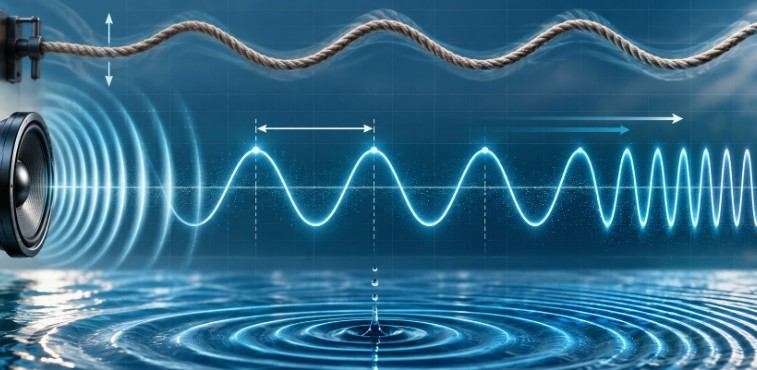
A wave can cross a classroom, an ocean, or interplanetary space, yet the same compact relationship connects its speed, frequency, and wavelength. That is why wave speed frequency wavelength problems are deceptively simple: the algebra may take one line, but unit errors, graph mistakes, and weak physical reasoning can still produce a wrong answer.
The essential equation is: v = fλ
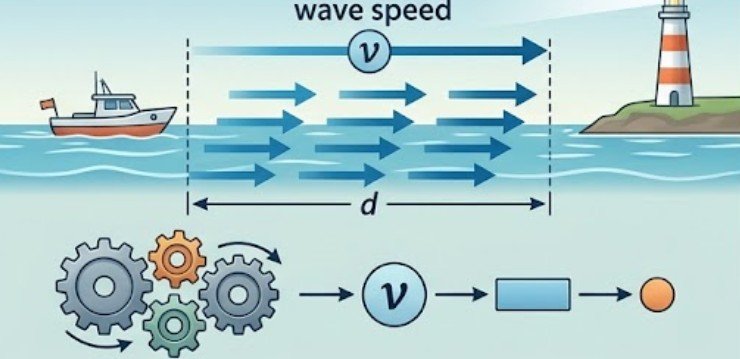
Here, v is wave speed in meters per second (m/s), f is frequency in hertz (Hz), and λ is wavelength in meters (m). OpenStax derives the relationship from the fact that a wave travels one wavelength during one period; because f = 1/T, v = λ/T becomes v = fλ.
The Equation Works Because the Quantities Have Physical Meaning
Wavelength is the distance between matching points on neighboring cycles, such as crest to crest. Frequency is the number of cycles passing a point each second. Wave speed tells you how quickly the disturbance propagates.
| Quantity | Symbol | SI unit | Rearranged relationship |
| Wave speed | v | m/s | v = fλ |
| Frequency | f | Hz or s⁻¹ | f = v/λ |
| Wavelength | λ | m | λ = v/f |
| Period | T | s | T = 1/f |
The key concept is that wave speed is generally controlled by the medium and the type of wave rather than by frequency alone. HyperPhysics at Georgia State University notes that propagation speed is determined by properties of the medium. In the same medium under stable conditions, increasing frequency therefore makes wavelength shorter instead of automatically making the wave travel faster.
A Four-Step Method for Wave Speed Frequency Wavelength Problems
Identify the two known quantities and the unknown. Convert values to compatible SI units. Rearrange v = fλ before inserting numbers. Then calculate and check both the final unit and whether the size of the answer makes physical sense.
That unit check catches many mistakes. For wavelength, λ = v/f gives (m/s) ÷ (1/s), leaving meters. If the units do not reduce to the quantity you are trying to find, revisit the setup.
The same discipline helps elsewhere in physics. If you are also studying mechanics, the labeling process used in how to draw a free-body diagram reinforces the same habit: identify what is known before choosing an equation.
Worked Example 1: Calculate Wave Speed
A laboratory wave has a frequency of 60.0 Hz and a wavelength of 0.85 m. What is its speed?
so, v = fλ
v = (60.0)(0.85)
v = 51 m/s
A fast estimate supports the result. Sixty cycles each second, with each cycle covering slightly less than one meter, should produce a speed slightly below 60 m/s.
Worked Example 2: Calculate Wavelength
A 3.00 kHz sound wave travels through air at approximately 343 m/s. Find its wavelength.
First convert the frequency:
3.00 kHz = 3000 Hz
Then use:
like, λ = v/f
λ = 343/3000
λ ≈ 0.114 m, or 11.4 cm
Oregon State University physics materials use about 343 m/s for sound in air in standard classroom calculations.
The important lesson here is the conversion. Substituting 3 instead of 3000 would make the answer 1,000 times too large.
Worked Example 3: Calculate Frequency
A wave on a string travels at 420 m/s and has a wavelength of 1.05 m. What is its frequency?
this way, f = v/λ
f = 420/1.05
f = 400 Hz
Estimate first whenever possible. Because 1.05 m is close to 1 m, a result near 420 Hz is expected. The calculated 400 Hz is reasonable.
What Happens When a Wave Enters a New Medium?
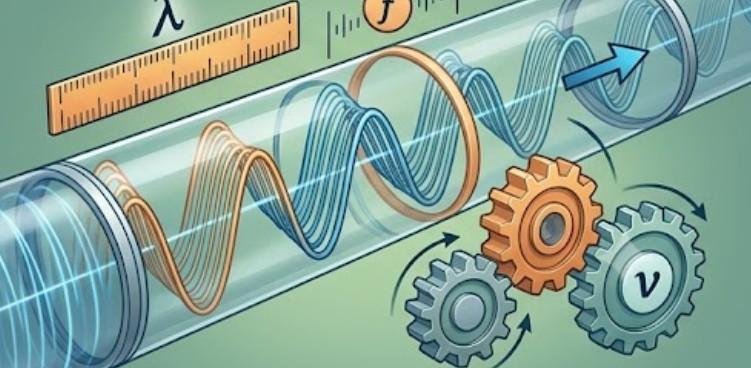
This is where calculation questions become more conceptual. If a wave crosses into a different medium, its speed may change because the propagation conditions have changed. The frequency usually remains set by the source, so the wavelength changes instead.
For example, if sound enters a medium where it travels faster while its frequency stays constant, λ = v/f shows that its wavelength becomes longer. OpenStax lists widely different sound speeds for gases, liquids, and solids, demonstrating that the medium matters.
Electromagnetic waves follow the same speed-frequency-wavelength relationship. NASA explains that electromagnetic radiation spans radio waves through gamma rays and that electromagnetic waves propagate at the speed of light in vacuum. The frequency and wavelength differ across the spectrum, but they remain linked by the wave equation.
Three Mistakes That Produce Plausible-Looking Wrong Answers
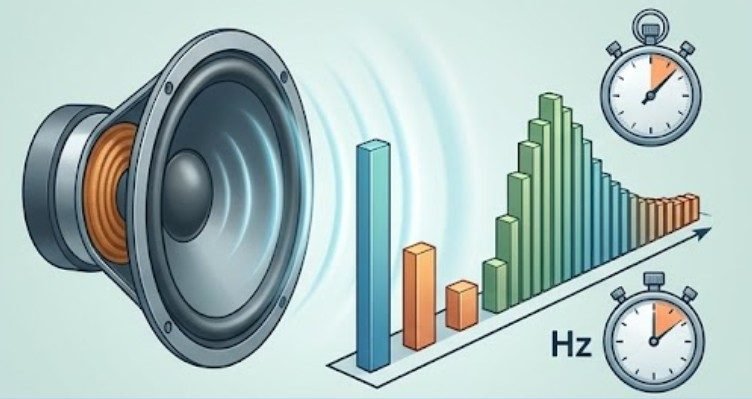
Unit inconsistency is the most common trap. Convert kilohertz to hertz, centimeters to meters, and nanometers to meters before using SI-based calculations.
A second mistake is reading the wrong quantity from a graph. A displacement-versus-position graph reveals wavelength along the horizontal axis. A displacement-versus-time graph reveals period, which must be converted using f = 1/T. Georgia State University’s wave-graph materials make the same distinction between distance-based and time-based wave graphs.
A third error is confusing amplitude with wavelength. Amplitude measures the maximum displacement from equilibrium. It does not belong in v = fλ.
Real ocean waves also deserve a caution. NOAA defines wavelength as the horizontal distance between successive crests or troughs, but actual ocean-wave speeds can depend on water depth and other physical conditions. The classroom relationship v = fλ still describes speed, frequency, and wavelength, but you should not assume the speed itself is constant unless the problem gives that condition.
Use Proportional Reasoning as an Error Check
Before submitting an answer, ask whether the variables changed in the direction you expected. At fixed speed, frequency and wavelength are inversely related. Double the frequency and the wavelength must halve. At fixed frequency, a larger wave speed means a longer wavelength.
These checks are quick enough to perform mentally and often expose a calculator entry, unit-conversion, or algebra error before it costs points.
Frequently Asked Questions
1. What formula connects wave speed, frequency, and wavelength?
Use v = fλ, where v is wave speed, f is frequency, and λ is wavelength.
2. How do I find wavelength from speed and frequency?
Use λ = v/f. If speed is in m/s and frequency is in Hz, the wavelength will be in meters.
3. Does higher frequency mean higher wave speed?
Not necessarily. In the same medium under stable conditions, higher frequency usually means shorter wavelength while wave speed remains essentially unchanged.
4. Why does frequency stay the same across a boundary?
The source sets the oscillation rate. When the medium changes, speed and wavelength can change while frequency remains tied to the source.
The Takeaway
The useful insight is not merely that one equation solves three kinds of calculations. The equation also predicts how wave behavior must change. Once you connect v = fλ to units, the medium, and proportional reasoning, wave speed frequency wavelength problems become much easier to check rather than merely calculate.
Identify the unknown, convert units before substitution, and use the frequency-wavelength relationship as a built-in sanity test. That approach works for sound, strings, electromagnetic waves, and many other periodic-wave problems.
Leave a Reply