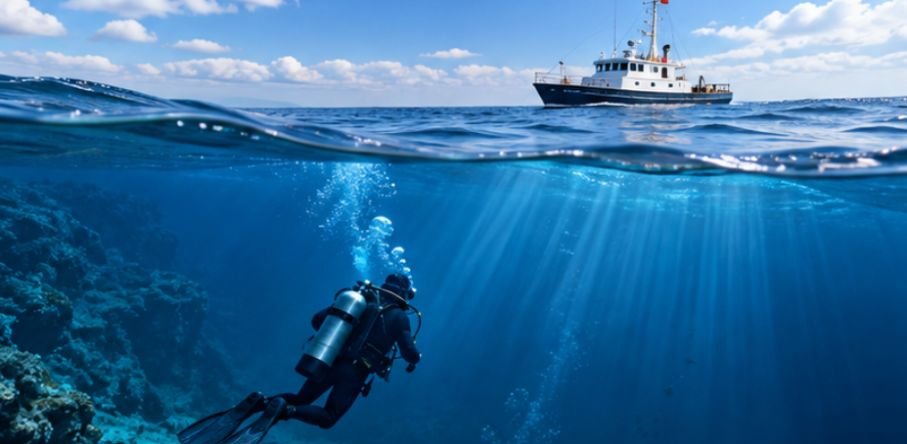
Go only about 33 feet below the ocean surface and the surrounding pressure rises by roughly one additional atmosphere. NOAA’s ocean pressure explainer uses that rule of thumb to explain why divers can feel pressure changes after descending only a short distance.
Most pressure at depth problems physics questions become straightforward once you decide whether the problem wants gauge pressure or absolute pressure. The arithmetic is usually simple. The real challenge is choosing the correct equation and keeping the units consistent.
Why Pressure Increases as You Go Deeper
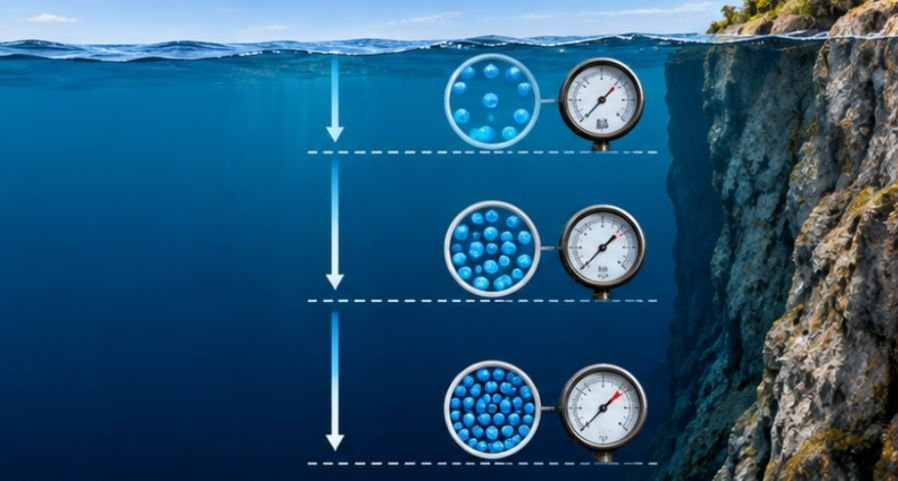
A fluid has weight. At a point below the surface, the fluid above that point presses downward because gravity acts on its mass. The deeper the point, the taller the fluid column above it and the greater the pressure.
For a fluid at rest with nearly constant density, the pressure increase is:
P_gauge = ρgh
Here, ρ is fluid density in kilograms per cubic meter, g is gravitational acceleration, and h is vertical depth in meters.
If the surface is exposed to the atmosphere, total pressure is:
P_absolute = P₀ + ρgh
P₀ is the pressure at the surface. NIST’s SI conversion reference gives standard atmospheric pressure as 101,325 Pa, or 101.325 kPa.
OpenStax University Physics derives this relationship from the weight of a fluid column and notes an important limit: the familiar equation assumes density is effectively constant over the depth being considered. That works very well for many liquids, but not for every gas or extreme-depth situation.
Gauge Pressure vs. Absolute Pressure

Gauge pressure measures only the pressure added by the fluid. Absolute pressure includes the pressure already acting at the surface.
A swimming-pool problem asking for “pressure due to the water” normally wants gauge pressure. A problem asking for “total pressure on a diver” usually requires atmospheric pressure to be added.
| Quantity | Equation | Meaning |
| Gauge pressure | P = ρgh | Pressure caused by the fluid column |
| Absolute pressure | P = P₀ + ρgh | Surface pressure plus fluid pressure |
| Depth from absolute pressure | h = (P − P₀)/(ρg) | Depth found from a total-pressure reading |
| Pressure difference | ΔP = ρgΔh | Change between two depths |
The University of Tennessee physics reference similarly distinguishes gauge pressure from absolute pressure and shows that atmospheric pressure must be included when total pressure is required.
A Reliable Method for Pressure at Depth Problems Physics
1. Identify the Pressure Type
Look for words such as gauge, absolute, total, atmospheric, or pressure due to the liquid. If an absolute pressure is given and depth is required, subtract the surface pressure before solving for h.
2. Convert Everything to SI Units
Use density in kg/m³, depth in meters, and g ≈ 9.81 m/s². The resulting pressure will be in pascals because 1 Pa equals 1 N/m².
For many introductory problems, freshwater is approximated as 1,000 kg/m³. Seawater is denser, so it produces slightly more pressure at the same depth.
3. Substitute Before Calculating
Writing the full equation helps prevent a common mistake: adding atmospheric pressure when the problem asks only for gauge pressure, or forgetting it when total pressure is required.
4. Perform a Reasonableness Check
Pressure should increase with depth and density. In a constant-density liquid, doubling the depth should double the gauge pressure.
Worked Example: Five Meters Under Freshwater
Suppose a swimmer is 5.0 m below the surface of a freshwater pool. Use ρ = 1,000 kg/m³ and g = 9.81 m/s².
P_gauge = ρgh
P_gauge = (1,000)(9.81)(5.0)
P_gauge = 49,050 Pa = 49.1 kPa
If the pool is open to the atmosphere:
P_absolute = 101.325 kPa + 49.1 kPa
P_absolute ≈ 150.4 kPa
Reporting 49.1 kPa when the question asks for total pressure would miss the atmospheric contribution.
Reverse Problem: Finding Depth From Pressure
Suppose an underwater instrument records an absolute pressure of 350 kPa in freshwater.
First remove atmospheric pressure:
P_gauge = 350,000 − 101,325
P_gauge = 248,675 Pa
Then rearrange the hydrostatic equation:
h = P_gauge/(ρg)
h = 248,675 ÷ [(1,000)(9.81)]
h ≈ 25.3 m
The critical step is subtracting surface pressure first. Using the entire 350 kPa as ρgh would produce an incorrect depth.
Why Saltwater Produces a Different Result
NOAA states that ocean pressure rises by about one atmosphere for approximately every 33 feet, or roughly 10 meters, of depth.
At 10 m, using a representative seawater density of 1,025 kg/m³:
P_gauge = (1,025)(9.81)(10)
P_gauge ≈ 100.6 kPa
Adding one standard atmosphere gives an absolute pressure of about 201.9 kPa, close to two atmospheres.
The lesson is simple: use the density provided by the problem instead of assuming every liquid behaves like freshwater.
The same principle of using the correct fluid density is important when learning how to calculate buoyant force with density, where fluid density and displaced volume determine the upward force.
Where the Simple Formula Stops Working
The equation ρgh is a hydrostatic relationship. Penn State’s hydrostatic pressure resource shows that pressure at a point depends on surface pressure, density, gravity, and vertical depth. Container shape does not appear in the equation.
That means a narrow tank and a wide tank can have the same pressure at the same depth if they contain the same static fluid under the same surface pressure.
For moving fluids, however, speed may matter. Pipe-flow and jet problems may require Bernoulli’s equation rather than a basic hydrostatic calculation.
The constant-density assumption can also fail for gases because their density may change significantly with pressure or altitude. For standard liquid problems in introductory physics, however, treating water as effectively incompressible is normally appropriate.
Mistakes That Commonly Ruin Correct Setups
The first is using a slanted distance instead of vertical depth. The h in ρgh is the vertical distance below the reference surface.
The second is mixing centimeters with meters or kPa with Pa. Convert before substituting.
The third is confusing pressure with force. Pressure is force per unit area. If a later question asks for force on a surface, you may need F = PA after finding the pressure.
Keeping the system and forces clearly defined is just as important in conservation of momentum problems with collisions, where the correct system determines whether momentum can be treated as conserved.
The fourth is assuming a wider container automatically creates more pressure. At a given depth in a static fluid, pressure is controlled by depth and density, not the container’s width.
Frequently Asked Questions
1. Does pressure always increase linearly with depth?
For a constant-density liquid under constant gravity, yes. Since P = ρgh, doubling the depth doubles the pressure caused by the fluid.
2. Do I always add atmospheric pressure?
No. Add it only for absolute or total pressure. Gauge-pressure questions normally use ρgh alone.
3. What value of gravity should I use?
Most US physics problems use 9.8 or 9.81 m/s² unless another value is provided.
4. Can I use P = ρgh for air?
Only when density changes are small. Over large altitude ranges, air is compressible, so a more complete model is needed.
The Takeaway
Pressure at depth becomes much easier once you separate the physics from the wording. Identify the fluid, vertical depth, density, and whether the question wants gauge or absolute pressure. I would make one habit automatic: write P = ρgh and P_absolute = P₀ + ρgh side by side before solving. That quick check prevents the most common mistake and makes pressure at depth problems physics easier to verify. The deeper you go, the pressure rises for a simple reason—the increasing weight of fluid above you.
Leave a Reply