A steel ship can weigh thousands of tons and still float, while a small solid steel block sinks. The difference is not the metal itself. It is the amount of fluid displaced.
That is the quickest way to understand how to calculate buoyant force with density. The core equation is:
Fb = ρVg
The buoyant force equals the surrounding fluid’s density multiplied by the volume of fluid displaced and gravitational acceleration. Archimedes’ principle says the same thing another way: buoyant force equals the weight of the displaced fluid.
Why Density Produces Buoyant Force
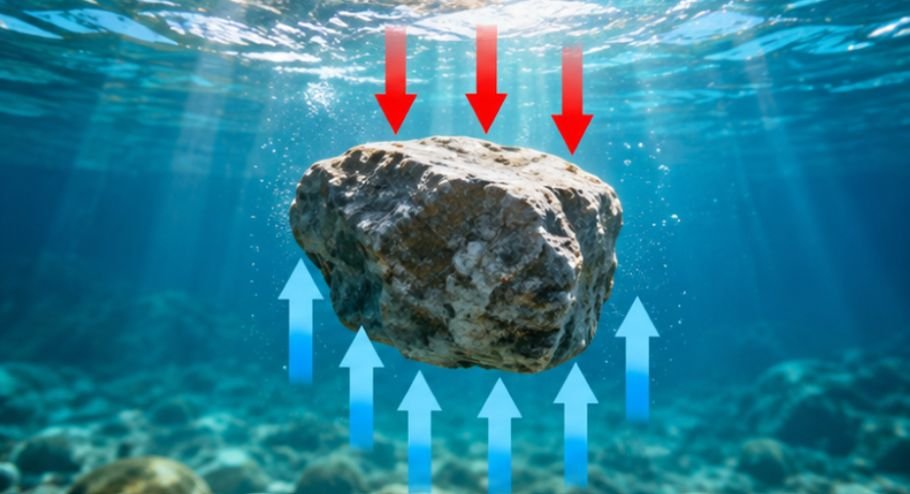
Fluid pressure increases with depth, so the bottom of a submerged object is pushed upward more strongly than the top is pushed downward. That pressure difference creates a net upward force.
OpenStax University Physics notes that buoyant force exists whether an object floats, sinks, or remains suspended. NASA’s Archimedes’ Principle resource likewise explains buoyancy through the weight of displaced fluid.
A denser fluid contains more mass in the same volume, so equal displaced volumes produce greater buoyant force in the denser fluid.
| Symbol | Meaning | SI Unit |
| Fb | Buoyant force | newtons (N) |
| ρ | Fluid density | kg/m³ |
| V | Displaced fluid volume | m³ |
| g | Gravitational acceleration | m/s² |
Near Earth’s surface, most problems use g = 9.81 m/s² unless another value is specified.
How to Calculate Buoyant Force With Density Step by Step
1. Find the Fluid Density
Use the density of the liquid or gas around the object, not the object’s density.
Fresh water is commonly approximated as 1,000 kg/m³ in introductory physics. UC Santa Barbara’s Archimedes’ principle demonstration notes that water at 25°C is closer to 0.997 g/mL, or about 997 kg/m³, showing why temperature can matter when higher precision is required.
2. Determine the Displaced Volume
If an object is completely submerged, displaced volume equals its submerged volume. If it floats partly above the surface, use only the volume below the fluid line.
This distinction is crucial. The equation does not automatically use the object’s total volume. Archimedes’ principle applies to both partially and completely submerged objects.
3. Convert Units Before Calculating
The cleanest form of the equation uses SI units. In the United States, however, volume may be given in gallons, cubic inches, or cubic feet.
The NIST SI conversion guide lists 1 US gallon as approximately 3.785412 × 10⁻³ m³. Convert customary units before combining them with density in kg/m³.
4. Multiply the Three Values
Calculate:
Fb = ρVg
Then check whether the result makes physical sense. Increasing fluid density or displaced volume should increase buoyant force.
Worked Example: A Fully Submerged Object
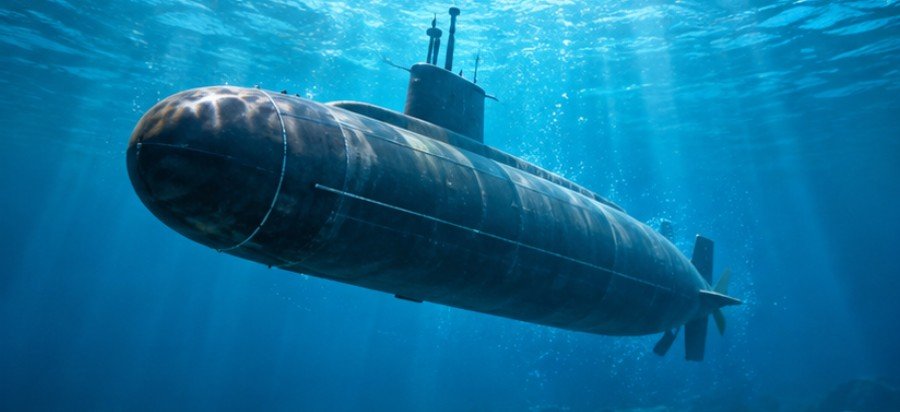
Suppose a sealed device is completely submerged in fresh water and displaces 0.018 m³.
ρ = 1,000 kg/m³
V = 0.018 m³
g = 9.81 m/s²
Fb = 1,000 × 0.018 × 9.81
Fb = 176.58 N
The water pushes upward with about 177 newtons.
Notice that the object’s mass is not needed to calculate buoyancy. Mass becomes important when comparing buoyant force with the object’s weight to determine whether it rises or sinks.
US Example: Volume Given in Gallons
Suppose a flotation component has 2.5 US gallons submerged in fresh water.
Convert the volume first:
2.5 × 0.003785412 = 0.00946353 m³
Then calculate:
Fb = 1,000 × 0.00946353 × 9.81
Fb ≈ 92.8 N
That equals roughly 20.9 pounds-force of upward support.
This conversion is particularly useful in US boating and dock problems, where flotation capacities are often expressed in customary units.
Floating Objects Require One Extra Idea
For a freely floating object at rest, buoyant force equals the object’s weight. The object settles until it displaces enough fluid for the forces to balance.
An 8 kg floating object has a weight of:
W = mg = 8 × 9.81 = 78.48 N
Its buoyant force is therefore also 78.48 N. Solving backward for displaced volume:
V = Fb ÷ (ρg)
V = 78.48 ÷ (1,000 × 9.81) = 0.008 m³
So it must displace 8 liters of fresh water.
This explains why shape matters: a hollow hull can displace enough water for a vessel made from dense materials to float.
Fluid Density vs. Object Density
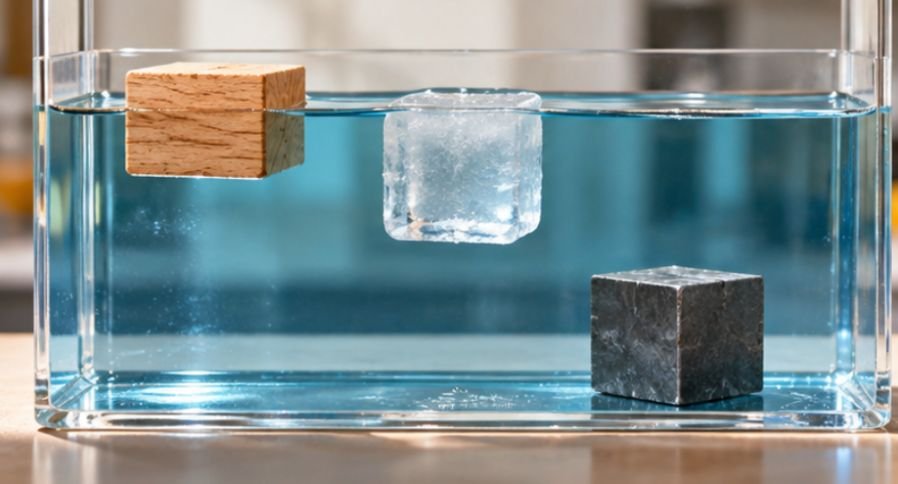
These two densities answer different questions.
Fluid density belongs in the buoyant-force equation. Object density helps predict whether the object will float or sink. OpenStax explains that an object with a lower average density than the surrounding fluid can float, while a denser object tends to sink.
That is also why saltwater generally provides more buoyant support than fresh water: greater fluid density means more displaced mass for the same submerged volume.
Three Common Mistakes That Change the Answer
The first mistake is using object density instead of fluid density. The second is using total object volume when only part is submerged. The third is mixing units, such as gallons with kg/m³.
The same attention to choosing the correct quantities and avoiding common calculation mistakes is useful when learning how to solve projectile motion problems step by step.
Another misconception is that a fully submerged rigid object automatically becomes more buoyant as it goes deeper. In a uniform, nearly incompressible fluid, both top and bottom pressures rise with depth, but the pressure difference responsible for buoyancy remains tied to displaced volume.
Boston University’s pressure and buoyancy resource shows the relationship between displaced-fluid weight, density, volume, and buoyant force.
A Fast Check for Any Buoyancy Problem

Before accepting the result, confirm four things: you used fluid density, you used submerged volume, your units are compatible, and your answer is in newtons.
Then compare buoyant force with weight. The same habit of identifying the forces and checking the system applies to conservation of momentum problems with collisions, where you compare total momentum before and after an interaction.
If Fb exceeds weight, the net force is upward. If Fb is smaller, the object tends to sink. If they are equal, the object is in vertical equilibrium.
A related useful equation is:
Apparent weight = actual weight − buoyant force
This is why objects seem lighter underwater.
Frequently Asked Questions
1. What is the buoyant force formula using density?
Use Fb = ρVg, where ρ is fluid density, V is displaced fluid volume, and g is gravitational acceleration.
2. Do I use object density or liquid density?
Use the surrounding fluid’s density in the buoyant-force formula. Object density is mainly useful for predicting whether something floats or sinks.
3. Does buoyant force increase with depth?
Not for a rigid object of unchanged volume in a uniform incompressible fluid. Pressure rises with depth, but the pressure difference creating buoyancy remains essentially unchanged.
4. What if only half the object is underwater?
Use only the submerged half of its volume as V. The formula depends on displaced fluid volume, not total object size.
The Takeaway
Buoyancy looks complicated because pressure, density, volume, and weight appear at once. But the calculation itself is straightforward. Once fluid density and displaced volume are known, how to calculate buoyant force with density comes down to ρ × V × g. The real skill is choosing the correct fluid density, identifying only the submerged volume, and converting units before multiplying. Get those details right, and the same method works for a physics assignment, floating dock, boat hull, or submerged piece of equipment.
Leave a Reply