
Staring down a gnarly calculus product inside an integral sign can ruin anyone’s afternoon. When standard $u$-substitution fails, practice problems for integration by parts are the ultimate remedy to build genuine pattern recognition.
Let’s break down the strategy, look at the reference frameworks, and dive into targeted problem sets.
The Engine Behind the Formula

Integration by parts stems directly from the product rule of differentiation. The foundational formula states:
$$\int u \, dv = uv – \int v \, du$$
Choosing your $u$ and $dv$ correctly determines whether your integral collapses into a simple solution or spirals into an infinite loop. For most US curriculum courses, relying on the ILATE priority mnemonic (Inverse trigonometric, Logarithmic, Algebraic, Trigonometric, Exponential) streamlines the selection process:
| Priority Rank | Function Type | Example | Best Choice For |
| 1 | Inverse Trigonometric | $\arctan(x), \arcsin(x)$ | $u$ (differentiates into algebraic) |
| 2 | Logarithmic | $\ln(x), \log_2(x)$ | $u$ (eliminates logs entirely) |
| 3 | Algebraic | $x^2, 3x, 5$ | $u$ or $dv$ (depending on pairing) |
| 4 | Trigonometric | $\sin(x), \cos(x)$ | $dv$ (easy to integrate cleanly) |
| 5 | Exponential | $e^x, 5^x$ | $dv$ (survives integration smoothly) |
Single-Application and Multi-Step Practice Sets
To bridge the gap between theory and exam-day execution, work through these categorized problem tiers. If you find polynomial terms getting mixed up with expansion steps here, you might want to briefly review core concepts like quadratic equations to ensure your foundational algebra is airtight.
Mastering this technique feels less like memorizing black magic and more like unlocking a puzzle. Just as you need foundational fluency in algebraic manipulation or understanding matrix multiplication rules before tackling advanced linear algebra, conquering integration demands getting comfortable with the core product rule backward.
Basic Single-Step Drills
These exercises require a single application of the formula where $u$ quickly breaks down upon differentiation.
- Problem 1: Evaluate $\int x e^{5x} \, dx$
- Problem 2: Evaluate $\int x \cos(x) \, dx$
- Problem 3: Evaluate $\int x \sec^2(x) \, dx$
- Problem 4: Evaluate $\int \ln(x) \, dx$ (Hint: Let $u = \ln(x)$ and $dv = dx$)
Repeated Integration and Cyclical Loops
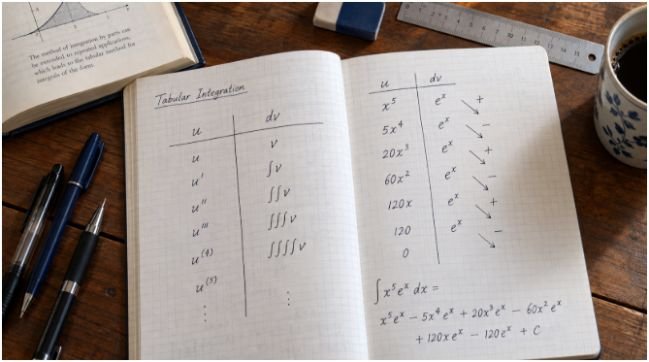
When dealing with higher powers or functions that never disappear—like exponentials multiplied by sines—you must apply the formula multiple times or use the tabular method.
- Problem 5: Evaluate $\int x^2 e^x \, dx$
- Problem 6: Evaluate $\int t^2 \sin(2t) \, dt$
- Problem 7: Evaluate $\int e^x \sin(x) \, dx$ (The classic “boomerang” loop integral)
Pro-Tip From the Trenches

Expert Insight: When tackling cyclical integrals like Problem 7, do not panic when the original integral reappears on the right side of your equation with a negative sign.
Treat the expression like an algebraic unknown $I$, add it to both sides, and divide by the coefficient. It is a deliberate mathematical design, not a mistake.
Frequently Asked Questions
1. What is the easiest way to remember the ILATE rule?
ILATE stands for Inverse trig, Logarithmic, Algebraic, Trigonometric, and Exponential, guiding which term to assign as $u$.
2. When should I use tabular integration instead of standard parts?
Use the tabular (D-I) method when your $u$ term is a polynomial power that hits zero after successive differentiation.
3. Can integration by parts solve definite integrals?
Yes, evaluate the $uv$ component across your upper and lower limits before subtracting the evaluated resulting integral.
4. What if my integral has no obvious second function?
Multiply the integrand by $1$, assigning $dv = dx$ and $u = \ln(x)$ or $\arctan(x)$.
Wrapping Up Our Calculus Journey
Tackling integration by parts without a plan is a fast track to algebraic burnout, but structured repetition turns confusion into muscle memory. Grab a pencil, work through these drills line by line, and watch those intimidating products start to unravel.