
Struggling to make sense of why matrix multiplication refuses to follow standard arithmetic? You are not alone. When I first encountered linear algebra, multiplying arrays felt less like math and more like a bizarre code. Unlike regular numbers, you cannot just multiply matching positions side by side. Success requires understanding strict structural dimensions and executing a precise row-by-column dance.
1. The Core Compatibility Rule
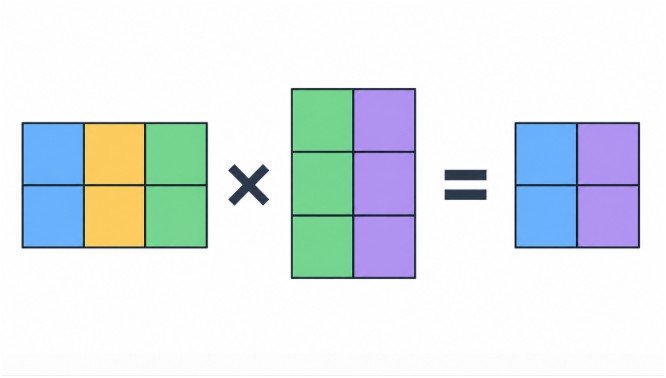
Before you perform any calculations, you must ask a fundamental question: Are these matrices even compatible? Size is always defined by Rows × Columns.
Dimensional Alignment
The golden rule of matrix scaling states that the number of columns in your first matrix must match the number of rows in your second matrix.
If you write their dimensions side by side, the inner numbers must match identically. The outer numbers reveal the exact dimensions of your final output matrix.
If you have ever solved quadratic equations or worked through complex calculus derivatives, you know that setup dictates everything. Matrices are no different; miss a dimension check, and the entire equation breaks down.
| Matrix A Dimension | Operation | Matrix B Dimension | Resulting Output Dimension | Compatibility Status |
| $2 \times 3$ | $\times$ | $3 \times 2$ | $2 \times 2$ | Valid ($3 = 3$) |
| $3 \times 3$ | $\times$ | $4 \times 2$ | None | Invalid ($3 \neq 4$) |
| $n \times m$ | $\times$ | $m \times p$ | $n \times p$ | Valid ($m = m$) |
2. The Mechanics: The Row-by-Column Routine
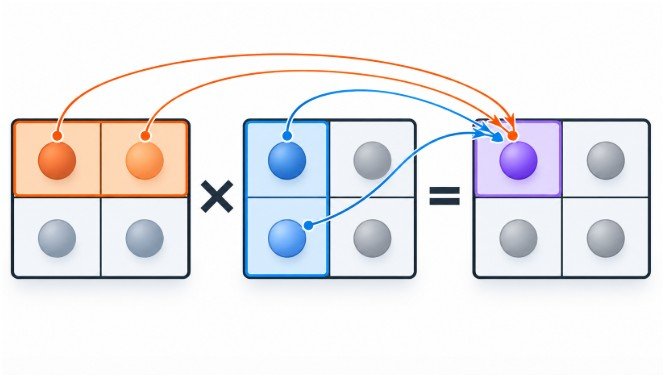
Once compatibility is confirmed, you execute the “over and down” method. For every position in your destination grid, you take a row from the left matrix and a column from the right matrix, multiply corresponding elements, and sum them up.
Step-by-Step Execution
Consider two $2 \times 2$ matrices, $A$ and $B$, where $A = \begin{bmatrix} 2 & -2 \\ 5 & 3 \end{bmatrix}$ and $B = \begin{bmatrix} -1 & 4 \\ 7 & -6 \end{bmatrix}$.
To find the top-left entry of your product matrix, multiply Row 1 of $A$ by Column 1 of $B$:
$2(-1) + (-2)(7) = -2 – 14 = -16$
Repeat this dot product routine for every coordinate quadrant to build the final grid.
| Output Grid Position | Row & Column Pairing | Mathematical Calculation | Final Value |
| Top-Left | Row 1 of $A \times$ Col 1 of $B$ | $(2 \times -1) + (-2 \times 7)$ | $-16$ |
| Top-Right | Row 1 of $A \times$ Col 2 of $B$ | $(2 \times 4) + (-2 \times -6)$ | $20$ |
| Bottom-Left | Row 2 of $A \times$ Col 1 of $B$ | $(5 \times -1) + (3 \times 7)$ | $16$ |
| Bottom-Right | Row 2 of $A \times$ Col 2 of $B$ | $(5 \times 4) + (3 \times -6)$ | $2$ |
The resulting product matrix becomes $\begin{bmatrix} -16 & 20 \\ 16 & 2 \end{bmatrix}$.
3. Core Properties and Structural Quirks

Matrix arithmetic ignores several standard rules from basic algebra. Keeping these algebraic boundaries clear prevents costly errors during advanced data modeling.
- Non-Commutativity: Order strictly dictates outcome. $AB$ rarely equals $BA$; flipping the sequence often renders the multiplication entirely illegal.
- Associativity: Grouping does not change the product. For any three compatible matrices, $(AB)C = A(BC)$.
- Distributivity: Matrices distribute seamlessly over addition, meaning $A(B + C) = AB + AC$.
- The Identity Matrix: Multiplying a matrix by the identity matrix ($I$)—which features ones along the main diagonal and zeros everywhere else—leaves the original matrix unchanged ($AI = IA = A$).
Frequently Asked Questions
1. Can you multiply a larger matrix by a smaller one?
Yes, as long as the inner dimension rule holds true: the columns of the first matrix must match the rows of the second.
2. Why is matrix multiplication not commutative?
Because changing the order alters the row-and-column pairing geometry, completely shifting the resulting dot products.
3. What happens if you multiply by a zero matrix?
Multiplying any matrix by a zero matrix of matching dimensions results in a zero matrix.
4. Does matrix multiplication require square matrices?
No, rectangular matrices multiply smoothly as long as their inner link dimensions align.
Stay In Formation Or Get Left Behind
Mastering these clear lessons on matrix multiplication rules ensures you never stumble over misplaced dimensions again. Matrix math leaves zero room for sloppy alignment or careless arithmetic assumptions.
Double-check your inner dimensions before you pen a single calculation. Treat every row-by-column pairing with absolute precision, and you will unlock the true power of linear algebra without breaking a sweat.