
Mastering calculus requires a clear grasp of how a curve shifts at any precise microscopic coordinate. When tracking step by step calculus derivatives examples, learning the mechanics behind foundational formulas prevents common algebraic errors. Calculus shapes real-world optimizations, machine learning gradient descents, and physics modeling.
Foundational Derivative Rules
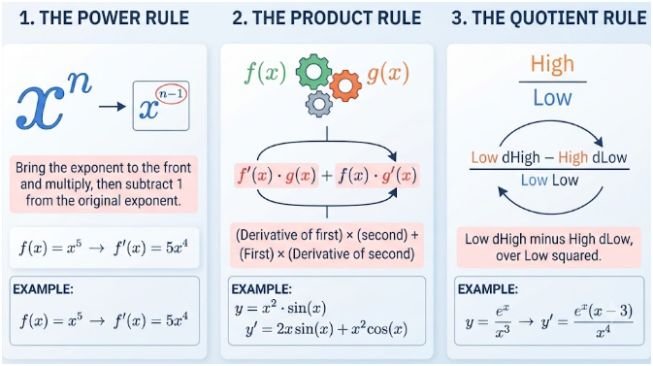
Navigating differential calculus relies on a core toolkit of operational formulas. Applying these mechanics correctly streamlines even the most complex expressions.
The Power Rule
The Power Rule governs any variable raised to a static exponent. Bring the exponent to the front as a coefficient and subtract one from the original power.
- Formula: dxd[xn]=nxn−1
- Example: Find the derivative of f(x)=x4.
- Identify the exponent n=4.
- Multiply by the front coefficient: 4x.
- Subtract one from the exponent (4−1=3), yielding 4×3.
The Product and Quotient Rules
When two independent expressions multiply or divide, standard single-term rules fail. The product rule evaluates combinations, while the quotient rule handles rational functions.
Math is Fun
- Product Rule Formula: dxd[f(x)g(x)]=f′(x)g(x)+f(x)g′(x)
- Quotient Rule Formula: dxd[g(x)f(x)]=[g(x)]2f′(x)g(x)−f(x)g′(x)
Reference Guide: Core Derivative Rules
| Rule Name | Function Form | Derivative Result |
| Power Rule | xn | nxn−1 |
| Product Rule | f(x)⋅g(x) | f′(x)g(x)+f(x)g′(x) |
| Quotient Rule | g(x)f(x) | [g(x)]2f′(x)g(x)−f(x)g′(x) |
| Chain Rule | f(g(x)) | f′(g(x))⋅g′(x) |
For extensive advanced rule breakdowns and proofs, review authoritative resources like Paul’s Online Math Notes or consult interactive calculation guides on Math is Fun. Additional standard formulas can also be referenced via comprehensive repositories like Derivative Formulas PDF Documentation.
Advanced Differentiation: The Chain Rule
Composite functions—where an entire equation sits trapped inside another layer—require the Chain Rule. Differentiate the outer shell completely while keeping the inner core untouched, then multiply by the inner layer’s derivative.
Worked Composite Example
Find the derivative of y=(5×3+2)7.
- Step 1: Treat the parentheses as an outer placeholder to get 7(inside)6.
- Step 2: Differentiate the inner function (5×3+2), which evaluates to 15×2.
- Step 3: Multiply them together: y′=7(5×3+2)6⋅(15×2).
- Step 4: Simplify coefficients to reach the final answer: 105×2(5×3+2)6.
Frequently Asked Questions
1. What is a derivative in plain English?
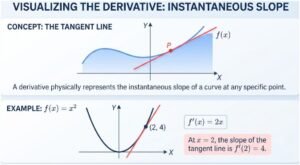
It measures the exact instantaneous rate of change or slope of a curve at any specific point.
Math is Fun
2. How do I know when to use the Chain Rule?
Use it anytime a function is nested inside another function, such as a trigonometric expression with an inner variable exponent.
3. Can a derivative be zero?
Yes, the derivative of any constant number is always zero because flat horizontal lines have no slope.
4. Where can I practice more problems?
Interactive problem sets are widely available through educational math platforms like Khan Academy Calculus.
Conclusion: Keep Derivatives Differentiated
Calculus is less about memorizing abstract symbols and more about recognizing structural patterns. Tackle complex functions by peeling back layers methodically rather than rushing the algebra. Grab a pencil, map out your inner and outer functions, and start solving your next equation today.