Mindblown: a blog about philosophy.
-

How to Use Flashcards for Exam Preparation
I used to think a thick stack of flashcards meant I was ready for an exam. Then I would recognize every answer during revision but struggle to produce one without a hint. The problem was not the cards themselves. I was reading them instead of testing my memory. Learning how to use flashcards for exam…
-

How to Prepare for Final Exams in College: A Study Plan That Works
When several exams land in the same week, I find that “study harder” is not a useful plan. I need to know what each exam covers, where I am losing marks, and what I can realistically finish before test day. That is where how to prepare for final exams in college becomes a practical question…
-

How to Stay Motivated During Exam Preparation When You Feel Stuck
I know how easy it is to make an ambitious study plan when an exam feels far away. A few weeks later, the chapters seem endless, practice scores may barely move, and even opening a textbook takes effort. When I think about how to stay motivated during exam preparation, I start by making the next…
-

Study Strategies for Students Taking Online Courses for Smarter Learning
Online classes give college students flexibility, but that freedom can quickly become a problem without structure. I have found that studying online requires more self-discipline than simply logging into a course portal and watching lectures whenever I have time. Without the physical routine of walking into a classroom, I have to create my own schedule,…
-
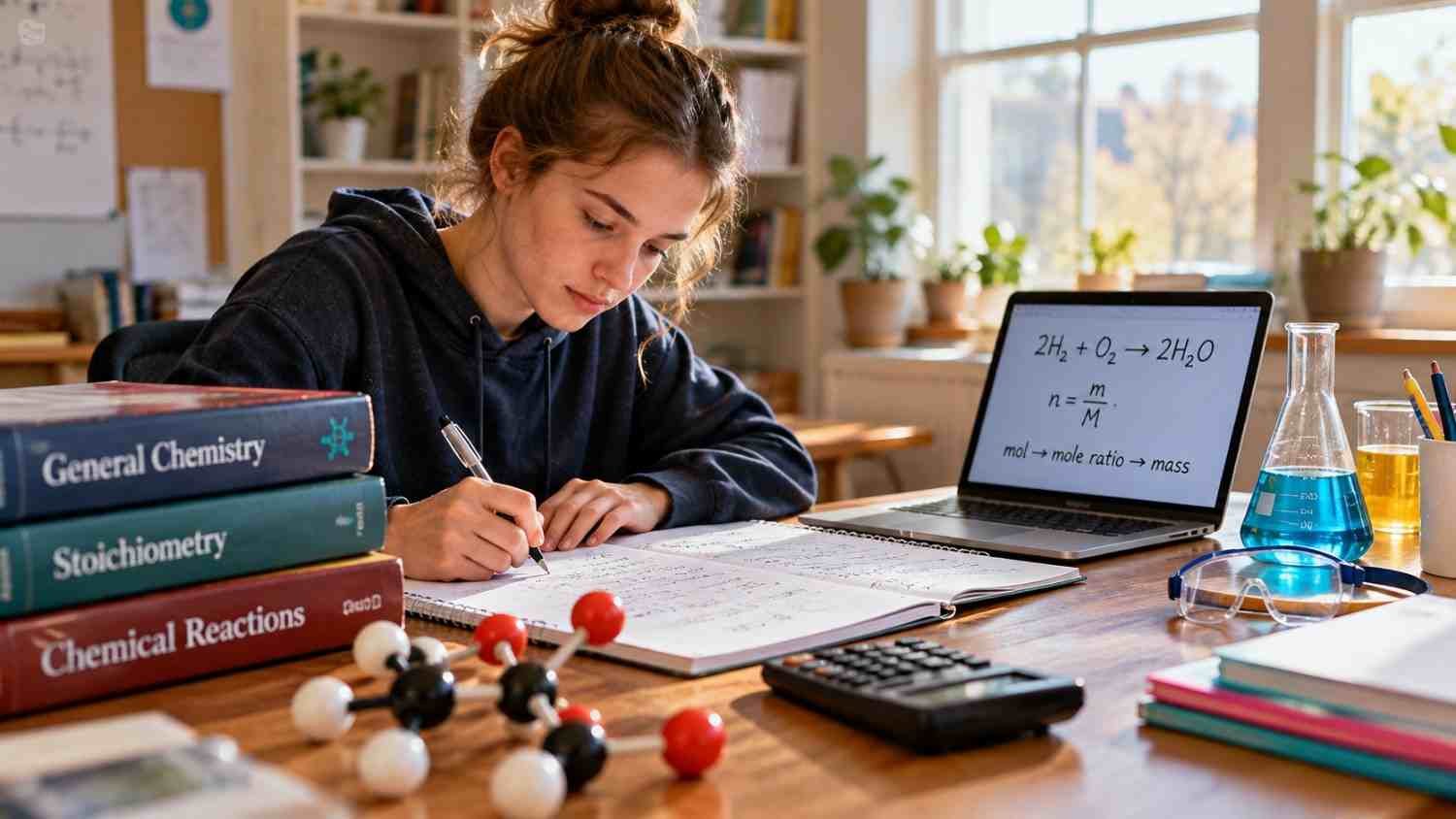
Chemistry Stoichiometry Problems With Worked Solutions for Better Practice
I used to think stoichiometry was mostly about remembering formulas. After working through a few chemistry problems, I noticed the harder part was usually figuring out which quantity mattered first and how the units connected. I also found that a problem could look intimidating until I wrote the balanced equation and treated the calculation as…
-

How to Study Effectively in Short Time Blocks When Every Minute Counts
Between classes, assignments, a part-time job, commuting, and everything else college life can throw at me, I do not always have two uninterrupted hours available for studying. That does not mean a 15- or 20-minute window has to go to waste. Once I learned how to study effectively in short time blocks, I stopped measuring…
-

How to Calculate Enthalpy Changes in Chemistry Using Key Formulas
I first found enthalpy confusing because several formulas seemed to describe the same thing. Once I connected each equation to the kind of information given in a problem, the calculations became much easier. I started asking one question: what data do I have? I also noticed that most mistakes came from signs, coefficients, units, or…
-

How to Prepare for Back-to-Back College Exams Without Burning Out
Back-to-back finals can turn a normal college week into a test of memory, time management, and stamina. I have found that the worst approach is treating each exam as a separate emergency and cramming for them one after another. A better strategy is to triage what matters, rotate subjects intelligently, and save enough mental energy…
-

How To Find The Inverse Of A Matrix: A Practical Linear Algebra Guide
Computing the inverse of a matrix can feel like navigating a maze of rigid algebraic rules without a map. Over years of working through advanced linear algebra models and data transformations, I realized that understanding the core mechanics—rather than just memorizing formulas—makes all the difference. When you multiply a square matrix by its inverse, the…
-

Sustainable Chemistry Principles Explained: Core Concepts, Benefits, and Applications
I started noticing how often chemistry is described as successful simply because a reaction produces the desired compound. That definition feels incomplete once you consider solvent, unused reactants, energy, and waste. A reaction can work in a flask and still create avoidable problems elsewhere. I realized that sustainable chemistry asks a more useful question: can…
Got any book recommendations?