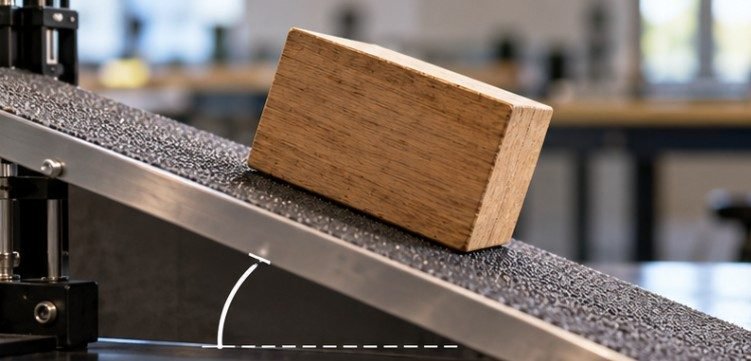
A useful surprise about a block sliding down a rough ramp is that its mass can disappear from the final acceleration equation. A 2-kg block and a 20-kg block can accelerate identically when they move on the same incline with the same coefficient of kinetic friction. This happens because both the component of gravity pulling the block down the slope and the friction resisting its motion increase in proportion to the block’s mass. When Newton’s second law is applied, those mass factors cancel.
That cancellation is more than a mathematical curiosity. It reveals a simple and reliable way to approach inclined plane problems with friction. Instead of working with the block’s weight in its original vertical direction, rotate the coordinate system so that one axis runs parallel to the slope and the other points perpendicular to it. This separates the forces into manageable components, making it easier to identify the forces causing motion, calculate friction, and determine the block’s acceleration without unnecessary complexity.
Start With the Ramp, Not the Equations
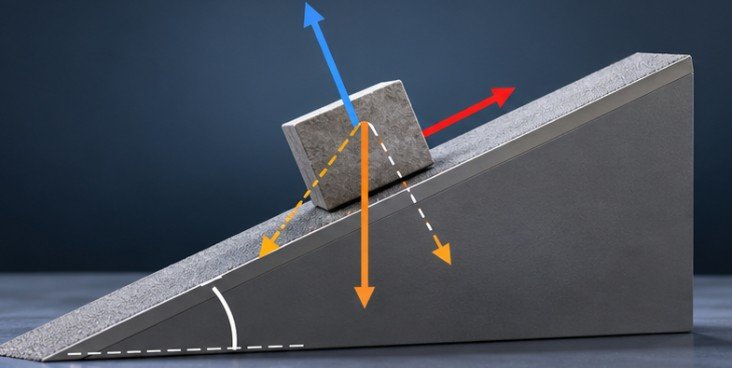
Begin with a free-body diagram. Draw the object, then add only the real forces acting on it: weight mgmg vertically downward, the normal force NN perpendicular to the surface, friction parallel to the surface, and any applied force or tension in the problem.
Georgia Tech’s inclined-plane treatment uses the same approach, resolving forces along and perpendicular to the ramp before applying Newton’s second law. Georgia Tech Physics Book: Inclined Plane The advantage is practical: the object normally has no acceleration through the surface, so the perpendicular direction is usually solved first.
Friction opposes relative motion or the tendency to move. If a block slides down, kinetic friction points up the ramp. If the block is being pulled upward, friction points down the ramp.
Rotate the Axes and Split Gravity
Let the ramp make an angle θ\theta above the horizontal. Resolve gravity relative to the incline:
- Parallel to the ramp: mgsinθmg\sin\theta
- Perpendicular to the ramp: mgcosθmg\cos\theta
University of Tennessee physics materials show why this works: the perpendicular component of gravity is balanced by the surface’s normal force when there is no acceleration away from or into the plane. You can take help of flash cards to remember better.
For a block with no other force pushing into or pulling away from the surface,
N=mgcosθN=mg\cos\theta
That quadratic equation solving is not universal. If someone pushes down on the block at an angle, pulls upward at an angle, or another force has a perpendicular component, the normal force changes.
Decide Whether Friction Is Static or Kinetic
This is where many otherwise correct solutions fail. Kinetic friction applies when the surfaces slide relative to one another:
fk=μkNf_k=\mu_kN
Static friction applies when the surfaces are not sliding, but it is not automatically equal to μsN\mu_sN:
fs≤μsNf_s\leq\mu_sN
OpenStax explains that static friction adjusts to the value needed to prevent slipping, up to a maximum of μsN\mu_sN. Only at the threshold of motion does fs=μsNf_s=\mu_sN.
| Situation | Friction rule | Key question |
| Block sliding | fk=μkNf_k=\mu_kN | Which way is the block moving? |
| Block at rest | fs≤μsNf_s\leq\mu_sN | How much friction is actually required? |
| About to slip | fs=μsNf_s=\mu_sN | Has static friction reached its maximum? |
Apply Newton’s Second Law Along the Ramp
Suppose the block slides down the incline. Choose downhill as positive:
mgsinθ−fk=mamg\sin\theta-f_k=ma
Substitute fk=μkmgcosθf_k=\mu_kmg\cos\theta:
mgsinθ−μkmgcosθ=mamg\sin\theta-\mu_kmg\cos\theta=ma
Cancel mm:
a=g(sinθ−μkcosθ)a=g(\sin\theta-\mu_k\cos\theta)
This result applies to a block sliding freely down a rough incline with no other applied forces.
Worked Example: An 8-kg Block on a 30° Ramp
Assume m=8 kgm=8\text{ kg}, θ=30∘\theta=30^\circ, μk=0.20\mu_k=0.20, and g=9.81 m/s2g=9.81\text{ m/s}^2.
First find the normal force:
N=(8)(9.81)cos30∘≈67.97 NN=(8)(9.81)\cos30^\circ\approx67.97\text{ N}
Then calculate kinetic friction:
fk=(0.20)(67.97)≈13.59 Nf_k=(0.20)(67.97)\approx13.59\text{ N}
The downhill component of gravity is
mgsin30∘=(8)(9.81)(0.5)=39.24 Nmg\sin30^\circ=(8)(9.81)(0.5)=39.24\text{ N}
So the net downhill force is 39.24−13.59=25.65 N39.24-13.59=25.65\text{ N}, giving
a=25.658≈3.21 m/s2a=\frac{25.65}{8}\approx3.21\text{ m/s}^2
A useful check is the frictionless value, gsin30∘=4.905 m/s2g\sin30^\circ=4.905\text{ m/s}^2. Friction should reduce the acceleration, and the result does.
Check Whether a Stationary Block Will Slide
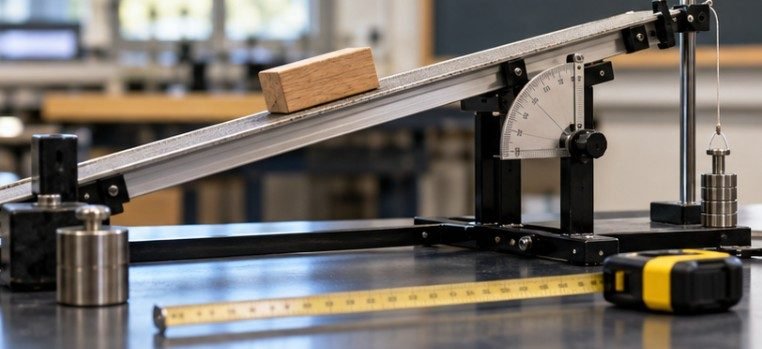
For a block resting on a ramp, gravity tries to pull it downhill with mgsinθmg\sin\theta. Maximum static friction is
fs,max=μsmgcosθf_{s,\max}=\mu_smg\cos\theta
The block stays at rest if
mgsinθ≤μsmgcosθmg\sin\theta\leq\mu_smg\cos\theta
Cancel mgmg:
tanθ≤μs\tan\theta\leq\mu_s
At the exact angle where slipping begins,
μs=tanθ\mu_s=\tan\theta
The Feynman Lectures at Caltech discusses this inclined-plane relationship as a way to connect the onset of sliding with the coefficient of friction.If μs=0.60\mu_s=0.60, for example, the threshold angle is about 31∘31^\circ.
Mistakes That Produce the Wrong Answer

A common mistake is writing N=mgN=mg. That works on a level surface with no additional vertical forces, but on a simple incline the correct expression is N=mgcosθN=mg\cos\theta.
Another error is making friction oppose gravity rather than motion. Friction does not automatically point uphill. If an external force drives the object up the incline, friction points downhill.
Also watch for ropes, pushes, springs, or angled forces. Those can change both the parallel force balance and the normal force, so the shortcut equations may no longer apply.
Finally, f=μNf=\mu N is a simplified model. Real friction depends on materials and surface conditions. The University of Rhode Island’s inclined-plane laboratory notes that the coefficient characterizes the interacting surfaces, which is why experimental values can differ from ideal textbook numbers.
Frequently Asked Questions
1. What is the fastest way to solve inclined plane problems with friction?
Rotate the axes to match the slope, find NN, determine the correct friction force, then apply Newton’s second law parallel to the incline.
2. Why is the normal force mgcosθmg\cos\theta on an incline?
Because only the perpendicular component of weight pushes into the surface. If no other perpendicular forces act, the surface balances that component.
3. Does static friction always equal μsN\mu_sN?
No. Static friction takes the value needed to prevent motion, up to a maximum of μsN\mu_sN. Equality applies only at impending slip.
4. Can friction point down the incline?
Yes. If the object moves or tends to move up the ramp, friction acts down the ramp because it opposes relative motion.
The Best Check Is Physical, Not Algebraic
Prep right for every exam in college with these solutions, I treat every ramp problem as a force-direction problem before treating it as an equation problem. The algebra is usually short once the diagram is right.
If the calculated acceleration exceeds the frictionless value without an extra driving force, the signs are probably wrong. If static friction must exceed its maximum, the object cannot remain at rest. And if the normal force ignores an angled applied force, revisit the perpendicular direction. The durable habit is simple: align the axes with the surface, let friction oppose the actual tendency to move, and let Newton’s second law do the rest.
Leave a Reply