A wrong angle can spoil an otherwise perfect polar-form answer. I see it most often when a student finds the right reference angle but forgets the quadrant. These complex numbers polar form practice problems start with conversions, then build toward multiplication, powers, and roots. Each solution shows enough working to help you spot where an error began.
The equations below use plain text and standard math symbols, so you can paste them directly into Google Docs. Angles are in radians unless stated otherwise.
Formulas to Keep Beside You
A complex number has rectangular form z = x + yi. Its polar form describes the same point using a distance r and an angle θ:
z = r(cos θ + i sin θ) = r cis θ
r = √(x² + y²)
x = r cos θ y = r sin θ
Here, r is the modulus and θ is an argument. I use −π < θ ≤ π for principal arguments. An answer in 0 ≤ θ < 2π is equally valid when it points in the same direction. For example, −5π/6 and 7π/6 describe the same angle after a full turn.
Find the quadrant from the signs of x and y before choosing θ. Calculating arctan(y/x) alone can give the wrong direction. The zero complex number has modulus 0, but its argument is undefined, so it has no unique polar angle. OpenStax explains these conversions and the related operations in its polar form lesson.
Rectangular and Polar Form Practice
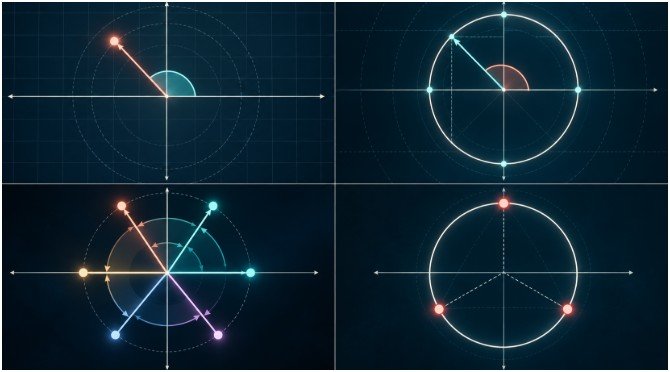
Problems 1–4: Find the Modulus and Argument
Problem 1. Convert 1 + √3i to polar form.
r = √(1² + (√3)²) = √4 = 2
The point lies in Quadrant I. Its reference angle is π/3, so:
Answer: 1 + √3i = 2(cos(π/3) + i sin(π/3))
Problem 2. Convert −5 + 5i to polar form.
r = √((−5)² + 5²) = √50 = 5√2
The coordinates place the point in Quadrant II. Its reference angle is π/4, making θ = 3π/4.
Answer: −5 + 5i = 5√2(cos(3π/4) + i sin(3π/4))
Problem 3. Convert −√3 − i to polar form.
r = √((−√3)² + (−1)²) = 2
This point lies in Quadrant III. The reference angle is π/6. In our chosen principal-argument interval, θ = −5π/6.
Answer: −√3 − i = 2(cos(−5π/6) + i sin(−5π/6))
You may also write 7π/6 if your class uses angles from 0 to 2π.
Problem 4. Convert −4i to polar form.
The point sits on the negative imaginary axis, four units from the origin. It points straight down, so θ = −π/2.
Answer: −4i = 4(cos(−π/2) + i sin(−π/2))
Axis cases deserve a pause. Dividing y by x here would mean dividing by zero. The point’s position gives the angle directly.
Problems 5–7: Convert Polar Form to Rectangular Form
For these complex numbers polar form practice problems, evaluate the cosine and sine, then multiply each by r. Khan Academy’s polar-to-rectangular explanation shows the same coordinate relationship visually.
Problem 5. Convert 4(cos(π/4) + i sin(π/4)).
cos(π/4) = √2/2 and sin(π/4) = √2/2.
Answer: 4(√2/2 + i√2/2) = 2√2 + 2√2i
Problem 6. Convert 6(cos(4π/3) + i sin(4π/3)).
Both coordinates are negative at 4π/3:
cos(4π/3) = −1/2 sin(4π/3) = −√3/2
Answer: 6(−1/2 − i√3/2) = −3 − 3√3i
Problem 7. Convert 2 cis(−π/6).
cis(−π/6) = cos(−π/6) + i sin(−π/6) = √3/2 − i/2
Answer: 2 cis(−π/6) = √3 − i
Multiplication and Division in Polar Form
Problem 8: Use Angles Instead of Expanding Brackets
Let z₁ = 6 cis(5π/6) and z₂ = 2 cis(π/3). Find z₁z₂ and z₁/z₂.
When I multiply polar-form numbers, I multiply their moduli and add their angles:
z₁z₂ = (6 × 2) cis(5π/6 + π/3)
z₁z₂ = 12 cis(7π/6)
Thus, z₁z₂ = 12(cos(7π/6) + i sin(7π/6)). If your answer needs a principal argument in −π < θ ≤ π, write 12 cis(−5π/6).
For division, I divide the moduli and subtract the angles:
z₁/z₂ = (6/2) cis(5π/6 − π/3)
z₁/z₂ = 3 cis(π/2) = 3i
That final rectangular answer is a useful check: cos(π/2) = 0, while sin(π/2) = 1. MIT OpenCourseWare also presents multiplication as adding angles and division as subtracting them in its complex numbers notes.
De Moivre’s Theorem Practice
Problem 9: Raise a Complex Number to a Power
Find (1 − i)¹⁰ in rectangular form.
First, write 1 − i in polar form. Its modulus is √2 and its angle is −π/4:
1 − i = √2 cis(−π/4)
De Moivre’s theorem raises the modulus to the power and multiplies the angle by it:
(1 − i)¹⁰ = (√2)¹⁰ cis(−10π/4)
(1 − i)¹⁰ = 32 cis(−5π/2) = 32 cis(−π/2)
Answer: (1 − i)¹⁰ = −32i
The last step uses coterminal angles: −5π/2 and −π/2 differ by −2π. Wolfram MathWorld gives the De Moivre identity behind this shortcut.
Problem 10: Find Every Cube Root
Find all cube roots of 8i.
Write 8i = 8 cis(π/2). Every cube root has modulus ∛8 = 2. To get all three angles, add a full turn before dividing by 3:
wₖ = 2 cis((π/2 + 2πk)/3), for k = 0, 1, 2
For k = 0: w₀ = 2 cis(π/6) = √3 + i
For k = 1: w₁ = 2 cis(5π/6) = −√3 + i
For k = 2: w₂ = 2 cis(3π/2) = −2i
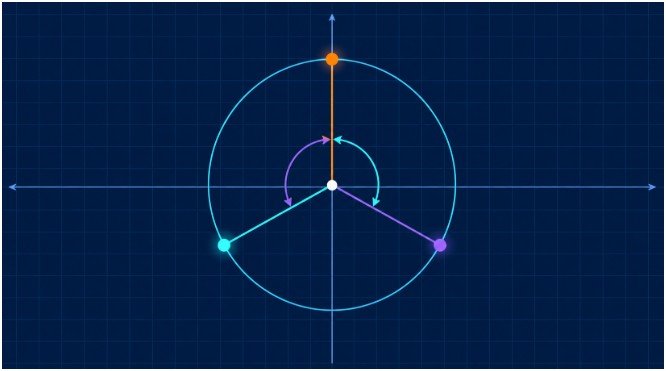
The answers sit equally spaced around a circle of radius 2. That spacing helps me notice a missing root before I finish. Roots of complex numbers also appear in later algebra topics; sequence and series formulas and examples of differential equations can provide useful next steps. Replace those suggested internal paths with your published page URLs.
A Fast Way to Check Your Answers
I use three checks on complex numbers polar form practice problems. First, confirm that the modulus is nonnegative and matches the point’s distance from the origin.
Next, confirm that the angle points into the correct quadrant or along the correct axis. For roots, substitute one answer back into the original equation.
Take w = −2i from Problem 10:
(−2i)³ = −8i³ = −8(−i) = 8i
That check catches a sign mistake that a polished-looking polar answer might hide. If you want more drills after these worked examples, try Khan Academy’s complex-plane polar-form practice.
FAQs
1. How do I find the correct quadrant in a polar-form problem?
Check the signs of the real and imaginary parts, then place the reference angle in that quadrant.
2. Can a complex number have more than one polar angle?
Yes. Adding any integer multiple of 2π gives another angle for the same nonzero complex number.
3. Why are there three cube roots of 8i?
Each value k = 0, 1, 2 gives a distinct angle; the next value repeats the first root.
4. Should I use degrees or radians for complex-number practice?
Use the unit your course requests. These examples use radians, which are common in precalculus.
The Angle Has the Last Word
I would redo Problems 2, 3, and 10 without looking at the solutions. They test the three errors I see most: choosing the wrong quadrant, mixing angle intervals, and leaving out a root. Find the modulus, draw a quick direction check, and only then commit to the angle. That small habit makes the longer calculations much easier to trust.
Leave a Reply