
I used to look at a Lewis structure and think I understood a molecule, only to realize that the flat drawing told me little about its shape. Once I started picturing electron groups around a central atom, molecular geometry became easier to understand. Instead of memorizing random shapes, I could see why atoms arrange themselves in particular directions.
I also noticed that a small change, such as adding a lone pair, can change the visible shape dramatically. Water and methane, for example, both have four electron regions around their central atoms, yet one is bent while the other is tetrahedral. VSEPR theory provides a simple way to understand that difference and make sense of molecules in three dimensions.
What Is VSEPR Theory?
VSEPR stands for Valence Shell Electron Pair Repulsion. It is a model chemists use to predict the three-dimensional arrangement of atoms around a central atom. Regions of electron density repel one another, so they arrange themselves as far apart as possible.
Those regions can come from bonding pairs or lone pairs. Because electrons are negatively charged, keeping electron-rich regions separated reduces repulsion and generally gives a lower-energy arrangement. VSEPR is a simplified model that works well for many common molecules.
If you are wondering why molecules have different shapes in chemistry, electron arrangement around the central atom is a major part of the answer.
How Electron Groups Control Shape
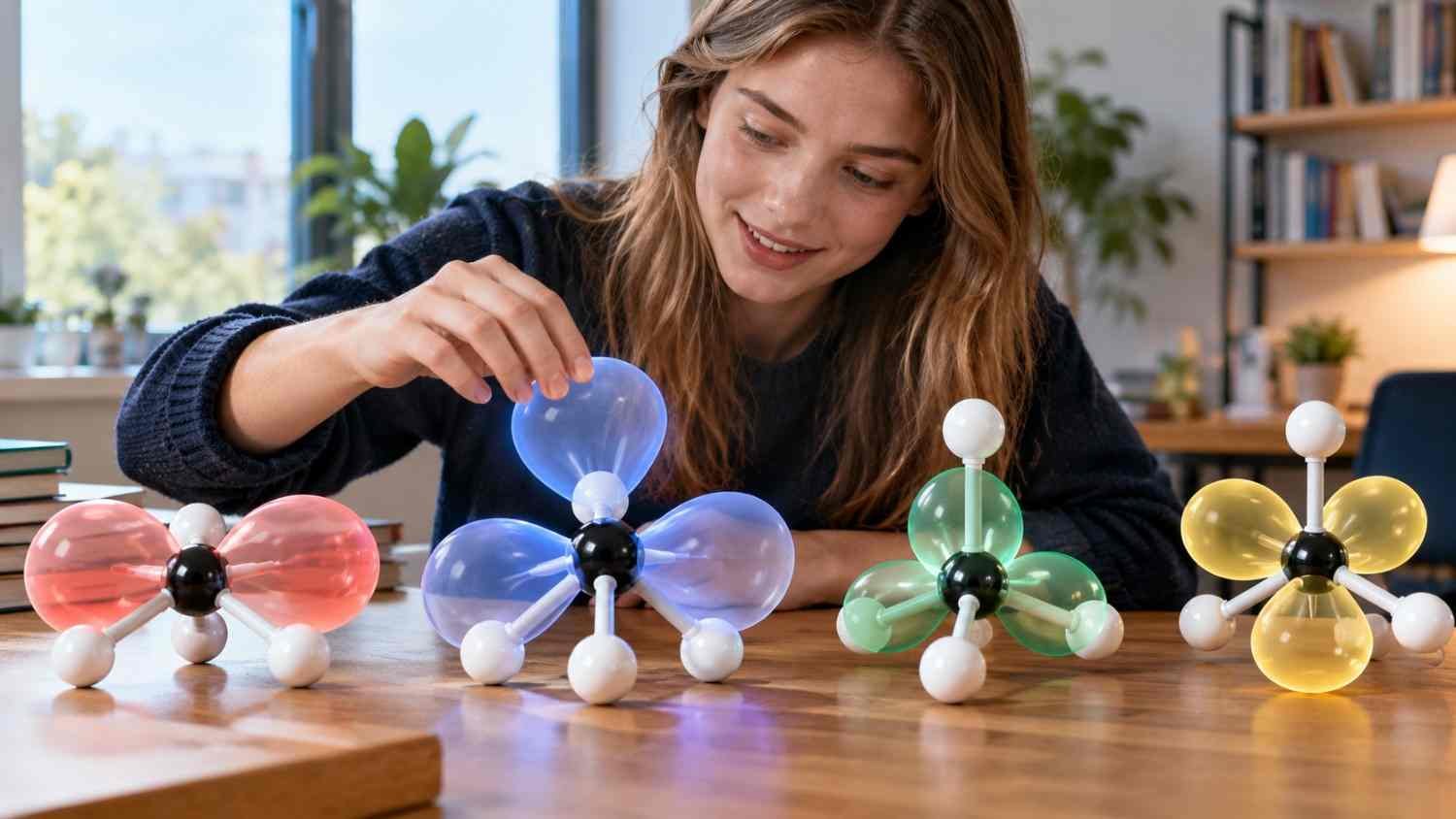
A single bond counts as one region, and so do double and triple bonds. Each lone pair on the central atom also counts as one region.
Carbon dioxide, CO2, has two electron regions around carbon because each carbon-oxygen double bond counts as one region. They produce a linear arrangement with an angle of about 180 degrees.
With three regions, the arrangement becomes trigonal planar, with ideal angles of about 120 degrees. Four regions produce a tetrahedral electron arrangement with an ideal angle of 109.5 degrees.
Electron Geometry and Molecular Geometry
These terms describe different things. Electron geometry considers every electron region around the central atom, including lone pairs. Molecular geometry describes the arrangement of bonded atoms and excludes lone pairs.
This distinction explains why molecules with the same number of electron regions can look different. Methane has four bonding regions and no lone pairs, so its molecular geometry is tetrahedral. Ammonia has three bonding regions and one lone pair, giving it a trigonal pyramidal molecular shape. Water has two bonding regions and two lone pairs, producing a bent shape.
Why Lone Pairs Matter
Lone pairs are not visible as atoms, but they still occupy space around the central atom. They generally repel other electron regions more strongly than bonding pairs do. As a result, lone pairs can push bonded atoms closer together and reduce bond angles.
Ammonia has a tetrahedral electron arrangement, but its H-N-H bond angle is about 107 degrees rather than 109.5 degrees. Water is bent, with an H-O-H angle of about 104.5 degrees. Two lone pairs around oxygen exert more influence than the single lone pair around nitrogen.
A Simple Way to Predict Molecular Shape
When facing an unfamiliar molecule, use a consistent sequence rather than guessing. First, draw its Lewis structure and identify the central atom. Then count the electron regions around that atom. Remember that each bond, whether single, double, or triple, counts as one region.
Next, identify the electron geometry based on the total number of regions. After that, count the lone pairs and use them to determine the molecular geometry.
For example, consider NH3. Nitrogen has three N-H bonds and one lone pair, giving four electron regions. Because one region is a lone pair, the atoms form a trigonal pyramidal molecular shape.
Common Shapes Worth Knowing
For beginner chemistry, several shapes appear repeatedly. Two electron regions give linear geometry. Three give trigonal planar geometry when there are no lone pairs. Four give tetrahedral geometry when all four regions are bonding.
Lone pairs create familiar variations. Three regions with one lone pair produce a bent shape, while four regions with one lone pair produce trigonal pyramidal geometry. Four regions with two lone pairs produce a bent molecule, as in water.
More complex molecules can have five or six electron regions, leading to trigonal bipyramidal and octahedral electron geometries.
Why Molecular Shape Matters
The three-dimensional arrangement of atoms affects how a molecule interacts with other molecules and can influence properties such as polarity and reactivity.
For example, carbon dioxide has polar carbon-oxygen bonds, but its linear, symmetrical shape allows those bond dipoles to cancel. Water has polar bonds and a bent shape, so the dipoles do not cancel in the same way.
Once molecular geometry makes sense, questions about why reaction rates change with temperature can become easier to connect to particle behavior.
FAQs: VSEPR theory explained in simple terms for Understanding Molecules
1. What does VSEPR stand for?
VSEPR stands for Valence Shell Electron Pair Repulsion. It predicts molecular shape by considering how electron regions around a central atom repel and arrange themselves.
2. Do double bonds count as two electron groups?
No. A single, double, or triple bond counts as one electron region because each connects the central atom to one surrounding atom.
3. Why are lone pairs important in VSEPR?
Lone pairs occupy space and usually repel other electron regions strongly. They can change molecular shape and make bond angles smaller than their ideal values.
4. Is VSEPR the same as molecular geometry?
Not exactly. VSEPR is the model used to predict arrangements. Electron geometry includes lone pairs, while molecular geometry describes the positions of bonded atoms.
Why Molecular Shapes Become Easier to See
VSEPR becomes much less intimidating once it is treated as a reasoning tool instead of a list of vocabulary words. Start with the Lewis structure, count electron regions, identify the electron geometry, and then account for lone pairs. That sequence turns a flat formula into a three-dimensional picture. It also explains why molecules have different shapes in chemistry without requiring you to memorize every molecule individually.
That same habit helps with other chemistry concepts. Chemistry feels more connected when the reasons behind the rules become visible. When you understand what particles are doing, unfamiliar problems become less mysterious, and familiar rules begin to fit together with greater clarity in chemistry too.
Leave a Reply