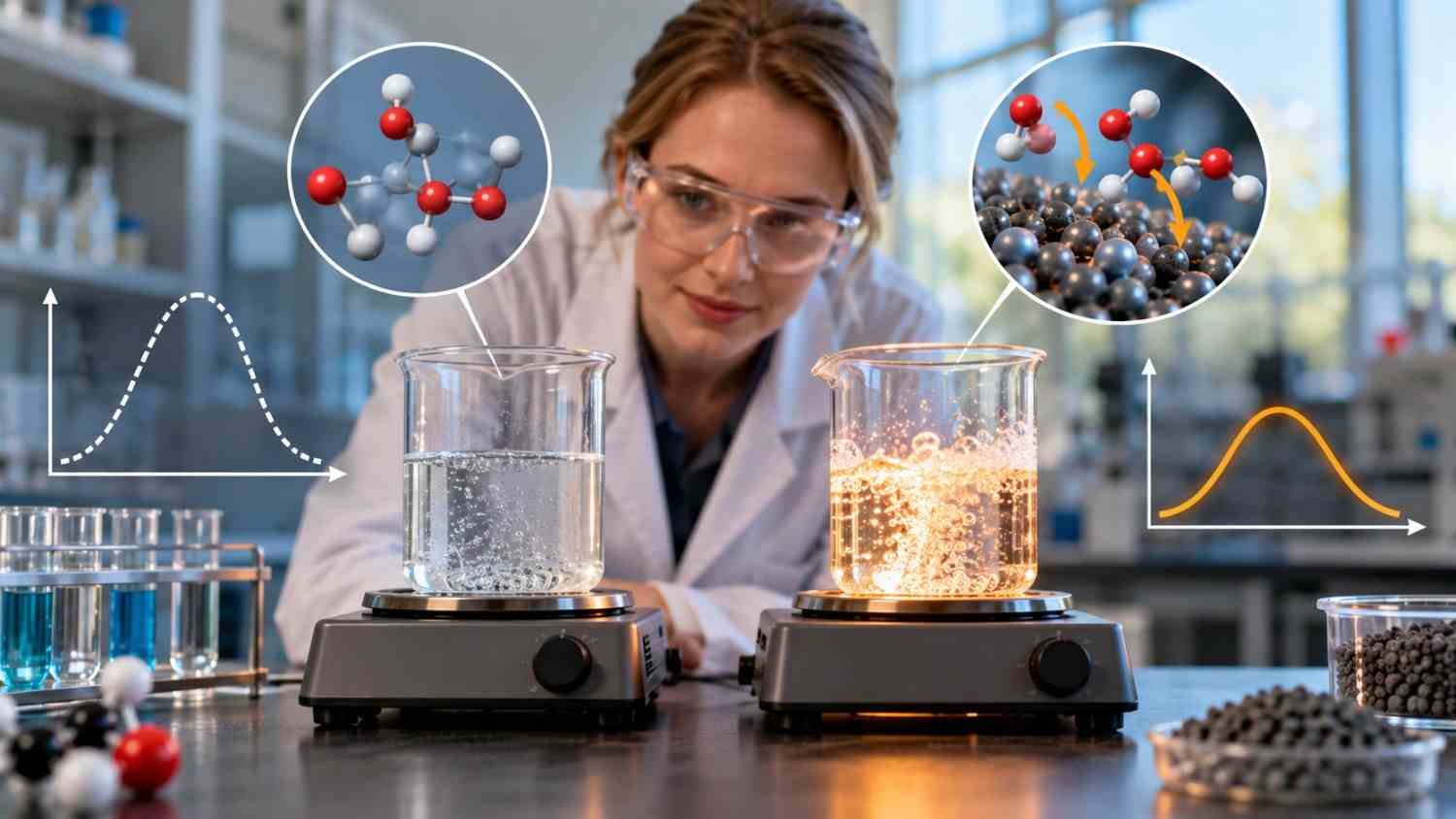
I used to think of a catalyst as something that simply made a reaction happen faster. That explanation works at first, but when I looked more closely at reaction mechanisms, I realized the better question is what the catalyst actually changes along the way. The answer sits in the sequence of molecular steps between reactants and products.
I also noticed that “lower activation energy” can sound more mysterious than it is. A catalyst does not give a reaction extra energy or change the final products. Instead, it provides another route, often involving temporary intermediates, that allows the reaction to pass through easier energy barriers. That distinction makes reaction rates much easier to understand.
What a Catalyst Changes in a Reaction
A catalyst changes the mechanism a reaction follows. In an uncatalyzed reaction, molecules may need to pass through a high-energy transition state before products form. With a catalyst, the reaction can follow a different sequence of elementary steps with lower energy barriers.
That alternative pathway is the heart of catalysis. The overall chemical equation can remain the same even though the individual steps differ. In a multistep mechanism, the catalyst may interact with a reactant, form an intermediate, and later be regenerated. It participates without being permanently consumed.
Why Lower Activation Energy Matters
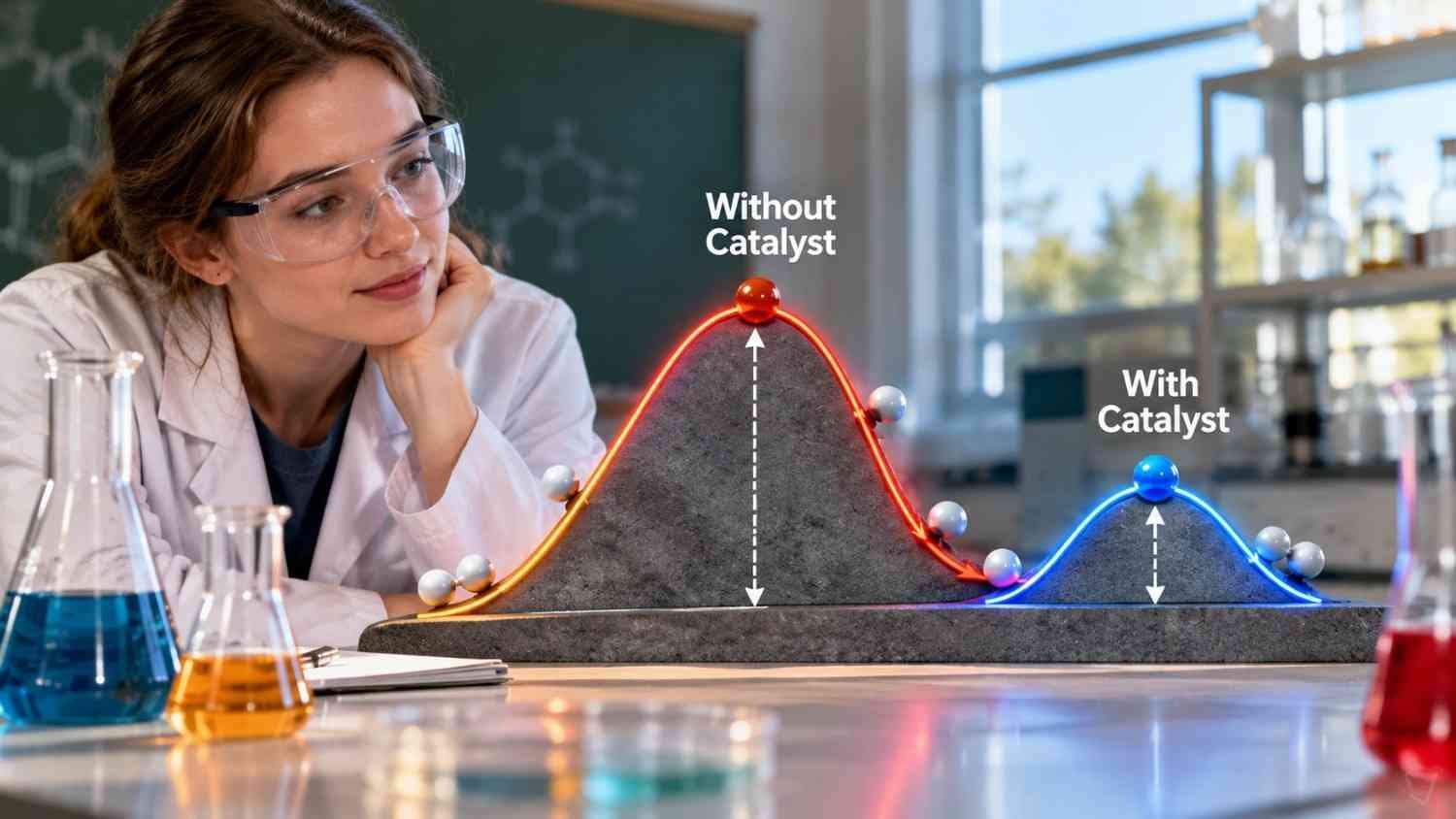
Every reaction has an energy barrier that must be crossed before reactants become products. This barrier is the activation energy. At a given temperature, only some molecules have enough energy to cross it.
A catalyst lowers the relevant activation barrier by offering a different mechanism. On a potential-energy diagram, the catalyzed pathway has a lower transition-state peak than the corresponding uncatalyzed pathway. In a multistep reaction, several peaks may represent transition states, separated by valleys representing intermediates. That is especially useful when interpreting unfamiliar energy diagrams.
The highest barrier along the pathway strongly influences reaction rate. If the catalyst lowers that difficult step, more molecules can progress through the mechanism during the same period. The result is a faster reaction.
Intermediates Make the Mechanism Different
Catalytic mechanisms become easier to understand when intermediates are included. An intermediate forms during one elementary step and is consumed during a later step. It appears in the mechanism but cancels when the individual steps are combined to obtain the overall reaction.
For example, a catalyst might first bind to one reactant and create a temporary catalyst-reactant complex. That species can react with another molecule, producing an intermediate. A later step releases the product and regenerates the catalyst.
The catalyst and intermediate are not the same thing. The catalyst is regenerated, while an intermediate is produced and then consumed within the mechanism. Keeping those roles separate prevents a common mistake in reaction-mechanism problems.
Heterogeneous catalysis offers another useful example. A solid catalyst can provide a surface where reactants adsorb, bonds become easier to break or form, and products eventually leave. This surface-mediated pathway is widely used in industrial chemistry.
How Mechanisms Change Reaction Rates
Reaction rate depends on how quickly successful elementary events occur. The Arrhenius relationship connects the rate constant with activation energy, temperature, and a frequency factor. Because activation energy appears exponentially in that relationship, even a meaningful reduction in the barrier can produce a substantial increase in reaction rate.
A catalyst does not need to make every collision successful. It changes the conditions under which key chemical steps can occur efficiently. More molecules can reach the relevant transition state, so the reaction proceeds faster at the same temperature.
What a Catalyst Does Not Change
A catalyst speeds up the approach to equilibrium, but it does not move the equilibrium position. It lowers barriers for the relevant forward and reverse pathways, allowing both directions to proceed more quickly. The equilibrium constant remains determined by thermodynamics rather than by the catalyst.
The catalyst also does not change the overall enthalpy difference between reactants and products. On an energy diagram, the starting and ending energy levels stay the same; the pathway between them changes. This distinction separates kinetics from thermodynamics.
That idea connects naturally with green chemistry concepts, because catalysts can help chemists design processes that use energy and materials more efficiently. A catalytic route may reduce harsh conditions, improve selectivity, or decrease unwanted byproducts, although the environmental benefit depends on the complete process.
Where Catalytic Mechanisms Appear
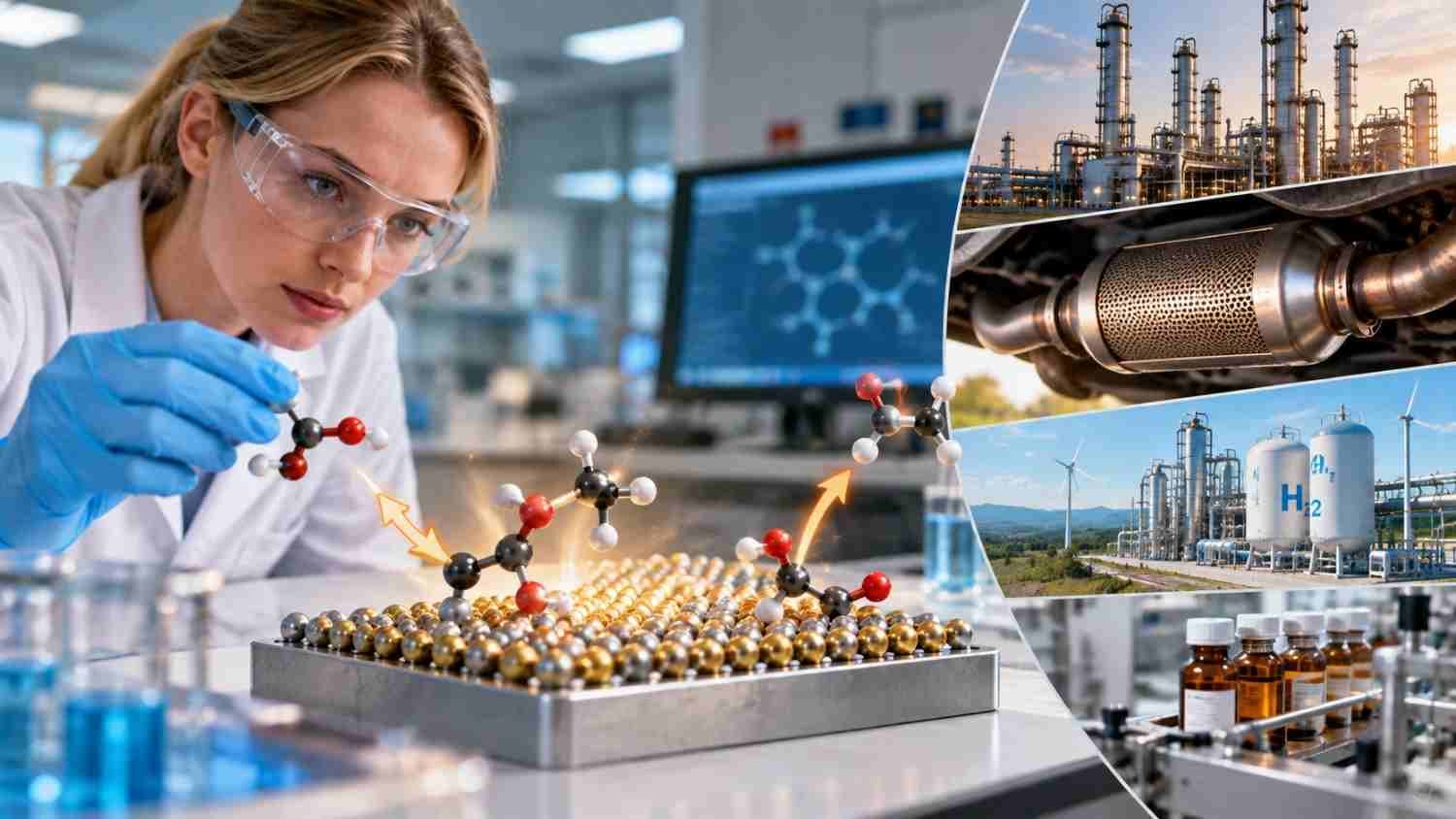
Catalysis is not limited to laboratory reactions. Enzymes are biological catalysts that control countless reactions inside living systems. Their active sites interact with particular substrates and help organize chemical groups so specific reaction pathways become more accessible.
These examples show why mechanism matters. A catalyst is valuable not simply because it speeds something up, but because its interactions can determine which pathway is practical, selective, and efficient.
A Simple Way to Analyze a Catalyzed Mechanism
When looking at a chemistry problem, start with the overall reaction, then examine the elementary steps. Ask what new species appears, whether the catalyst is regenerated, and which transition state has the largest relevant energy barrier.
Then compare the catalyzed and uncatalyzed pathways rather than only their final products. If the reactants and products are unchanged but the energy profile contains an easier pathway, the catalyst is affecting kinetics through the mechanism.
That approach is also useful with digital study tools. When checking how to verify AI-generated chemistry answers, check whether the proposed steps add up to the overall reaction, atoms and charge balance, and the catalyst is regenerated.
FAQs: How Does a Catalyst Affect Reaction Mechanisms and Reaction Rates?
1. Does a catalyst change the overall reaction?
No. A catalyst changes the pathway used to reach the products, while the overall chemical equation remains the same.
2. Does a catalyst lower activation energy?
Yes. It provides a pathway with a lower relevant activation barrier, allowing the reaction to proceed faster at the same temperature.
3. Can a catalyst change equilibrium?
No. A catalyst helps the system reach equilibrium faster but does not change the equilibrium constant or final equilibrium position.
4. Is a catalyst consumed during a reaction?
A catalyst can participate in individual steps and form temporary species, but it is regenerated by the mechanism and is not consumed overall.
Why the Mechanism Matters
Understanding catalysis becomes easier once the focus shifts from “faster reaction” to “different pathway.” The catalyst changes the sequence of molecular events, often introduces intermediates, and lowers the energy barrier that controls the rate. The products and overall thermodynamic landscape remain the same, but the route between them becomes more accessible.
That is the real power of a catalyst: not more energy, but a smarter path.
Leave a Reply