
A ray diagram is not an artistic sketch; it is a prediction tool. With only two carefully chosen rays, you can locate an image, decide whether it is real or virtual, and determine whether it is upright, inverted, enlarged, or reduced. That is the key to learning how to draw ray diagrams for lenses: accuracy comes from a few geometric rules, not from drawing lots of light rays.
The method commonly taught in U.S. high-school and introductory college physics comes from geometric optics, where light can be modeled as straight-line rays that change direction when interacting with materials. OpenStax explains that this ray model is particularly useful when light interacts with objects much larger than its wavelength.
Why Lens Ray Diagrams Actually Work
Classroom problems usually treat the lens as a thin lens. Real light refracts at both surfaces of a glass lens, but the thin-lens model simplifies that behavior so the change in direction can be represented at a single lens plane.
Georgia State University’s HyperPhysics explains that three principal rays can be used to visualize image formation, although only two are necessary to locate an image.
Stanford University demonstrates the same basic Gaussian ray-tracing principle: rays starting from a particular point on an object are redirected by the lens, and their paths identify the corresponding point in the image.
A real image forms where actual light rays meet and can therefore be projected onto a screen. A virtual image appears where diverging rays seem to originate after their paths are extended backward.
Set Up the Diagram Before Tracing Any Light
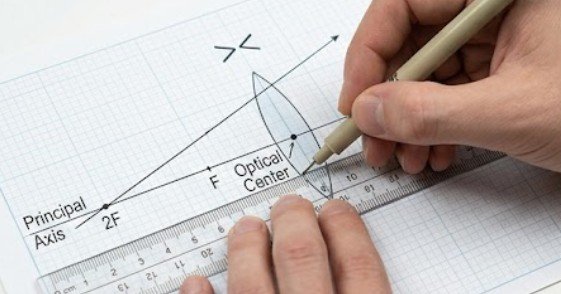
Begin with the principal axis, a straight horizontal line across the page. Place the lens vertically through the center of that line.
A convex, or converging, lens is thicker through its middle and brings parallel rays toward a focal point. A concave, or diverging, lens is thinner through its middle and spreads parallel rays outward.
Mark the focal point F at equal distances on both sides of the lens. If the problem uses 2F, place those marks exactly twice the focal distance from the lens.
Next, draw the object as an upright arrow resting on the principal axis.
Use a ruler whenever possible. Uneven focal points, a tilted principal axis, or inaccurate ray directions can make an otherwise correct method produce the wrong apparent image location.
The Three Principal Rays to Remember
| Principal ray | Converging lens | Diverging lens |
| Parallel ray | Refracts through the far focal point | Leaves as if it originated from the near focal point |
| Center ray | Continues essentially straight through the optical center | Continues essentially straight through the optical center |
| Focal ray | Passes through the near focus and emerges parallel | Aims toward the far focus and emerges parallel |
Ohio University illustrates these same three rays in its convex-lens ray-diagram tutorial. Khan Academy also uses these relationships to determine image position, size, and nature for convex and concave lenses.
How to Draw Ray Diagrams for Lenses Step by Step
- Draw the principal axis, lens, focal points, optional 2F points, and the object arrow.
- Starting at the tip of the object, draw your first ray parallel to the principal axis until it reaches the lens.
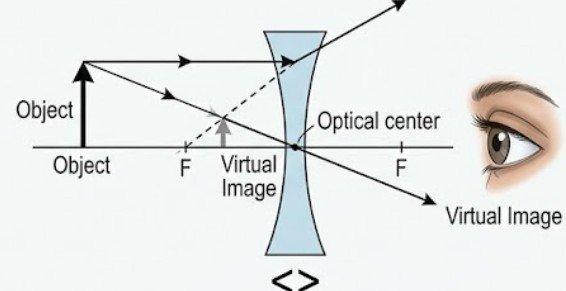
- For a convex lens, continue that ray through the focal point on the opposite side. For a concave lens, draw the ray diverging outward and extend it backward with a dashed line toward the focal point on the object’s side.
- Draw a second ray from the object’s tip directly through the optical center. Under the thin-lens approximation, continue this ray in a straight line.
- Look for the intersection. If the actual refracted rays meet, their crossing identifies the top of a real image. If they spread apart, extend them backward using dashed lines. Where those extensions meet is the top of a virtual image.
- Draw the image arrow from the principal axis to that point. Then identify whether it is upright or inverted, enlarged or reduced, and real or virtual.
Careful diagram construction is useful throughout physics, not just optics. Reviewing how to draw a free-body diagram reinforces the same discipline of choosing reference lines and representing directions accurately. Similar geometric organization also helps when working through inclined-plane problems with friction.
What Happens When the Object Changes Position?
For a converging lens, image characteristics depend strongly on object location.
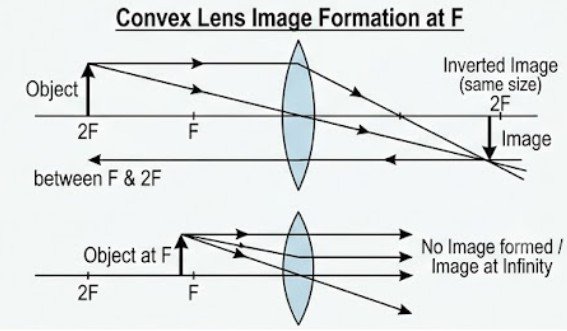
An object beyond 2F produces a real, inverted, reduced image between F and 2F. Place the object at approximately 2F and the resulting image is real, inverted, and about the same size.
Move the object between F and 2F, and the image forms beyond 2F. It remains real and inverted but becomes enlarged.
The situation changes dramatically when the object moves inside F. The outgoing rays diverge rather than meeting on the far side of the lens. Their backward extensions intersect on the object’s side, producing an upright, enlarged virtual image. That behavior explains the basic operation of a magnifying glass.
A diverging lens behaves differently. With a normal real object, it typically produces an upright, virtual, reduced image located between the lens and its near focal point.
Check Your Drawing With the Thin-Lens Equation
A ray diagram gives a visual prediction, while the thin-lens equation provides a mathematical check:
1/f = 1/do + 1/di
Here, f represents focal length, do is object distance, and di is image distance.
OpenStax connects this equation directly with the geometric results obtained through ray tracing.
Magnification provides another useful check:
m = hi/ho = -di/do
Here, hi and ho represent image and object height.
Under the commonly used sign convention, negative magnification indicates an inverted image. A magnification magnitude greater than 1 means the image is enlarged, while a magnitude below 1 means it is reduced.
Sign conventions can vary slightly between textbooks, so use the convention specified by your instructor or course materials.
Mistakes That Can Ruin an Otherwise Correct Diagram
One frequent error is bending the center ray. Under the ideal thin-lens model, a ray traveling through the optical center continues essentially undeviated.
Another mistake is drawing virtual extensions as solid rays. Dashed lines matter because they indicate that light is not physically traveling backward.
Students also commonly choose the wrong focal point. For a convex lens, a ray arriving parallel to the principal axis refracts toward the far focal point. With a diverging lens, the refracted ray behaves as though it originated from the near focal point.
There is also an important limitation to remember. Thin-lens ray diagrams are models. Real lenses have measurable thickness and may produce spherical or chromatic aberrations. The principal-ray method predicts idealized image behavior rather than tracing every photon through a real optical system.
FAQ
1. How many rays are needed to locate an image?
Two correctly drawn principal rays are sufficient. A third ray can confirm your result and should pass through the same image point.
2. Why are virtual-image rays drawn with dashed lines?
Dashed lines represent backward extensions of diverging rays. They show where the light appears to originate rather than where light physically travels.
3. Does a concave lens always produce a smaller image?
For a standard real object in introductory thin-lens problems, a concave diverging lens creates an upright, virtual, reduced image.
4. Do I always need to mark 2F?
No. The focal point F is essential. The 2F positions are mainly useful for quickly predicting image location and size with converging lenses.
Make the Diagram Predict Before the Math Does
The best ray diagrams allow you to see the optical result before calculating it. Start with a level principal axis, position F carefully, choose two principal rays, and determine whether the real rays or their backward extensions intersect. Then use the thin-lens equation to verify what the geometry already suggests.
Once those habits become automatic, lens problems stop looking like a maze of arrows and begin behaving like a predictable visual system. Every useful line has a specific purpose. Draw the right ones accurately, and image formation becomes far easier to understand.
Leave a Reply