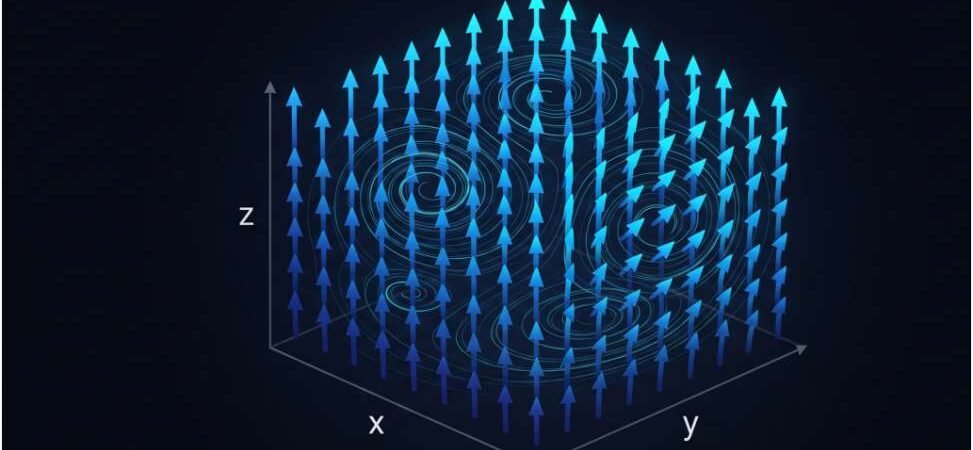
Staring down a multi-variable vector calculus exam requires more than memorizing formulas; it demands raw procedural fluency. When I first tutored university engineering students, I watched brilliant minds stumble simply because they rushed past foundational multi-variable limits or misapplied foundational calculus derivatives.
Finding reliable vector calculus practice questions with answers bridges the gap between abstract theory and exam-day success. Let’s break down targeted practice sets designed to sharpen your analytical edge.
Conquering Gradient, Divergence, and Curl
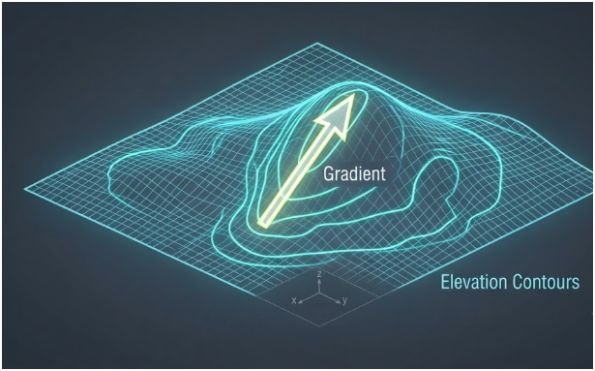
Differential operators form the structural backbone of vector calculus. Before you can evaluate massive surface integrals, you must command spatial rates of change.
The Gradient Vector and Directional Derivatives
The gradient points in the direction of the steepest ascent for a scalar field. Consider a scalar function $\phi(x, y, z) = x^2y + y^2z + z^2x$. Finding its gradient at the coordinate point $(1, -1, 2)$ requires taking partial derivatives with respect to each independent variable.
- Partial with respect to $x$: $2xy + z^2 \implies 2(1)(-1) + (2)^2 = 2$
- Partial with respect to $y$: $x^2 + 2yz \implies (1)^2 + 2(-1)(2) = -3$
- Partial with respect to $z$: $y^2 + 2zx \implies (-1)^2 + 2(2)(1) = 5$
This yields the resulting gradient vector: $2\hat{i} – 3\hat{j} + 5\hat{k}$. Before attempting these, ensure you know how to calculate limits in calculus so you never trip up on continuity requirements.
Divergence and Curl Field Mechanics
Divergence measures source behavior in a vector field, while curl measures rotation. For instance, taking the curl of a smooth vector field $\vec{F} = x\hat{i} + xy\hat{j} + \hat{k}$ through a determinant cross-product yields $y\hat{k}$. This tells you precisely how the vector field spins around the z-axis at any given point $(x,y)$.
Mastering Line Integrals and Conservative Fields
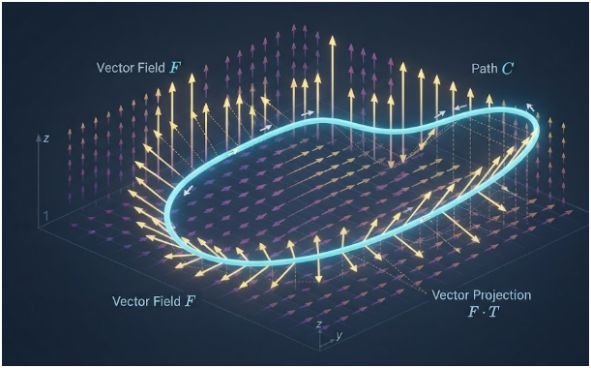
Line integrals calculate accumulated effects along a curve, bridging single-variable integration with multi-variable spatial paths.
Evaluating Line Integrals Directly
Consider evaluating $\int_C \vec{F} \cdot d\vec{r}$ where $\vec{F} = y\hat{i} – x\hat{j}$ along the unit circle $x^2 + y^2 = 1$ in a counter-clockwise orientation. Parameterizing the circle as $x = \cos t$ and $y = \sin t$ transforms the integral into a straightforward single-variable integral over $[0, 2\pi]$, resulting in $-2\pi$.
Identifying Conservative Vector Fields
Conservative fields simplify work calculations because the path taken does not matter. If the curl of a vector field equals zero ($\nabla \times \vec{F} = \vec{0}$), the field is conservative. Integrating the components step-by-step lets you recover the exact scalar potential function $f(x,y,z)$ without hassle.
Conquering Green’s, Stokes’, and Divergence Theorems
The heavy-hitters of vector calculus—Green’s, Stokes’, and Divergence theorems—save hours of tedious calculation by transforming difficult boundary integrals into manageable domain integrals.
Green’s Theorem Shortcuts
Green’s Theorem connects a line integral around a simple closed curve $C$ to a double integral over the plane region $D$ it encloses. Applying it to boundary triangles simplifies complex polynomial line integrals into standard double integrals over $x$ and $y$.
Gauss’s Divergence Theorem Applications
The Divergence Theorem links surface fluxes to volume integrals. When evaluating flux across a solid cylinder, computing the volume integral of $\nabla \cdot \vec{F}$ using cylindrical coordinates eliminates complex surface parameterizations entirely.
Frequently Asked Questions
1. What prerequisites do I need for vector calculus?
You need a solid grasp of multivariable calculus, linear algebra, and parametric equations.
2. How do I know if a vector field is conservative?
Calculate its curl; if the curl vector is zero everywhere in a simply connected domain, it is conservative.
3. Why are line integrals important in physics?
They are essential for calculating work done by a variable force along a curved path.
4. What is the geometric meaning of curl?
Curl measures the infinitesimal rotation or tendency of a vector field to spin an object around an axis.
Recommended Learning References
To deepen your study, consult these authoritative external mathematics repositories:
| Source Name | Platform Type | Focus Area | Authority Link |
| MIT OpenCourseWare | University Curriculum | Multivariable Calculus & Proofs | MIT OCW Vector Calculus |
| Paul’s Online Math Notes | Educational Blog | Step-by-Step Practice Problems | Lamar Math Notes |
| Khan Academy | Interactive Learning | Conceptual Videos & Practice | Khan Academy Calculus |
| LibreTexts Mathematics | Open Textbook | Advanced Vector Proofs | LibreTexts Calc |
Wrapping Up the Vector Maze
Tackling vector calculus practice problems builds the intuition required to survive rigorous STEM coursework. Keep your algebra clean, respect your parameterization boundaries, and never skip verifying your vector orientations.