A one-line equation explains why some circuits draw milliamps while others draw amps: V = IR. The arithmetic is simple; most mistakes come from choosing the wrong form, mixing units, or applying the rule where resistance is not constant.
If you are looking for ohm’s law problems with solutions, learn a repeatable method instead of memorizing answers. Identify voltage, current, and resistance, rearrange the formula, convert units, and check whether the result makes physical sense.
What Ohm’s Law Actually Tells You
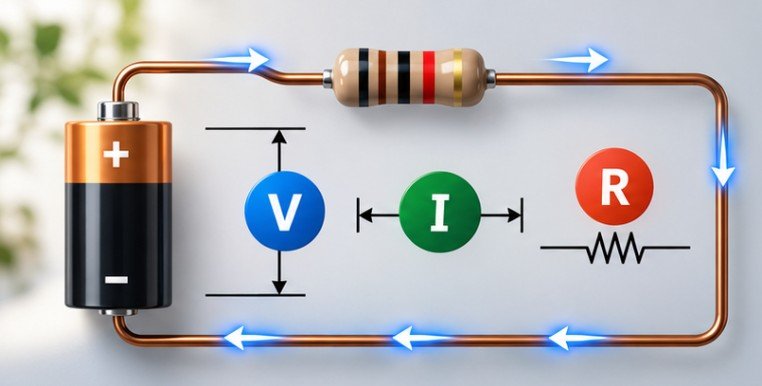
Ohm’s law connects voltage, current, and resistance. Voltage is measured in volts (V), current in amperes (A), and resistance in ohms (Ω).
The standard form is:
V = I × R
Rearranged, it becomes:
I = V/R
R = V/I
The National Institute of Standards and Technology defines the ohm through the relationship 1 Ω = 1 V/A. That definition is also a useful way to check whether the units in a calculation make sense.
| Quantity | Symbol | Unit | Formula |
| Voltage | V | volt (V) | V = IR |
| Current | I | ampere (A) | I = V/R |
| Resistance | R | ohm (Ω) | R = V/I |
University physics material makes an important distinction: Ohm’s law describes components that show an approximately linear relationship between voltage and current. It should not be treated as a universal rule for every electrical device.
A Four-Step Method for Solving Ohm’s Law Problems
Step 1: Identify the Known Values
Label every number as V, I, or R before calculating anything. If a problem gives 12 V and 6 Ω, current is the missing quantity.
This small step prevents a surprisingly common mistake: plugging the correct numbers into the wrong version of the equation.
Step 2: Convert the Units
The biggest numerical trap is mixing milliamps with amps or kilohms with ohms.
1 mA = 0.001 A
1 kΩ = 1,000 Ω
1 MΩ = 1,000,000 Ω
Therefore, 5 mA becomes 0.005 A before being used in a calculation expressed in standard SI units.
Step 3: Choose the Correct Formula
If current is unknown, use I = V/R.
If resistance is unknown, use R = V/I.
If voltage is unknown, use V = IR.
Writing the formula first and then substituting the numbers is safer than trying to rearrange it mentally while calculating.
Step 4: Sense-Check Your Result
At the same voltage, increasing resistance should reduce current. At the same resistance, increasing voltage should increase current. If your calculated result suggests the opposite, check the equation and unit conversions again.
Ohm’s Law Problems With Solutions
Problem 1: Finding Current
A 9 V battery is connected across an 18 Ω resistor. How much current flows?
Known values:
V = 9 V
R = 18 Ω
Use:
I = V/R
I = 9/18 = 0.5 A
Answer: 0.5 A.
The answer also passes a quick reasonableness check. With 18 Ω of resistance connected to 9 V, a current below 1 A is reasonable.
Problem 2: Finding Resistance
A circuit operates at 12 V and draws 0.25 A. What is its resistance?
Use:
R = V/I
R = 12/0.25 = 48 Ω
Answer: 48 Ω.
This calculation is useful when you know a circuit’s supply voltage and measured current and want to estimate the effective resistance of a simple load.
Problem 3: Finding Voltage
A 44 Ω resistor carries 2 A of current. What is the voltage across it?
Use:
V = IR
V = 2 × 44 = 88 V
Answer: 88 V.
The important detail here is that voltage is the unknown, so the operation is multiplication rather than division.
Problem 4: Working With Milliamps and Kilohms
A 2.2 kΩ resistor carries 5 mA. Find the voltage.
Convert the values first:
2.2 kΩ = 2,200 Ω
5 mA = 0.005 A
Now calculate:
V = IR
V = 0.005 × 2,200 = 11 V
Answer: 11 V.
This example shows why unit conversion matters. Forgetting the prefixes can move an otherwise correct answer by a factor of 1,000.
Problem 5: A U.S. Household-Voltage Example
Suppose a purely resistive load is connected to 120 V and draws 0.5 A. What is its effective resistance?
R = V/I
R = 120/0.5 = 240 Ω
Answer: 240 Ω.
Common U.S. household receptacles operate around 120 V, but this is a mathematical example rather than an instruction to measure a live outlet. OSHA electrical-safety training warns that ordinary household voltages can produce hazardous currents. l
How to Check an Answer Without Reworking Everything

Start by checking the final unit. Voltage must end in volts, current in amperes, and resistance in ohms.
Next, put the answer back into V = IR. If you calculated 48 Ω from 12 V and 0.25 A, then 0.25 × 48 should return 12 V.
Finally, estimate the order of magnitude. A 10 V source across roughly 1,000 Ω should produce about 0.01 A, or 10 mA—not 10 A.
This quick check catches many calculator and conversion errors before they cost points on an exam.
Where Ohm’s Law Can Mislead You
One common mistake is treating 20 mA as 20 A. Another is reversing R = V/I and calculating I/V instead.
The more important misconception is assuming every device has a fixed resistance.
Oregon State University explains that Ohm’s law applies to linear, or ohmic, resistors and cautions against assuming the same behavior for other components. A conventional incandescent lamp, for example, may not behave as a simple constant-resistance device because its filament temperature changes during operation.
That means calculating R = V/I at one operating point does not necessarily prove that the resistance will remain unchanged at every voltage.
One Step Further: Connecting Ohm’s Law to Power
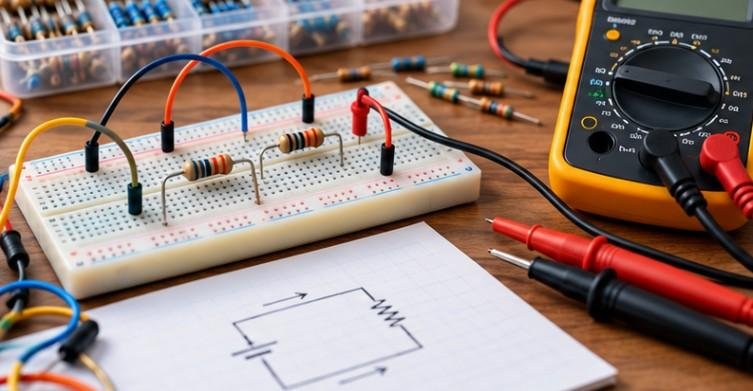
Once voltage and current are known, electrical power can be calculated using:
P = VI
Combining the power formula with Ohm’s law produces two additional forms:
P = I²R
P = V²/R
For example, a 12 V load drawing 2 A uses:
P = 12 × 2 = 24 W
Power matters because real components must be capable of dissipating or handling the energy involved. A mathematically correct resistance value does not automatically mean a component is appropriately rated for the circuit.
OpenStax connects Ohm’s law directly with electrical power as well as series and parallel circuit calculations, making those topics the logical next step after single-resistor problems.
Frequently Asked Questions
1. What is the easiest way to remember Ohm’s law?
Start with V = IR. Isolate the unknown variable: divide by resistance for current or divide by current for resistance. Understanding the relationship is more reliable than memorizing three unrelated equations.
2. Does Ohm’s law work for every electrical device?
No. It works best for ohmic components whose resistance remains approximately constant under the conditions analyzed. Diodes, lamps, and temperature-sensitive components can show nonlinear behavior.
3. Why is my answer 1,000 times too large or too small?
A unit-conversion mistake is usually responsible. Check whether milliamps were treated as amps or kilohms as ohms before assuming the formula was wrong.
4. Can Ohm’s law be used with household electricity?
Yes, for appropriate calculations and simplified resistive loads. Actual appliances may contain motors, electronic controls, capacitors, or other components, so resistance alone may not describe their complete electrical behavior.
Final Takeaway
Ohm’s law rewards a disciplined process more than clever arithmetic. Identify what you know, convert the units, select the correct form of V = IR, solve the equation, and then test the result against physical common sense.
After enough ohm’s law problems with solutions, the equation stops feeling like three formulas that need to be memorized. It becomes one relationship you can rearrange confidently. That foundation carries directly into power calculations, series and parallel circuits, electronic troubleshooting, and more advanced electrical analysis.
Leave a Reply