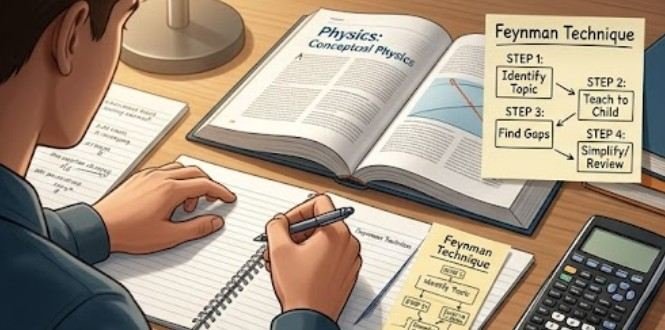
The most productive way to prepare for a physics exam is also the one students often avoid: close the notes and start solving problems.
Physics exams rarely reward recognition alone. A formula may look familiar on a study sheet, yet the real test is whether you can identify the relevant principle, translate a situation into mathematics, and decide whether your final answer makes physical sense. That is why the most useful good tips for studying for a physics exam focus less on rereading and more on retrieval, reasoning, diagrams, and repeated problem-solving.
Stanford University’s Center for Teaching and Learning makes a similar point in its physics study guidance: students need active practice and should understand why individual steps in a solution work rather than memorize specific solutions.
Start by Diagnosing What You Actually Know
Before creating a study schedule, test yourself.
Choose several problems covering the major units on your exam. Attempt them without notes, worked examples, online solutions, or a formula sheet unless your real exam permits one.
Then classify every mistake into one of four categories:
| Type of mistake | What it usually means | Best response |
| Concept error | You misunderstood the physics | Review the principle and explain it in your own words |
| Setup error | You knew the concept but chose the wrong equation or diagram | Practice identifying knowns, unknowns, and relevant laws |
| Math error | Algebra, trig, signs, or arithmetic caused the mistake | Review the specific math skill and retry |
| Execution error | You rushed, skipped units, or misread information | Practice under timed exam conditions |
This diagnosis matters because studying everything equally wastes time. If your real weakness is vector decomposition, rereading an entire chapter on forces will not fix it efficiently.
Cornell University’s Learning Strategies Center recommends retrieval practice—recalling material without looking at it—because it exposes what students truly understand and what still needs work.
Learn the Physics Behind the Formula
A formula sheet can become a trap if every equation is treated like a recipe.
Suppose you remember:
F = ma
That alone is not enough. You should also be able to explain what net force means, recognize whether acceleration is zero, choose appropriate axes, and determine which forces belong on a free-body diagram.
Try asking four questions for every important equation:
What does each variable represent?
Under what conditions does the equation apply?
What changes if one variable increases?
What physical situation would make the equation inappropriate?
This turns formulas into models rather than isolated symbols.
Another effective test is to explain a principle as if you were teaching someone who has not taken physics. If your explanation of conservation of energy immediately collapses into unexplained equations, you probably need another round of conceptual review.
Use a Repeatable Method for Every Physics Problem
Strong physics students do not necessarily see the answer immediately. They develop a dependable procedure for finding it.
OpenStax recommends identifying the relevant physical principles, determining known and unknown quantities, completing the mathematics, and then evaluating whether the answer is reasonable.
A practical exam routine looks like this:
1. Identify the target
Write down exactly what the question asks you to calculate. If the problem wants acceleration, do not start manipulating equations simply because you recognize velocity or force values.
2. Extract the known information
List quantities with their units. Convert units early when necessary so kilometers, meters, hours, and seconds do not become hidden sources of mistakes.
3. Draw the situation
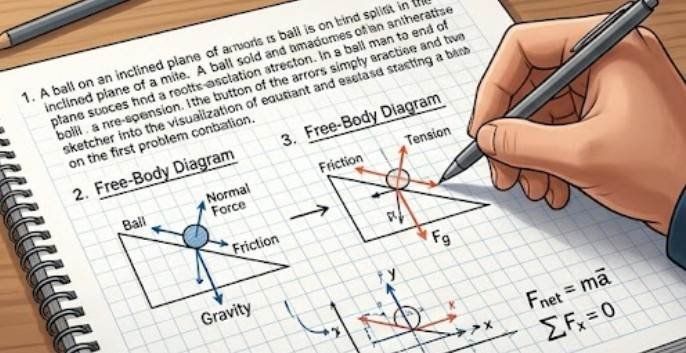
For mechanics, sketch the object, directions, forces, angles, and coordinate axes.
Free-body diagrams are especially useful because they force you to distinguish actual forces from motion. An object moving upward, for example, does not automatically have an upward net force.
4. Choose the physics before inserting numbers
Write the relevant principle symbolically first. Instead of immediately typing numbers into a calculator, establish the relationship between the variables. This makes incorrect assumptions easier to spot.
5. Solve and perform a reality check
Check dimensions, sign, direction, and magnitude. If you calculate that a bicycle is traveling at 4,000 meters per second, flawless algebra does not make the answer physically reasonable.
Practice Different Problems, Not Just More Problems
Doing 20 nearly identical projectile-motion questions can make you fast at recognizing one pattern without preparing you for unfamiliar exam questions. Mix related problem types instead.
Practice a kinematics problem, then energy, then forces, before returning to another kinematics question. This forces you to decide which principle applies instead of having the chapter heading make that decision for you.
You should also modify familiar problems. Change an angle, remove one piece of information, reverse the requested unknown, or ask what would happen if friction disappeared. That small change turns routine calculation into genuine reasoning.
Build Your Own Formula Sheet
Even when formula sheets are prohibited during the exam, creating one is useful preparation.
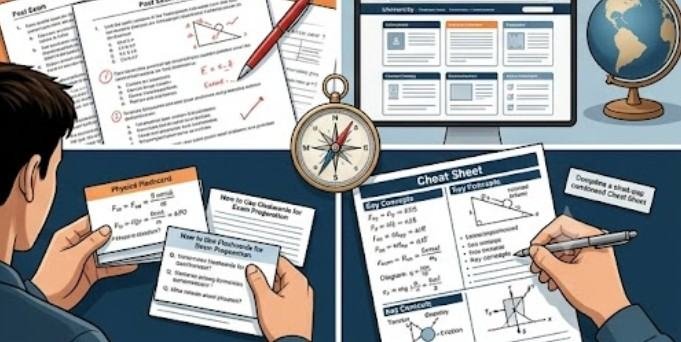
Do not simply copy equations. Organize formulas by physical idea and include conditions such as “constant acceleration only” or “isolated system.”
Add units, common rearrangements, diagrams, and one-line reminders about recurring mistakes.
Flashcards can help with definitions, equations, units, and conceptual relationships, especially when combined with active retrieval. This method for using flashcards for exam preparation can supplement problem-solving rather than replace it.
Take at Least One Timed Practice Exam
Problem-solving ability changes when a clock is running.
Use an old exam or assemble several representative questions and recreate the actual testing conditions. Follow the real time limit and use only resources permitted during the test.
Afterward, do not focus only on the score. Identify which questions consumed too much time and which mistakes happened because of pressure rather than lack of knowledge.
Cornell notes that practice tests performed under realistic conditions use retrieval and help students identify both knowledge gaps and pacing problems.
Protect Sleep Instead of Trading It for One More Chapter
An all-nighter may produce more study minutes while reducing the quality of those minutes.
The CDC reports that adequate sleep supports students’ concentration and academic performance. For teenagers ages 13–18, recommended sleep is 8–10 hours per 24 hours.
If motivation starts falling during a long preparation period, breaking the workload into specific daily targets is more sustainable than depending on last-minute urgency. These strategies for staying motivated during exam preparation can help keep the plan moving.
Frequently Asked Questions
1. What are the most important good tips for studying for a physics exam?
Solve problems without notes, identify conceptual weaknesses, practice diagrams, understand equations rather than memorizing them, redo previous assessments, and complete at least one timed practice test.
2. How many hours should I study for a physics exam?
There is no universal number. Base your schedule on your current knowledge, course difficulty, and exam coverage. Several focused sessions across multiple days are generally more useful than one marathon session.
3. Should I memorize every physics formula?
Usually not. Know important equations, but concentrate on what each equation means, when it applies, its units, and how variables relate.
4. Is studying old exams useful for physics?
Yes, particularly when you attempt them independently and under realistic conditions. Afterwards, classify your mistakes so future study targets the reason you lost points.
The Final Takeaway
The strange thing about physics preparation is that feeling comfortable can be a warning sign. Notes look familiar, solved examples appear obvious, and formulas seem easy when the answers are sitting nearby.
Real preparation begins when those supports disappear.
The strongest study session therefore resembles the exam itself: identify a problem, decide which physics applies, draw what you need, solve carefully, and question the result. Start with the questions you cannot solve today rather than repeatedly reviewing the ones you already understand. By exam day, the goal is not to have seen every possible problem. It is to have developed a process that still works when you see one you have never encountered before.
Leave a Reply