
A point in an electric field can have a potential of 10,000 volts even when no particle is sitting there. Yet that same point has no specific electric potential energy until a charge is introduced.
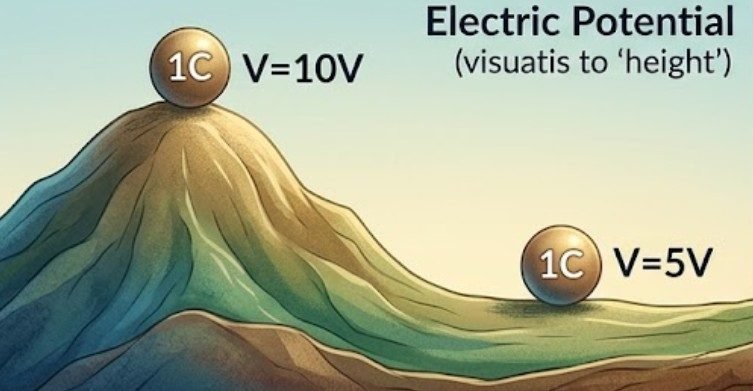
That distinction unlocks electric potential vs electric potential energy. Electric potential describes how much potential energy would exist per unit charge at a location. Electric potential energy describes the actual energy associated with a particular charge interacting with an electric field.
The difference sounds small, but confusing the two can lead to wrong units, wrong signs, and incorrect answers in electrostatics problems.
The Core Difference in One Equation
The relationship is:
V = U / q
or, rearranged:
U = qV
where:
V = electric potential, measured in volts (V)
U = electric potential energy, measured in joules (J)
q = charge, measured in coulombs (C)
Openbooks defines electric potential as potential energy per unit charge and emphasizes that the test charge cancels from the definition. That means the potential at a location is determined by the source charges, not by the test charge eventually placed there.
Think of potential as information about the location. Potential energy tells us what happens when a particular charge occupies that location.
What Electric Potential Really Tells You
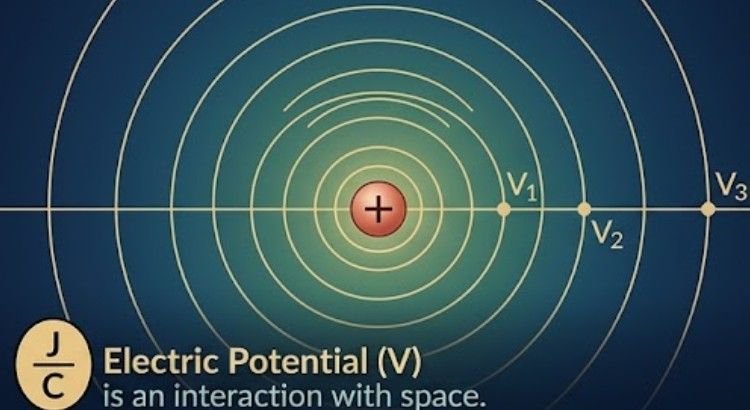
Electric potential tells us how strongly a location is positioned energetically within an electric field.
For a point source charge Q:
V = kQ / r
where:
k ≈ 8.99 × 10^9 N·m²/C²
Q = source charge
r = distance from the source charge
Notice what is missing: the test charge.
Oregon State University’s physics materials give the same point-charge relationship and show that potential depends on the source charge and distance from it.
If the source charge is positive, its potential is positive when infinity is chosen as zero. A negative source charge produces negative potential.
Because potential is a scalar, potentials produced by several charges can be added algebraically:
Vtotal = V1 + V2 + V3 + …
There is no need to resolve directions as there is with electric-field vectors.
Why Potential Energy Depends on the Charge You Add
Now place a test charge q at that location.
Its potential energy becomes:
U = qV
Suppose the electric potential is:
V = 500 V
Place a +2 × 10^-6 C charge there:
U = (2 × 10^-6 C)(500 J/C)
U = 1 × 10^-3 J
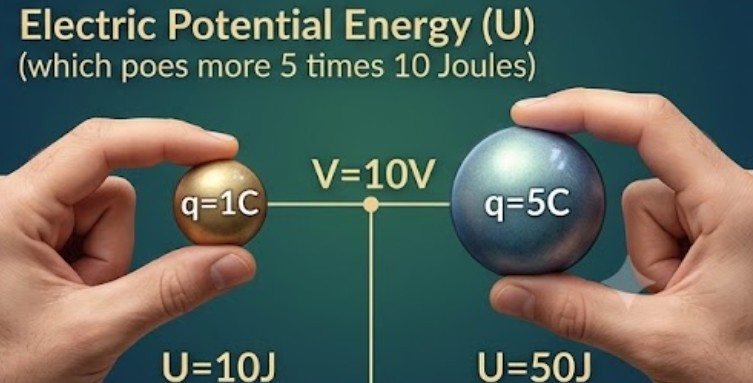
Now replace it with a charge twice as large. Its potential energy doubles, even though the potential at that location remains exactly the same.
Georgia Tech’s physics materials describe electric potential energy as energy belonging to a system of interacting charges and note that it may be positive or negative depending on their signs and arrangement.
This dependency is the heart of electric potential vs electric potential energy.
A Worked Point-Charge Example
Consider a source charge:
Q = +3 μC = 3 × 10^-6 C
Suppose we want the potential 0.20 m away.
Use:
V = kQ/r
V = (8.99 × 10^9)(3 × 10^-6) / 0.20
V ≈ 1.35 × 10^5 V
So the location has a potential of approximately:
135,000 V
Now place a +2 nC charge there:
q = 2 × 10^-9 C
& U = qV
U = (2 × 10^-9)(1.35 × 10^5)
U ≈ 2.70 × 10^-4 J
If the test charge were -2 nC instead, the potential would still be +135,000 V, but its potential energy would become:
U ≈ -2.70 × 10^-4 J
Changing the test charge changes U, not V.
Potential Difference Is What We Usually Call Voltage
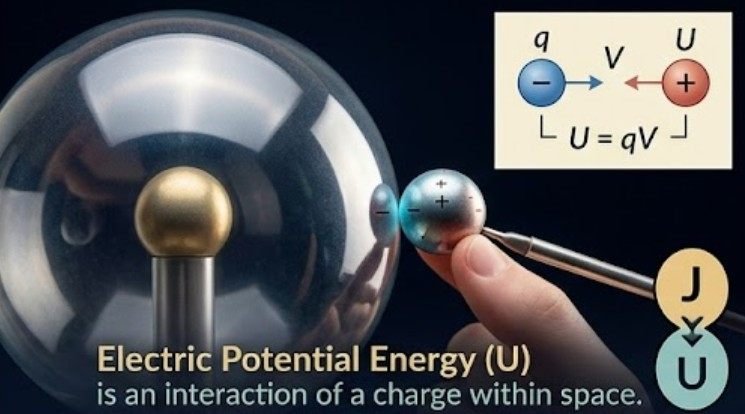
In practical circuits, we are usually more interested in the difference in electric potential between two locations than in an absolute value.
That relationship is:
ΔV = ΔU / q
or:
ΔU = qΔV
MIT’s electricity and magnetism materials describe potential difference as work or energy change per unit charge and emphasize that electric potential should not be confused with electric potential energy.
A 9 V battery, for example, establishes a potential difference of 9 joules per coulomb between its terminals. That does not mean the battery gives every charged particle 9 joules. The actual energy change depends on how much charge moves.
The Sign Rule That Often Causes Mistakes
Positive charges and negative charges respond differently because:
ΔU = qΔV
For a positive charge, moving toward lower potential produces lower potential energy.
For a negative charge, the opposite can happen. Since q is negative, moving toward higher electric potential may decrease its potential energy.
That is why saying “charges always move from high potential to low potential” is incomplete. It is generally useful for positive test charges, but electrons carry negative charge.
A safer principle is:
A freely moving system tends toward lower potential energy.
Volts and Joules Are Not Interchangeable
Another frequent error in electric potential vs electric potential energy problems is treating volts as though they were energy units.
They are not.
1 V = 1 J/C
The volt measures energy per charge, while the joule measures energy itself.
NIST maintains the official SI framework and conversion information used for electrical and energy units. This unit check is one of the fastest ways to catch a wrong equation during an exam.
A Three-Step Test for Choosing the Right Quantity
Step 1: Ask whether a particular test charge is involved
If the problem asks about a location before specifying a test charge, it probably wants electric potential.
If it asks about energy belonging to a particular charge or charge system, calculate potential energy.
Step 2: Check the required units
Volts or J/C → electric potential.
Joules → electric potential energy.
Step 3: Look at the variables
If your expression contains only the source charge and distance:
V = kQ/r
you are calculating potential.
If it contains both interacting charges:
U = kQq/r
you are calculating potential energy.
Two Misconceptions Worth Avoiding
Zero potential does not necessarily mean zero electric field
Potentials from different source charges can cancel because potential is scalar. The electric-field vectors at the same point may not cancel.
For example, between equal positive and negative charges, a location may have V = 0 while still experiencing a nonzero electric field.
Potential energy belongs to the system
It is convenient to say a particle “has” potential energy, but electrostatic potential energy fundamentally arises from interactions among charges.
For systems containing several charges, the total energy must account for each interacting pair. Simply multiplying every charge by a total potential without avoiding double-counting can produce an incorrect result.
Frequently Asked Questions
1. Is electric potential the same as voltage?
Electric potential refers to a value at a point relative to a reference. Voltage usually means the potential difference between two points.
2. Can electric potential energy be negative?
Yes. Negative values commonly occur for configurations involving attractive opposite charges when the reference energy is chosen to be zero at infinite separation.
3. Does electric potential depend on the test charge?
No. Electric potential is determined by the source charges and location. Electric potential energy changes with the magnitude and sign of the test charge.
4. What is the main formula connecting the two concepts?
The fundamental relationship is U = qV. For changes between two locations, use ΔU = qΔV.
The Takeaway
The most reliable way to separate these concepts is to ask one question: “Am I describing the location, or the energy of a particular charge at that location?”
Electric potential describes the electrical energy landscape in volts. Electric potential energy tells you how much energy a specific charge has within that landscape, in joules. Once that distinction is clear, formulas such as V = U/q, U = qV, and ΔU = qΔV stop looking like separate rules and become different versions of the same physical idea.
Leave a Reply