
Staring at a blank geometry page while trying to figure out how to write a valid proof triggers instant frustration for many students. Learning geometry theorems proof step by step transforms an intimidating puzzle into a predictable, logical sequence.
Logic, axioms, and established rules replace guesswork. Tackling foundational proofs builds the exact analytical muscle needed for advanced mathematics and engineering.
Why Mastering Geometry Proofs Changes Everything
Proofs form the core architectural blueprint of mathematics. Memorizing formulas lets you solve basic homework problems, but understanding how those formulas originate unlocks true mathematical fluency.
When you dissect a proof, you learn how to argue logically from a hypothesis to a definitive conclusion. Authoritative resources like Khan Academy Geometry Proofs demonstrate that every single complex spatial problem relies on these foundational steps.
Core Foundations: Triangle Angle Sum Theorem Proof
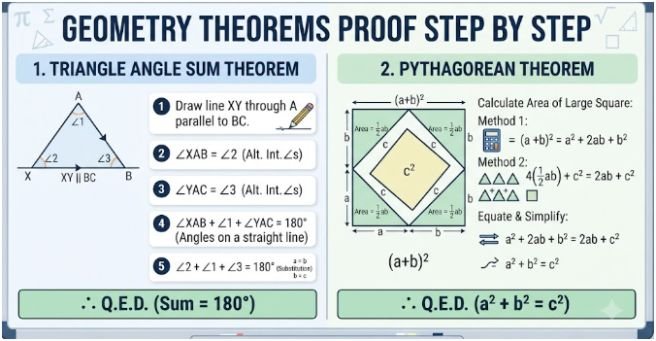
The Triangle Angle Sum Theorem states that the interior angles of any triangle always add up to $180^\circ$. Proving this requires setting up parallel lines and manipulating alternate interior angles.
Step-by-Step Breakdown of the Triangle Angle Sum
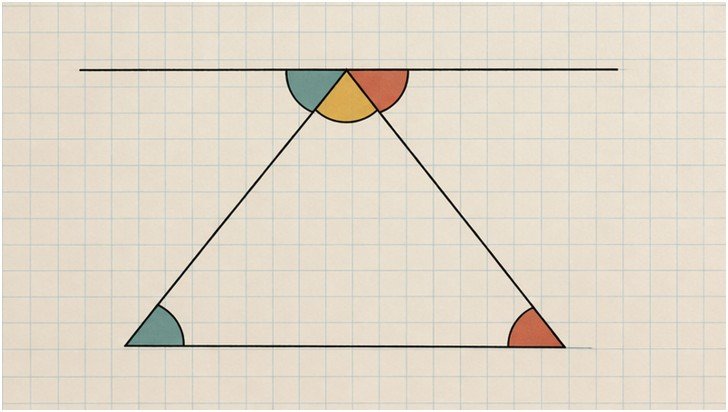
Start with triangle ABC. Label the angle at A as ∠1, the angle at B as ∠2, and the angle at C as ∠3. We want to prove that m∠1 + m∠2 + m∠3 = 180°.
Draw a straight line XY through A, parallel to BC, with X on the side of AB and Y on the side of AC. Lines AB and AC now cross the two parallel lines. By the Alternate Interior Angles Theorem, m∠XAB = m∠2 and m∠YAC = m∠3.
The three adjacent angles along the straight line at A add up to 180°. Therefore, m∠XAB + m∠1 + m∠YAC = 180°.
Substitute m∠2 and m∠3 for their equal angles: m∠2 + m∠1 + m∠3 = 180°. Rearrange the terms to reach the result: m∠1 + m∠2 + m∠3 = 180°.
According to Wolfram MathWorld Triangle Documentation, this fundamental property holds true across all Euclidean triangles.
Geometric Mastery: The Pythagorean Theorem Algebraic Proof
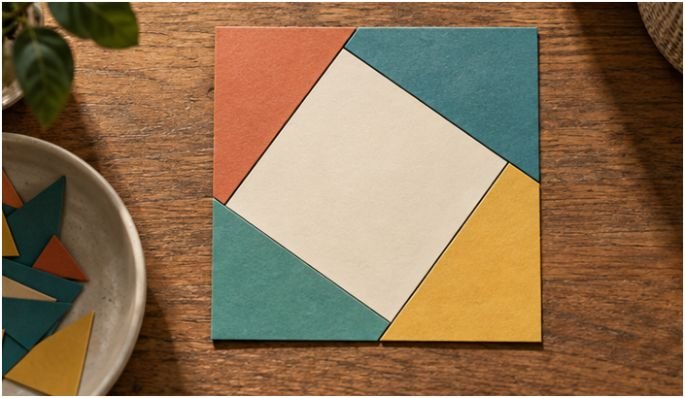
The Pythagorean Theorem establishes that in a right-angled triangle, the square of the hypotenuse ($c$) equals the sum of the squares of the other two legs ($a$ and $b$).
Breaking Down the Area Method Proof
Arrange four identical right triangles inside a large square. Each triangle has legs of length a and b and a hypotenuse of length c. The outer square has side length a + b, while the space between the triangles forms a smaller, tilted square with side length c.
Find the outer square’s area in two ways. Using its side length gives:
(a + b)² = a² + 2ab + b²
Adding the areas of the pieces inside gives four triangles plus the central square:
4 × (½ab) + c² = 2ab + c²
Both expressions describe the same area, so a² + 2ab + b² = 2ab + c². Subtract 2ab from both sides to obtain a² + b² = c². This proves the Pythagorean Theorem for a right triangle.
For a visual explanation, see Math is Fun’s Pythagorean Theorem.
Essential Reference Tables for Proof Justifications
Quickly referencing geometric rules speeds up homework completion and test preparation. The following tables organize essential definitions and algebraic properties frequently used in proofs.
Geometric Postulates and Theorems Reference

| Theorem or Postulate | Core Definition | Primary Application |
| Parallel Postulate | Through a point not on a line, exactly one parallel line can be drawn. | Constructing auxiliary lines in angle proofs. |
| Alternate Interior Angles | When parallel lines are cut by a transversal, alternate interior angles are equal. | Transferring angle measurements across parallel boundaries. |
| Linear Pair Postulate | Two adjacent angles that form a straight line sum to $180^\circ$. | Establishing supplementary relationships. |
Algebraic Properties Reference
| Property Name | Mathematical Expression | Proof Usage |
| Substitution Property | If $x = y$, then $y$ can replace $x$ in any equation. | Replacing angle variables with equivalent values. |
| Commutative Property | $a + b = b + a$ | Rearranging terms to match the target theorem statement. |
| Subtraction Property | If $a = b$, then $a – c = b – c$. | Eliminating redundant terms from both sides of an equation. |
Frequently Asked Questions
1. What is the easiest way to start a geometry proof?
Start by listing all given information and marking up your diagram with matching tick marks and arc symbols.
2. Why do geometry proofs require reasons for every step?
Reasons ensure your logical deduction relies on established mathematical laws rather than visual assumptions.
3. Can a proof have multiple valid pathways?
Multiple correct sequences often exist to reach the same mathematical conclusion.
4. How do I know which theorem to apply next?
Work backward from your target conclusion to identify what intermediate angle or side relationship you need.
Wrapping Up Our Mathematical Journey
Tackling proofs no longer requires crossing your fingers and hoping for the best. Master the foundational axioms, organize your statements cleanly, and let logic guide your pen. Pick one theorem today, grab a piece of paper, and write out your very first independent proof from scratch.
Leave a Reply