
A narrowing pipe does not lower pressure “by magic.” The change is an energy trade: pressure energy can become kinetic energy as fluid speeds up, while elevation can also gain or surrender energy. That is the key to solving bernoulli equation problems step by step without getting lost in symbols.
For steady, incompressible flow with negligible viscous losses,
P₁ + ½ρv₁² + ρgh₁ = P₂ + ½ρv₂² + ρgh₂
Here, P is pressure, ρ is fluid density, v is speed, g is gravitational acceleration, and h is elevation. OpenStax’s explanation of Bernoulli’s equation describes the relationship as conservation of energy applied to frictionless fluid flow, which is the most useful way to understand it.
What the Equation Is Actually Balancing
The three terms represent pressure energy, kinetic energy per unit volume, and gravitational potential energy per unit volume. If one rises, another must fall when total mechanical energy remains constant.
That is why a fluid that accelerates through a restriction often shows lower static pressure, and why fluid climbing to a higher elevation may lose pressure, speed, or both.
NASA’s Glenn Research Center Bernoulli resource emphasizes that the familiar equation depends on important assumptions, including steady and incompressible flow with negligible viscosity. Bernoulli is generally applied along a streamline under these idealized conditions. Ignore those restrictions and a clean-looking numerical answer can still be physically wrong.
A Six-Step Method for Most Bernoulli Problems
Use the same workflow instead of searching for a different shortcut for every question.
| Step | Action | Purpose |
| 1 | Mark Point 1 and Point 2 | Defines the two fluid states being compared |
| 2 | List P, v, h, ρ, and area | Reveals known values and the true unknown |
| 3 | Pick a height datum | Allows one elevation to be set to zero |
| 4 | Use continuity if area changes | Finds a missing velocity |
| 5 | Cancel genuinely equal terms | Simplifies the equation safely |
| 6 | Solve symbolically, then substitute | Reduces algebra and unit mistakes |
Oregon State University’s continuity and Bernoulli lesson pairs the two principles because they frequently work together. For steady incompressible flow, conservation of mass gives:
A₁v₁ = A₂v₂
A smaller cross-sectional area therefore requires a greater velocity when the volume flow rate remains constant.
Sketch the system before calculating, too. The same visual discipline used when learning how to draw a free-body diagram can prevent you from assigning the wrong elevation, pressure, or flow direction.
Worked Example 1: A Pipe Narrows Horizontally
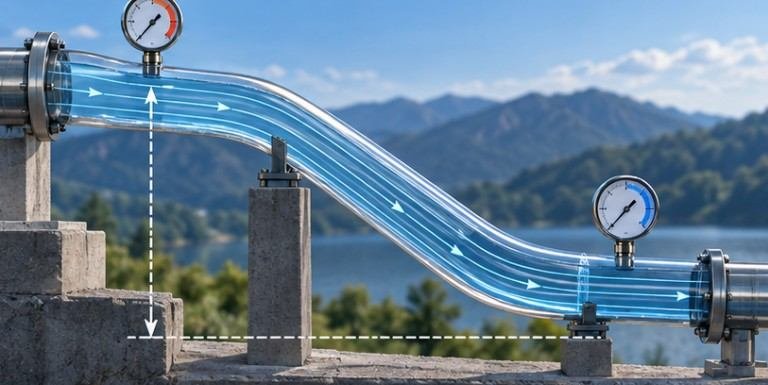
Suppose water enters a horizontal pipe with a diameter of 4 inches at 3 ft/s and 40 psi. The pipe narrows to 2 inches. What is the downstream pressure?
Step 1: Find the New Velocity
Because circular cross-sectional area is proportional to diameter squared,
A₁/A₂ = (D₁/D₂)²
A₁/A₂ = (4/2)² = 4
Continuity therefore gives:
v₂ = 4v₁ = 12 ft/s
The diameter was cut in half, but the area became one-quarter as large. That is why velocity increases by a factor of four rather than two.
Step 2: Remove the Elevation Terms
The pipe is horizontal, so:
h₁ = h₂
The elevation terms cancel. Bernoulli can conveniently be written in head form:
P₁/γ + v₁²/(2g) = P₂/γ + v₂²/(2g)
For water, use a specific weight of approximately 62.4 lbf/ft³ and gravitational acceleration of about 32.2 ft/s².
Step 3: Calculate the Pressure
First convert 40 psi to pounds per square foot:
40 × 144 = 5,760 lb/ft²
Now calculate the velocity heads:
v₁²/(2g) = 3²/(2 × 32.2) ≈ 0.14 ft
v₂²/(2g) = 12²/(2 × 32.2) ≈ 2.24 ft
The velocity head increases by about 2.10 ft, so the pressure head decreases by the same amount.
The resulting downstream pressure is approximately:
P₂ ≈ 39.1 psi
The roughly 0.9 psi decrease represents pressure energy being converted into kinetic energy as the water accelerates.
Yale University’s fluid-dynamics lecture explains the continuity principle in similar terms: if incompressible fluid cannot accumulate inside a pipe, the same flow must move faster through a smaller area.
Worked Example 2: Water Leaving an Open Tank
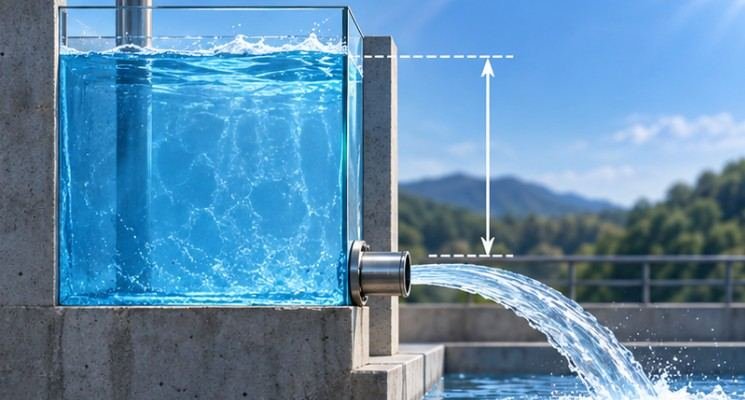
Consider a large open tank with a small outlet located 10 ft below the water surface. Estimate the water’s exit speed.
Choose Point 1 at the free surface and Point 2 at the outlet.
Both locations are exposed to the same atmospheric pressure, so their atmospheric-pressure terms cancel. Because the tank’s surface area is much larger than the outlet area, the free surface moves slowly enough that we can approximate:
v₁ ≈ 0
Now choose the outlet as the zero-height reference. Bernoulli becomes:
gh = ½v²
Rearrange:
v = √(2gh)
Substitute the values:
v = √(2 × 32.2 × 10)
v ≈ 25.4 ft/s
This result is known as Torricelli’s relation, a special case of Bernoulli’s equation. It also demonstrates why carefully choosing the two comparison points and the elevation reference can turn a complicated-looking problem into a short calculation.
Pressure References Can Quietly Ruin an Answer
A surprising number of bernoulli equation problems step by step go wrong because of pressure bookkeeping rather than difficult fluid mechanics.
If both selected points are exposed to the same atmosphere, atmospheric pressure cancels and gauge pressure works cleanly. If only one point is open to the atmosphere, however, keep the other pressure term and ensure both pressures use the same reference.
Never use absolute pressure at one point and gauge pressure at another without converting them consistently.
Units deserve the same attention. Do not put psi directly into a formula expecting lb/ft² without converting it, and never mix feet and meters within the same calculation.
When Basic Bernoulli Is the Wrong Tool
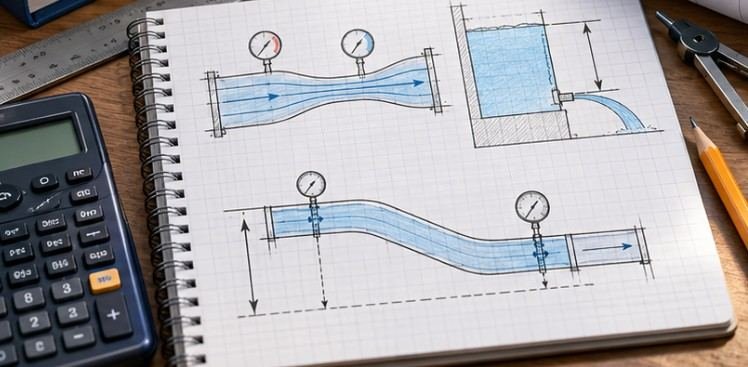
The ideal Bernoulli equation does not describe every real flow.
MIT OpenCourseWare’s fluid-mechanics materials distinguish ideal Bernoulli applications from topics such as pipe friction, energy losses, pumps, turbines, and more complex fluid behavior.
A long or rough pipe can lose significant mechanical energy through friction. A pump adds energy to the fluid, while a turbine extracts it. Strongly compressible gas flow, substantial viscosity, turbulence, or unsteady conditions may also require a more complete energy equation or another fluid-dynamics model.
A useful test is simple: between your two selected points, is mechanical energy being added, removed, or significantly dissipated? If yes, the elementary form of Bernoulli probably needs additional terms.
A 20-Second Error Check
Before accepting your answer, test it against the physical situation.
In a horizontal ideal-flow restriction, an increase in velocity normally accompanies a decrease in static pressure. If fluid rises while velocity remains roughly unchanged, pressure should generally decrease.
Then check magnitude and units. An impossible absolute pressure, an enormous velocity caused by a tiny height difference, or a pressure increase through an unpowered horizontal restriction should make you inspect your signs, conversions, and assumptions again.
NASA also connects the pressure-velocity relationship to pitot-static measurements used for determining aircraft speed, showing that Bernoulli’s energy balance has practical engineering applications beyond textbook pipe problems.
Frequently Asked Questions
1. What is the first step in a Bernoulli equation problem?
Choose two points along the fluid path and list the pressure, velocity, and elevation at each point before doing any algebra.
2. When should I use the continuity equation?
Use A₁v₁ = A₂v₂ for steady incompressible flow when cross-sectional area changes and one of the velocities is unknown.
3. Can atmospheric pressure be ignored?
Yes, when the same atmospheric pressure acts at both selected points and you use a consistent gauge-pressure reference throughout the calculation.
4. Does Bernoulli’s equation include friction?
Not in its basic ideal form. Real pipe problems may require head-loss terms and additional pump or turbine terms when mechanical energy changes.
Final Takeaway
The fastest way to master bernoulli equation problems step by step is to stop treating Bernoulli as a formula hunt and start treating it as an energy ledger. Pick two sensible points, track pressure, speed, and elevation, use continuity when geometry changes, and cancel only terms that are genuinely equal. Then challenge the result with physical common sense. A narrow pipe should suggest faster flow, an open tank should simplify atmospheric pressure, and a long rough pipe should remind you that ideal Bernoulli has limits. Once those habits become automatic, the algebra becomes the easy part.
Leave a Reply