
If you can expand (x + 2)² but get stuck at (x + 2)⁴, repeated multiplication is probably slowing you down. I use the binomial theorem to build each term in order, then run a short check for mistakes. These binomial theorem expansion solved examples show both steps, with equations you can copy into Google Docs.
The Binomial Theorem Formula Without the Formatting Mess
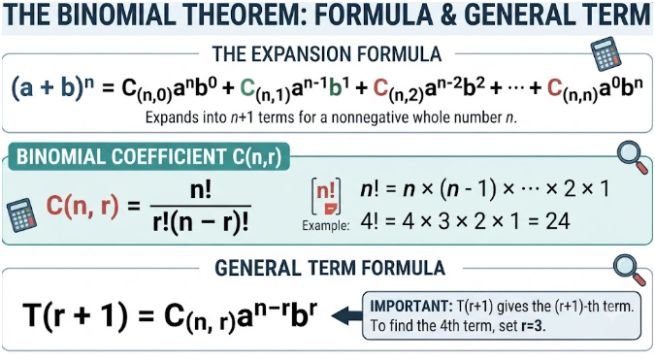
For a nonnegative whole number n, the theorem expands (a + b)ⁿ into n + 1 terms. Each term pairs a power of a with a power of b:
(a + b)ⁿ = C(n,0)aⁿb⁰ + C(n,1)aⁿ⁻¹b¹ + C(n,2)aⁿ⁻²b² + … + C(n,n)a⁰bⁿ
Here, C(n,r) is a binomial coefficient:
C(n,r) = n! / [r!(n − r)!]
The factorial symbol means multiplication down to 1. For example, 4! = 4 × 3 × 2 × 1 = 24. The general term gives you any part of an expansion without writing every term:
T(r + 1) = C(n,r)aⁿ⁻ʳbʳ
Notice the counting: r starts at 0, so r = 3 produces the fourth term. OpenStax’s binomial theorem chapter covers the coefficients and general-term formula.
Solved Binomial Expansion Examples
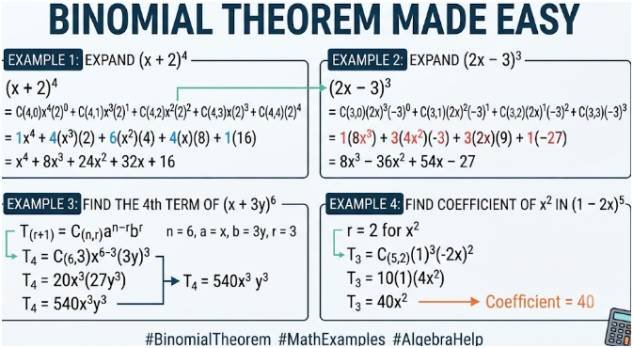
Example 1: Expand (x + 2)⁴
I first identify a = x, b = 2, and n = 4. The coefficients for the fourth power are 1, 4, 6, 4, 1. You can calculate them with C(4,r) or find them in Pascal’s triangle. Khan Academy’s Pascal’s triangle lesson demonstrates that connection.
(x + 2)⁴ = C(4,0)x⁴(2)⁰ + C(4,1)x³(2)¹ + C(4,2)x²(2)² + C(4,3)x(2)³ + C(4,4)(2)⁴
= 1x⁴ + 4(x³)(2) + 6(x²)(4) + 4(x)(8) + 1(16)
= x⁴ + 8x³ + 24x² + 32x + 16
Answer: (x + 2)⁴ = x⁴ + 8x³ + 24x² + 32x + 16
The power of x drops from 4 to 0 as the power of 2 rises from 0 to 4. That pattern keeps me from accidentally leaving out a term.
Example 2: Expand (2x − 3)³
A subtraction problem uses the same formula. I treat the second term as −3, including its sign: a = 2x, b = −3, and n = 3.
(2x − 3)³ = C(3,0)(2x)³(−3)⁰ + C(3,1)(2x)²(−3)¹ + C(3,2)(2x)(−3)² + C(3,3)(−3)³
= 1(8x³) + 3(4x²)(−3) + 3(2x)(9) + 1(−27)
= 8x³ − 36x² + 54x − 27
Answer: (2x − 3)³ = 8x³ − 36x² + 54x − 27
The signs alternate because successive powers of −3 alternate between positive and negative. If your signs do not follow that pattern here, check how you raised −3 to each power. Mathematics LibreTexts also explains expansions involving sums and differences.
Find a Specific Term Without Expanding Everything
Example 3: Find the Fourth Term of (x + 3y)⁶
Writing all seven terms would waste time if the question asks for only one. I use T(r + 1) = C(n,r)aⁿ⁻ʳbʳ.
The fourth term means r + 1 = 4, so r = 3. With n = 6, a = x, and b = 3y:
T₄ = C(6,3)x⁶⁻³(3y)³
C(6,3) = 6! / (3!3!) = 20
T₄ = 20x³(27y³) = 540x³y³
Answer: The fourth term is 540x³y³.
The term number and r differ by one. I write that step down every time; it prevents an otherwise easy counting error.
Example 4: Find the Coefficient of x² in (1 − 2x)⁵
This question asks for a coefficient, not an entire term. In the general term, (−2x)ʳ supplies xʳ. To get x², set r = 2:
T₃ = C(5,2)(1)³(−2x)²
= 10(4x²)
= 40x²
Answer: The coefficient of x² is 40.
This is also why I check the requested power before calculating.
My Three-Check Method for Catching Expansion Errors
Before I finish a problem, I run a term audit. First, an expansion with a nonnegative whole-number exponent n should have n + 1 terms before any like terms are combined. Second, the exponent of a falls by one while the exponent of b rises by one. Third, I substitute an easy value into both the original expression and my answer.
For Example 1, setting x = 0 gives (0 + 2)⁴ = 16. The expanded expression also gives 16. Setting x = 1 provides a stronger check: (1 + 2)⁴ = 81, while 1 + 8 + 24 + 32 + 16 = 81.
These checks catch many arithmetic slips, but matching one value alone does not prove an expansion is correct. I use it alongside the coefficient and exponent patterns.
Frequently Asked Questions
1. How many terms are in a binomial expansion?
For (a + b)ⁿ with nonnegative whole-number n, there are n + 1 terms before combining any like terms.
2. How do I find a binomial coefficient?
Use C(n,r) = n! / [r!(n − r)!], or read it from Pascal’s triangle when n is small.
3. Why do signs alternate in an expansion with subtraction?
Successive powers of the negative second term alternate in sign, provided its other factors do not change the sign.
4. What is the fastest way to find one term?
Use T(r + 1) = C(n,r)aⁿ⁻ʳbʳ, then set r to one less than the requested term number.
Now Make the Theorem Do the Heavy Lifting
When I practice, I expand one small expression fully, find one requested term, and check both answers. Try (x − 1)⁴ next. Write its five terms, then test your result at x = 0 and x = 1. That short routine builds accuracy faster than copying another finished solution.
Leave a Reply