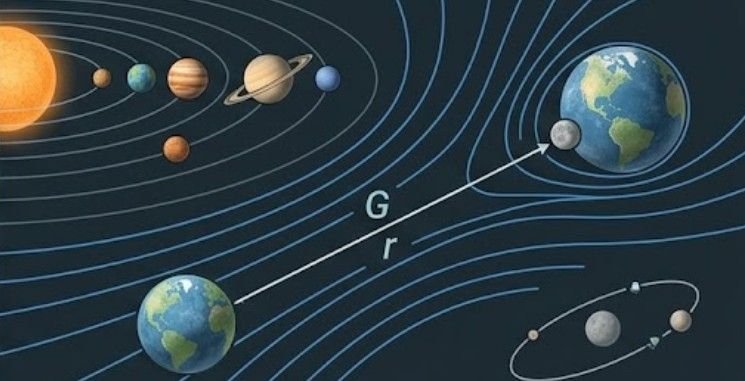
Physics does not actually have an official master list labeled “the 12 laws.” Different textbooks emphasize different principles depending on whether the subject is mechanics, thermodynamics, electricity, or quantum physics.
Still, if someone asks what are the 12 basic laws of physics, a useful answer is a set of foundational laws explaining motion, gravity, energy, heat, electric forces, electromagnetic induction, and thermal radiation. Together, they describe everything from why a seat belt matters during sudden braking to how generators produce electricity. Understanding the ideas matters more than memorizing twelve definitions.
The 12 Basic Laws at a Glance
| Law | Main idea | Everyday connection |
| Newton’s First Law | Motion remains unchanged without net force | Seat belts |
| Newton’s Second Law | Force changes motion according to F = ma | Pushing a cart |
| Newton’s Third Law | Forces occur in interacting pairs | Walking |
| Universal Gravitation | Masses attract each other | Falling objects, orbits |
| Conservation of Energy | Energy changes form but is conserved | Roller coasters |
| Zeroth Law of Thermodynamics | Thermal equilibrium defines temperature | Thermometers |
| First Law of Thermodynamics | Heat and work change internal energy | Engines |
| Second Law of Thermodynamics | Entropy constrains natural processes | Cooling coffee |
| Third Law of Thermodynamics | Entropy approaches a minimum near 0 K | Cryogenics |
| Coulomb’s Law | Charges exert distance-dependent forces | Static electricity |
| Faraday’s Law | Changing magnetic flux induces voltage | Generators |
| Planck’s Radiation Law | Temperature determines black-body spectrum | Thermal imaging |
1. Newton’s First Law: Objects Resist Changes in Motion
Newton’s first law is often called the law of inertia. An object remains stationary, or continues traveling at constant velocity in a straight line, unless a net external force changes that condition.
That explains why passengers move forward when a vehicle suddenly stops. The car slows because the brakes exert forces, while the passenger’s body initially tends to continue its previous motion.
NASA describes Newton’s three laws as the foundation for understanding relationships between objects, forces, and motion.
2. Newton’s Second Law: Force Produces Acceleration
The familiar equation is:
F = ma
Force equals mass multiplied by acceleration.
Push an empty shopping cart and it accelerates easily. Put several heavy bags inside, and producing the same acceleration requires more force.
The law is especially useful because it transforms observations of movement into measurable relationships among force, mass, and acceleration.
3. Newton’s Third Law: Forces Come in Pairs
Newton’s third law says that whenever one object exerts a force on another, the second object exerts an equal-magnitude force in the opposite direction.
Walking provides a simple example. Your foot pushes backward against the ground, while the ground pushes your body forward.
A common misconception is that the two forces cancel. They do not necessarily cancel because they act on different objects.
4. Newton’s Law of Universal Gravitation
Every pair of masses attracts each other. For two approximately point-like or spherically symmetric objects:
F = Gm₁m₂/r²
Increasing either mass strengthens gravitational attraction, while increasing their separation weakens it rapidly because distance is squared.
This same principle helped explain planetary motion. NASA notes that Newton’s gravitational theory successfully connected terrestrial motion with the movement of astronomical bodies, although Einstein’s general relativity provides a more complete description in extreme gravitational conditions.
5. The Law of Conservation of Energy
Energy does not simply disappear. It can move between objects or change from kinetic energy to heat, gravitational potential energy, electrical energy, radiation, and other forms.
Consider a roller coaster. Gravitational potential energy decreases as the car descends while kinetic energy increases. Friction converts some mechanical energy into thermal energy, but that does not mean energy has vanished.
The U.S. Department of Energy also highlights the deeper connection between energy conservation and time symmetry established through Noether’s theorem.
6. The Zeroth Law of Thermodynamics
If system A is in thermal equilibrium with system B, and system B is in equilibrium with system C, then A and C are also in thermal equilibrium.
This apparently simple idea makes reliable temperature measurement possible.
A thermometer works because it reaches thermal equilibrium with whatever it measures. Stanford’s thermodynamics materials describe the zeroth law as the foundation that allows temperature to be meaningfully defined and compared.
7. The First Law of Thermodynamics
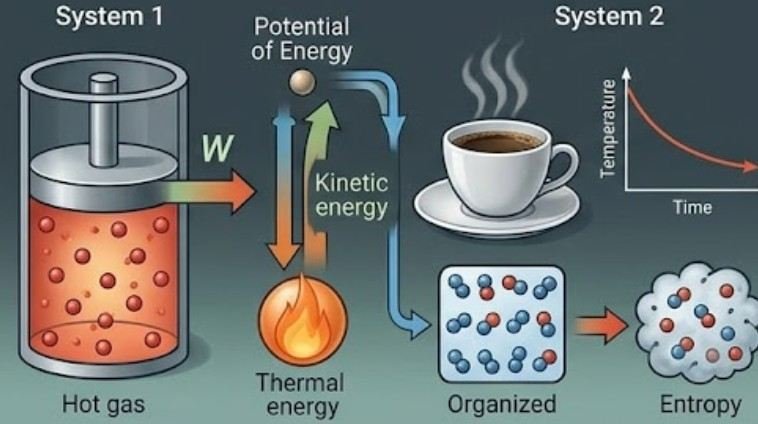
The first law applies conservation of energy to thermodynamic systems.
One common sign convention expresses it as:
ΔU = Q − W
Here, ΔU represents the change in internal energy, Q is heat added to the system, and W is work performed by the system.
It explains why heating a gas can raise its temperature, allow it to expand and perform work, or do both.
8. The Second Law of Thermodynamics
Not every energy transformation can happen equally in both directions.
Heat naturally transfers from hotter regions toward colder ones unless outside work intervenes. The law is also expressed through entropy: for an isolated system, entropy does not decrease during spontaneous processes.
That is why a hot cup of coffee cools in a room rather than spontaneously becoming hotter while the surrounding air becomes colder.
If a physics course feels difficult because several concepts overlap, identifying exactly where understanding breaks down can help. A structured approach to finding weak subjects before exams is often more effective than repeatedly rereading an entire textbook.
9. The Third Law of Thermodynamics
The third law concerns matter near absolute zero.
For an ideal perfect crystal, entropy approaches zero as temperature approaches 0 kelvin. In practice, reaching absolute zero exactly is not achievable through a finite sequence of ordinary cooling processes.
This principle matters in cryogenic physics, where researchers study materials at extraordinarily low temperatures.
10. Coulomb’s Law: How Electric Charges Interact
Coulomb’s law resembles Newton’s gravity equation:
F = k|q₁q₂|/r²
Electric force increases with the magnitude of the charges and decreases with the square of their separation.
Unlike gravity, however, electric forces may attract or repel. Opposite charges attract; like charges repel.
OpenStax explains both the inverse-square relationship and the importance of charge signs when determining force direction.
11. Faraday’s Law of Electromagnetic Induction
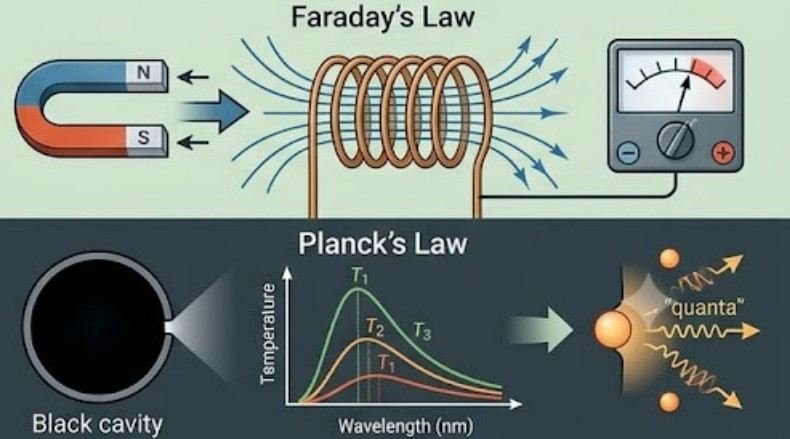
Move a magnet through a wire coil and a voltage can appear.
Faraday’s law describes this relationship:
ε = −N(ΔΦ/Δt)
The induced electromotive force depends on how quickly magnetic flux changes. The minus sign represents Lenz’s law: the induced current acts in a direction that opposes the change producing it.
This principle underlies electrical generators, transformers, induction systems, and many forms of power technology.
It is also a good example of why mathematical relationships matter in physics. Students comfortable with operations such as matrix multiplication rules generally find it easier to progress toward more advanced mathematical physics.
12. Planck’s Law of Black-Body Radiation
Planck’s radiation law describes how an ideal black body emits electromagnetic radiation according to its temperature and wavelength.
The breakthrough was historically important because classical physics could not correctly explain the observed radiation spectrum. Planck’s solution introduced energy quantization, helping open the path toward quantum physics.
The principle still has practical applications. NIST uses Planck’s radiation law in high-precision spectral radiance and temperature calibration work.
Frequently Asked Questions
1. What are the 12 basic laws of physics?
They commonly include Newton’s three laws, universal gravitation, energy conservation, four thermodynamic laws, Coulomb’s law, Faraday’s law, and Planck’s radiation law.
2. Which law of physics is the most important?
There is no single universally most important law. Different laws govern different phenomena, while principles such as energy conservation connect many branches of physics.
3. Are Newton’s laws always accurate?
They are highly accurate for everyday objects moving well below light speed. Relativity and quantum mechanics become necessary under conditions where classical mechanics no longer provides sufficient accuracy.
4. Why do students study these laws?
They provide a framework for predicting motion, energy changes, temperature behavior, electrical interactions, magnetic induction, and radiation before progressing to more advanced physical theories.
The Bigger Picture
The most useful answer to what are the 12 basic laws of physics is not twelve sentences to memorize. It is twelve ways of recognizing patterns in nature.
A sudden stop demonstrates inertia. A refrigerator illustrates thermodynamics. Static electricity reveals electric forces, while a power generator demonstrates electromagnetic induction. Planck’s law reaches even deeper, showing where classical explanations began giving way to quantum physics.
Once you connect each law to something observable, physics becomes less like a collection of formulas and more like a system for predicting what nature will do next.
Leave a Reply