
A pipe can become half as wide and make the fluid move four times faster—not twice as fast. The reason is easy to miss: pipe area depends on the square of its diameter. Once that relationship is clear, continuity equation fluid problems become much easier because the equation is really bookkeeping for one physical rule: mass cannot vanish while fluid moves through a system.
For steady flow, what enters a pipe, nozzle, duct, or channel must be balanced by what leaves it. For many liquid-flow problems, that rule becomes a simple area-and-velocity equation.
Start With Mass Conservation, Not Memorization
The general one-dimensional continuity relation is:
ṁ = ρAv
Here, ṁ is mass flow rate, ρ is fluid density, A is cross-sectional area, and v is average velocity. NASA Glenn Research Center presents this relationship as a consequence of conservation of mass, while MIT OpenCourseWare derives continuity from a mass balance on a fluid element.
For water and many other liquids under ordinary engineering conditions, density changes are small enough that the fluid can usually be treated as incompressible. If density is the same at two pipe sections, it cancels:
A₁v₁ = A₂v₂
The product Av is the volumetric flow rate, Q. Therefore:
Q = Av
If the flow area becomes smaller while Q remains constant, average velocity must increase.
The Diameter Trap That Changes the Answer
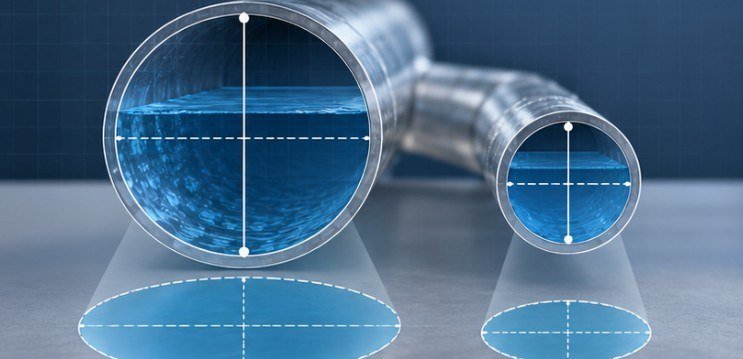
One of the most common mistakes in continuity equation fluid problems is substituting diameter directly for area. For a circular pipe:
A = πr² = πd²/4
Because diameter is squared, halving the diameter reduces the cross-sectional area to one-quarter. Under steady incompressible flow, velocity therefore becomes four times larger.
For circular pipes, a useful shortcut is:
v₂ = v₁(d₁/d₂)²
| Diameter change | Relative area | Velocity for the same Q |
| No change | 1 | 1× |
| Diameter cut in half | 1/4 | 4× |
| Diameter doubled | 4 | 1/4× |
Purdue University fluid-mechanics materials show that the broader incompressible-flow condition is divergence-free flow. The familiar pipe equation is a simpler one-dimensional application of the same conservation principle.
A Five-Step Method That Works on Most Problems
1. Decide Whether Density Changes
For ordinary water-flow exercises, density is generally treated as constant unless the problem indicates otherwise. For gases, strong heating, compression, or significant pressure changes, keep density in the equation:
ρ₁A₁v₁ = ρ₂A₂v₂
2. Identify Area Correctly
If the problem gives cross-sectional areas, use them directly. If it supplies a radius or diameter, calculate the area first or use the squared-diameter relationship for circular pipes.
Never assume that cutting a diameter by 50% also cuts area by 50%.
3. Keep Units Compatible
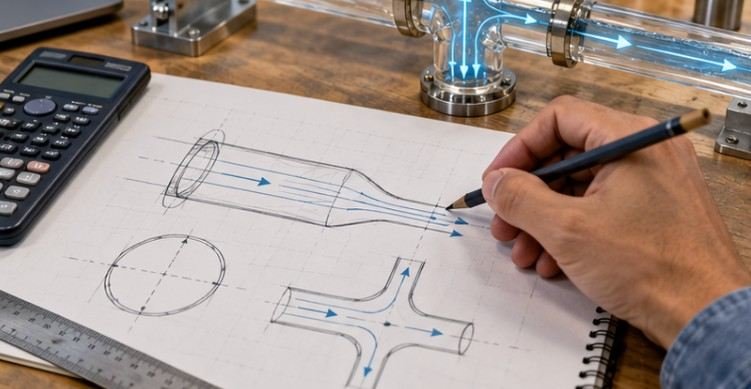
U.S. engineering problems often use square feet for area and feet per second for velocity, producing a volumetric flow rate in cubic feet per second.
Plumbing, irrigation, and water-system specifications may instead use gallons per minute. Convert measurements into compatible units before inserting them into the equation.
4. Rearrange Before Substituting Numbers
If velocity at section 2 is unknown:
v₂ = A₁v₁/A₂
Writing the symbolic equation first makes an inverted ratio or unit error much easier to notice.
5. Check the Physics
For steady incompressible flow, a narrower section should produce a greater average velocity. If your calculated velocity decreases as the pipe narrows, check the area calculation before accepting the result.
Worked Example: A Pipe Narrows From 4 Inches to 2 Inches
Suppose water travels through a 4-inch-diameter pipe at an average velocity of 3 ft/s. The pipe narrows to a diameter of 2 inches. What is the new velocity?
Start with:
A₁v₁ = A₂v₂
Because circular area is proportional to diameter squared:
A₁/A₂ = (d₁/d₂)²
Substitute the diameters:
A₁/A₂ = (4/2)² = 4
Now solve for velocity:
v₂ = 4 × 3 ft/s
v₂ = 12 ft/s
The water moves at 12 ft/s in the smaller section.
The diameter decreased by half, but velocity increased by a factor of four because the cross-sectional area became one-quarter as large. Physics LibreTexts explains the same inverse relationship between area and velocity for incompressible flow.
What Happens When a Pipe Splits?
A single inlet may feed several outlets. The conservation principle remains unchanged, but every flow crossing the system boundary must be counted.
For one inlet and two outlets carrying an incompressible fluid:
Qin = Qout,1 + Qout,2
or:
A₁v₁ = A₂v₂ + A₃v₃
This approach matters in residential plumbing, irrigation manifolds, HVAC duct networks, industrial piping, and municipal water systems.
A useful habit is to sketch a boundary around the junction and mark every inlet and outlet before doing any calculation. That prevents an overlooked branch from producing the wrong mass balance.
Where the Simple Continuity Formula Stops Being Enough
Continuity tells you how mass is conserved. It does not independently determine pressure loss, pump power, pipe friction, or forces acting on fittings.
If pressure, elevation, and velocity all matter, you may need Bernoulli’s equation or a broader energy equation.
If the problem asks for forces on a nozzle, elbow, or pipe support, momentum analysis may also be required. In that situation, this internal free-body diagram guide can help organize the forces before writing the momentum equations.
Compressible gas flow requires particular care. NASA notes that gas density may change as velocity and pressure change, meaning ρAv cannot automatically be reduced to Av. Boston University’s fluid-mechanics notes likewise describe continuity in its general form, accounting for both density and velocity variation.
Four Checks Before You Trust Your Answer
Before submitting a solution, ask four questions.
Did I use cross-sectional area rather than diameter itself? Did I square the diameter or radius ratio where necessary? Are all my units compatible? Did I cancel density only when assuming incompressible flow is justified?
Those checks catch many of the errors that make otherwise simple fluid calculations look difficult.
Frequently Asked Questions
1. What is the continuity equation for an incompressible fluid?
For steady flow between two sections, A₁v₁ = A₂v₂. It means volumetric flow rate remains constant when there are no leaks, branches, or fluid accumulation.
2. Why does fluid move faster in a narrower pipe?
A smaller cross-sectional area must carry the same volume of incompressible fluid each second, so its average velocity increases.
3. Can the continuity equation be used for gases?
Yes, but gas density may change. Use ρ₁A₁v₁ = ρ₂A₂v₂ unless constant density can reasonably be assumed.
4. Does the continuity equation determine pressure?
No. Continuity enforces mass conservation. Pressure usually requires another relationship, such as Bernoulli’s equation, an energy balance, or a momentum equation.
Final Takeaway
The fastest way to master continuity equation fluid problems is to stop seeing the equation as something to memorize and start seeing it as a mass-balance rule. Identify every inlet and outlet, determine whether density can be treated as constant, and convert diameter into area correctly.
Then make the result pass a physical test: a narrower passage should carry faster incompressible flow, while a wider passage should carry slower flow for the same volumetric rate. If your answer breaks that pattern, inspect the area ratio before trusting the arithmetic.
Leave a Reply